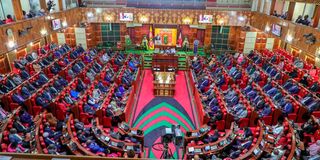
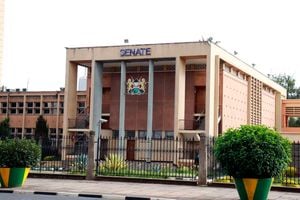
It will no longer be an expensive affair to legislate as the National Assembly and the Senate will have the discretion to limit duplication of public participation on a public policy or legislative matter that concerns the two Houses of Parliament if a proposed law is actualised.
The Public Participation Bill, 2025, keen on prudent and responsible use of public resources, follows National Assembly Speaker Moses Wetang’ula’s suggestion that public participation by the two Houses on a Bill that requires their concurrence is unnecessary and amounts to duplication.
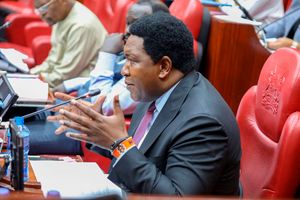
Rarieda MP Otiende Amolo.
Photo credit: File | Nation Media Group.
The Speaker noted that public participation can be handled by a committee of the House originating a Bill or a public policy document, with the other feeding in.
The Bill sponsored by MPs Dr Otiende Amollo (Rarieda) and Samuel Chepkong’a (Ainabkoi), currently before the National Assembly, seeks to define the scope and mechanisms of undertaking public participation on Bills and other public policy documents brought before Parliament for processing.
National Assembly’s Justice and Legal Affairs Committee Chairman Samuel Chepkonga addresses the Nation at the Ainabkoi Constituency Development Fund office at Kapsoya in Eldoret, Uasin Gishu County, on January 4, 2015. He chairs a House team that seeks to solve the IEBC matter. PHOTO | JARED NYATAYA | NATION MEDIA GROUP
The Bill also proposes to enhance, promote and facilitate participation of the people in governance while requiring the responsible authorities to develop specific procedures within a stipulated timeline to guide the process.
Clause 2 of the Bill defines “public participation” as the process of involving the public in making or implementing public policy decisions, including the enactment of legislation.
It also proposes responsible authorities and gives them the powers to undertake public participation as well as development of specific public participation guidelines.
“Public resources shall be used in a prudent and responsible manner. A committee of a House of Parliament may take measures to avoid duplicating public participation conducted by a committee of the originating House,” the Bill reads.
Currently, a committee of the originating House does its own public participation on a policy document or a Bill and when it gets to the other House for concurrence, the corresponding committee undertakes its own public participation exercise, a nugatory expenditure of public resources.
The Bill provides room for “additional views on the Bill” by the committee of the other House if substantive amendments have been made to the Bill during its consideration in the originating House.
To save public funds from what would be a duplicated exercise, the Bill advocates for joint sitting of the responsible committees of the National Assembly and Senate during the public participation exercise.
There have been three attempts to pass the Bill without success — in 2018, 2019 and 2023.