The Employment and Labour Relations Court has upheld the dismissal of a county ICT officer at the Independent Electoral and Boundaries Commission (IEBC) for unlawfully holding two public jobs at the same time.
The court held that the officer, Calisto Oyugi, could not benefit from his breach of the law.
Justice Nzioki wa Makau dismissed Oyugi's petition seeking reinstatement, payment of withheld salary, and a declaration that his dismissal in January 2023 was unconstitutional.
The court found that the petitioner was simultaneously employed by the IEBC and Maseno University on permanent and pensionable terms, in violation of the Constitution and conflict-of-interest laws governing public officers.
“The illegal position he held cannot be wished away,” the judge ruled. “He was rightfully removed from the employment of the respondent.”
Mr Oyugi had argued that his dismissal was unlawful because it followed a flawed disciplinary process. He told the court that his salary had been stopped without explanation in September 2021, when he was issued with a show-cause letter over alleged misconduct.
He said the disciplinary process dragged on for more than 16 months, during which he continued to work without pay. He also challenged the legality of the hearing, saying it was conducted by the wrong body under the commission’s human resource rules.
The petitioner further argued that the decision to dismiss him was invalid because it was ratified at a plenary meeting that lacked quorum. At the time, several commissioners had resigned, been suspended, or exited office, leaving the commission without the required membership.
He maintained that the dismissal letter issued on January 19, 2023 was therefore unconstitutional and void, as it was made when the commission was not properly constituted.
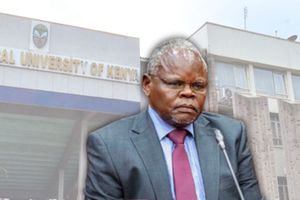
Entrance to Maseno University's main campus. Oyugi was simultaneously employed by the IEBC and Maseno University on permanent and pensionable terms.
Photo credit: File | Nation Media Group
Mr Oyugi also told the court that he had not been given the investigation report or evidence against him before the hearing, denying him a fair chance to defend himself. He said his appeal against the dismissal had remained unresolved for more than two years.
The IEBC opposed the petition, insisting that the dismissal was lawful and followed due process.
The commission said it discovered the dual employment after receiving credible information from Maseno University confirming that Mr Oyugi was concurrently employed there on permanent and pensionable terms.
It told the court that public officers are barred from holding another gainful employment and that the petitioner had failed to disclose his second job. The commission said it issued him with a show-cause letter, heard his response, and dismissed him after establishing the breach.
The IEBC also defended the decision to stop his salary during the disciplinary process, saying it was allowed under its human resource manual.
In its judgment, the court narrowed the dispute to whether the petitioner’s constitutional rights had been violated and whether he was entitled to the remedies he sought.
The judge found that the case had been improperly framed as a constitutional petition, noting that the petitioner had failed to clearly set out how his rights were violated.
“The petitioner has not articulated constitutional violations with particularity,” the court said, adding that the matter ought to have been filed as an ordinary employment claim.
Even so, the court proceeded to examine the substance of the dispute and found that the petitioner’s dual employment was unlawful.
The court cited the constitutional provision that bars full-time public officers from engaging in other gainful employment, saying the evidence showed that Mr Oyugi held two public positions at the same time.
The Chairperson, Independent Electoral and Boundaries Commission (IEBC), Erastus Ethekon addressing at Shimoni Fish Port during the Launch of Enhanced Continuous Voter Registration (ECVR) Exercise in Kwale County on March 30, 2026.
Photo credit: Kevin Odit | Nation
The court held that this breach could not be cured by any alleged procedural flaws within the commission.
"Merely because the Commission was not quorate cannot confer upon him any right to be declared a lawful employee of the Commission," the court said.
It also rejected his claims for reinstatement, back pay, and other benefits, finding no basis to grant the orders sought.
The court found that the dual employment breached provisions of the Conflict of Interest Act, the Leadership and Integrity Act, section 16 of the Independent Electoral and Boundaries Commission Act, Article 77(1) of the Constitution, the IEBC's Human Resource Manual, as well Part IV of his letter of appointment.