The newly appointed Independent Electoral and Boundaries Commission (IEBC) members have no luxury of time as they are expected to recruit officials into senior positions at the secretariat currently held in acting capacity ahead of the 2027 General Election.
The seven IEBC commissioners — Mr Erastus Ethekon (Chairperson), Ms Fahima Abdallah (Vice Chairperson) and commissioners Ms Ann Nderitu, Moses Mukhwana, Hassan Noor, Prof Francis Aduol and Ms Mary Sorobit — begun their six-year non-renewable term on July 11, 2025 following their swearing at the Supreme Court buildings after months of delay.
Some of the senior positions, including directors and managers, which can only be competitively filled by the commissioners, have remained vacant or held in acting capacity following the exit of the former commissioners in January 2023.
IEBC CEO and commission secretary Mr Marjan Hussein Marjan said the positions will be advertised soon.
“This is a policy issue requiring commission’s position. The vacancies will be advertised in the shortest time possible once a position has been taken. We will update you once this is done,” said Mr Marjan.
IEBC has a secretariat headed by Mr Marjan, which manages the day to day running of the commission affairs.
IEBC Chief Executive Officer Marjan Hussein Marjan in Nairobi on March 14.
Photo credit: File I Nation Media Group
Mr Marjan is assisted by two deputies— Ms Ruth Kulundu (Operations) and Mr Obadiah Keitany (Support Services).
Each directorate is headed by a director, while each department has a manager.
The secretariat also has 47 County Election Managers (CEMs) and 290 Constituency Election Coordinators (CECs).
Of the nine directorates, three have substantive office holders while others have acting directors.
The directorates that have substantive holders include Electoral Operations headed by Mr Moses Sunkuli, ICT headed by Mr Michael Ouma and Legal and Public Affairs of Mr Chrispine Owiye.
The directorates yet to be substantively filled include Voter Education, Partnerships and Communications that is currently held by Ms Joyce Ekuam in acting capacity, Human Resource and Administration with Mr Abdalla Hassan as acting director and Supply Chain Management that has Ms Khadija Ramadhani in acting capacity.
The Directorate of Research and Electoral Boundaries and Risk Management (DREB and RM) has Dr Meshack Lomoywara as the acting director.
There is also the directorate of Finance that has Mr Reuben Kiprotich as the interim boss and the Directorate of Audit Risk and Compliance that is currently headed by Ms Agatha Wahome in acting capacity.
Out of the 24 managers, 15 are substantive office holders with others yet to be filled.
The substantive IEBC managers include Mr Gideon Balang (Electoral Operations), Mr Abdidahir Maalim (Voter Registration), Ms Ekuam (Partnerships), Ms Amina Soud (Voter Education), Mr Abdalla Hassan (Administration and Welfare), Ms Hellen Sidi (Human Resource Development) and Silas Njeru (Business Systems Development).
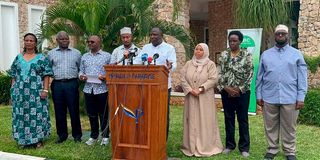
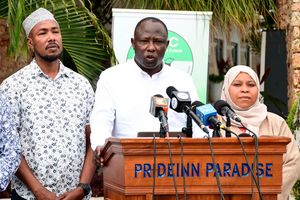
Independent Electoral and Boundaries Commission chairperson Erastus Ethekon (centre), CEO Marjan Hussein Marjan (left) and Vice Chairperson Fahima Araphat Abdallah address the media at Pride Inn Paradise in Shanzu, Mombasa County on July 19, 2025.
Photo credit: Wachira Mwangi | Nation Media Group
The others are Ms Hildah Kavongah (Security and business Continuity), Ms Lauranta Chepkwony (Systems and Infrastructure Support), Ms Naisiae Tobiko (Commission Services), Ms Khadija Ramadhan (Procurement), Mr Meshack Lomoyarwa (Strategy and Evaluation) and Mr Jason Akoyo (Budget).
Some of the positions with no substantive managers include Electoral Training, Legal Services and Warehouse and Logistics among others.
A senior manager at the commission, who did not want to go on record, told Nation that the filling of the positions is critical considering that the current officers are overstretched with responsibilities.
“We have senior managers who have been forced to act in more than two directorates because there are no officers to discharge the duties that cannot wait for the appointment of a substantive holder. This to some extent has overwhelmed some of us,” the senior manager confided to Nation.
University of Nairobi lecturer Mr Herman Manyora says that the commissioners must expedite the recruitment of the senior staff to “ensure there is no crisis in the operations of the commission.”
“We have lived dangerously as a country for the last two years when the mandate of the chairman and members of the IEBC expired in January 2023. We have elections in the next two years and we need a team that should start working now,” said Mr Manyora.
“In the absence of the members of the commission, the country has not been able to undertake critical constitutional callings like boundaries delimitation and boundary review,” added Mr Manyora.
The commission is responsible for conducting or supervising referenda and elections to any elective body or office established by the constitution as well as any other elections as prescribed by an Act of Parliament.
It is also responsible for the continuous registration of voters and revision of the voter's roll, settlement of electoral disputes, registration of candidates for elections, voter education, facilitation of the observation, monitoring and evaluation of elections and the delimitation of constituencies and wards, which has overshot its constitutional timeline.
The commission further undertakes regulation of political parties’ process, regulation of money spent by a candidate or party in respect of any election, development of a code of conduct for candidates and parties and monitoring of compliance with legislation on nomination of candidates by political parties.
The appointment of the senior staff at the IEBC is specifically critical for the delimitation of electoral boundaries and the undertaking of the by-elections that are well behind schedule.
For instance, Article 89 of the constitution states that IEBC shall review the names and boundaries of constituencies at intervals of not less than eight years, and not more than 12 years.
Any review, the constitution states, shall be completed at least 12 months before a general election.
The last review was undertaken in 2012 leading to the creation of 290 constituencies from the 210 constituencies that existed before.
This means that IEBC ought to have completed the exercise either by July 2021 being 12 months to the August 9, 2022 general election or by February 7, 2024.
Lawyer Charles Kanjama noted that the commission once fully constituted, can proceed and undertake boundary delimitation exercise this year but within six months.
“No need for an advisory opinion from the Supreme Court on how it should go about delimitation of electoral boundaries. The commission can do the job this year within six months,” said SC Kanjama.
But Mr Bobby Mkangi, who was part of the team that drafted the current constitution, noted that it will be prudent for the commission to seek the guidance of the Attorney-General and the Supreme Court on the electoral boundaries’ delimitation exercise.
“Hadn't the commission under Wafula Chebukati started the delimitation process? If this is the case, it can be argued that the process commenced within the requisite eight years period but completion was delayed,” said Mr Mkangi.
Mr Mkangi noted that once the commissioners have settled down and the secretariat fully constituted, “they can try to complete the task before August 2026,” for the changes to apply in 2027 even though he said it is “a tall order!”