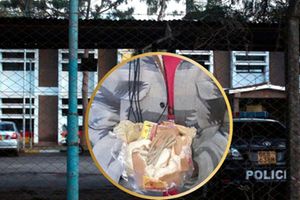
Sometimes it is food, sometimes it is drugs. And at times, it is a mobile phone. In the most serious cases, the item being smuggled may potentially help an inmate break out. Either way, it often makes the situation worse for the detainee and their loved one.
In 2022, Caroline Imenza arrived at Gilgil Police Station around 6am carrying a loaf of bread and a flask of hot tea for her husband, Stephen Nyabuto, who was in custody. When the loaf was opened, officers found five rolls of bhang, five cigarettes and a matchbox hidden inside it.
A subsequent search of Imenza allegedly uncovered another 80 rolls of bhang concealed in her undergarments. Police also alleged that she attempted to offer Sh2,000 to secure her release, a crime that was added to her charge sheet.
Four years later, Bernice Achieng’ Otieno is in Ms Imenza’s shoes, only that she was wearing them at Buruburu Police Station. Ms Otieno was arrested on Sunday after allegedly trying to sneak five rolls of bhang and a matchbox to her boyfriend, who is detained at the station. A search of her jacket yielded another seven rolls.
Bernice Achieng’ Otieno who was arrested after allegedly trying to sneak five rolls of bhang and a matchbox to her boyfriend who is detained at Buruburu Police Station.
Photo credit: DCI | Buruburu
The incidents offer a glimpse into the curious intersection of love, loyalty and crime behind Kenya’s police cell walls, where an innocent-looking meal can conceal something capable of changing the circumstances of the person receiving it.
A plate of rice and beef was headed to three suspects held at Ruai Police Station last week. But beneath the meal was something that had nothing to do with feeding hungry detainees.
Heavy-duty pliers and metal shears, wrapped in aluminium foil, had been hidden under the food, apparently intended to help three suspects facing gang-related felony charges cut through the wire and steel grills holding them inside.
The delivery, made by an 18-year-old woman, Christine Njoki Gitau, was intercepted by cell sentries on September 16 during a routine search.
Christine Njoki Gitau was arrested by officers from Ruai Police Station on September 16 for attempting to sneak tools into the police station cells to aid three rape and robbery with violence suspects escape custody.
Photo credit: DCI Ruai
The discovery may have prevented an escape attempt, but it also raised a more personal question: What would drive someone to risk arrest by carrying such items into a police station for people already facing serious criminal charges?
The answer is not always obvious from the police records. In some cases, the relationship is explicitly described as romantic.
In July 2020, two women were arrested in Kirinyaga after allegedly attempting to take 17 rolls of bhang into a police cell concealed in a tea flask. The then Kirinyaga East police boss, Antony Wanjuu, said the women had visited a suspected drug peddler in custody and claimed they had brought him tea. They reportedly admitted that they were taking the drug to the detainee, saying he became sick if he did not smoke.
The unsealed package raised suspicion among officers, and a search of it turned up five rolls of bhang.
In another case in March 2024, three women were arrested at Sagana Police Station in Kirinyaga County after allegedly attempting to deliver a mobile phone to murder suspect John Muriithi Karaya, alias California.
Once again, bread became the unlikely accomplice. A search allegedly revealed an Itel mobile phone concealed inside fresh brown bread.
Karaya was being held in connection with the deaths of at least 20 people who had consumed suspected poisonous alcohol at his bar in Kirinyaga.
The phone was intercepted before reaching him, and the three women were arrested on allegations of preparation to commit a felony.
A mobile phone may appear less threatening than a pair of metal shears, but for a detainee it can provide a communication channel beyond the control of officers guarding the cells.
The cases reveal a striking consistency in the methods used to get prohibited items past police security. Food becomes the disguise, bread becomes the container, and tea becomes the cover.
Under Kenyan law, aiding a prisoner to escape is a felony under Section 124 of the Penal Code, punishable by up to seven years in prison. Escaping or forcibly rescuing a person from lawful custody is covered under sections 123 and 122.
Possession and trafficking of narcotics are offences under Section 4(a) of the Narcotic Drugs and Psychotropic Substances (Control) Act, while Section 308 of the Penal Code provides for seven to 15 years’ imprisonment for being armed with a dangerous or offensive weapon with intent to commit a felony.
For the women involved, the calculation may begin with something as simple as wanting to help a loved one. It could be that a husband or boyfriend needs something. But the journey from fulfilling a request to committing an offence can be remarkably short.
Unlike bhang or a phone, the contraband confiscated in Ruai was not merely intended to provide comfort or communication. Pliers and metal shears have an obvious physical application when placed inside a facility secured by wire and steel grills.
Ruai Police Station in Nairobi County.
Photo credit: File | Nation
But the repeated use of ordinary food deliveries to conceal contraband shows why police and other security officers remain engaged in a constant cat-and-mouse game with those trying to get prohibited items into detention facilities. The first line of defence remains at the station entrance and the hands of the officers searching what relatives, friends and other visitors bring inside.
These cases do not establish that every woman taking something to a man in custody is acting out of romantic devotion, nor that every attempt to smuggle an item is connected to an escape plan. But they show how relationships can become a channel through which prohibited items reach detainees.
And sometimes, in the name of love, what looks like an ordinary visit can carry consequences that extend far beyond the prison or police station gate.
Sometimes, the threat to a locked door does not arrive carrying a weapon, but inside a packed lunch intended for guests of the State.