All motorists with vehicles older than four years from the date of manufacture must book an inspection appointment with the National Transport and Safety Authority (NTSA) beginning July 1 as the government rolls out a new set of rules to improve road safety on Kenyan roads.
In the new rules, motorists who fail to subject their vehicles to mandatory annual inspections risk prosecution, fines of up to Sh20,000, imprisonment for six months and, in some cases, permanently losing the right to use their vehicles on Kenyan roads under sweeping new regulations introduced by the government.
"All motor vehicle owners with vehicles older than four years from the recorded date of manufacture are therefore expected to book for annual inspection through the NTSA service portal accessible through the eCitizen platform," NTSA Director-General Nashon Kondiwa said on Friday.
National Transport and Safety Authority Director General Nashon Kondiwa (center) speaks to the media in Nairobi on March 10, 2026.
Photo credit: Wilfred Nyangaresi | Nation Media Group
This follows the implementation of the Traffic (Motor Vehicle Inspection) Rules, 2026, gazetted as Legal Notice No. 13 of 2026 in February 2026.
The new regulations significantly expand Kenya's vehicle inspection regime by requiring all privately owned vehicles that are more than four years old from the date of manufacture to undergo annual roadworthiness tests.
However, Mr Kondiwa clarified that, for now, inspection of private motor vehicles will not be compulsory and that the exact enforcement date will be announced later.
"Enforcement of mandatory inspection of private motor vehicles shall be communicated to the public in due course," Mr Kondiwa said.
The statement by the authority comes at a time when motorists were jittery over the enforcement of the new regulations, which would have seen millions of privately owned saloon cars, station wagons, sport utility vehicles, pickups and vans—that previously operated without mandatory inspections—having to undergo testing before they can legally continue using public roads.
The regulations, made under Section 119(g) of the Traffic Act, will be implemented by NTSA under the National Transport and Safety Authority Act. They create new obligations for millions of private motorists who have never been subjected to routine annual inspections. They also introduce tougher penalties for those who ignore the requirements and establish a framework under which damaged vehicles can be permanently removed from Kenyan roads, making the new rules one of the most far-reaching reforms to vehicle safety regulations in decades.
At the heart of the new regulations is a mandatory annual inspection requirement for virtually every private vehicle older than four years.
"Each motor vehicle, whether privately owned or owned by a government entity, once in each year, that is older than four years from the recorded date of manufacture, shall be subjected to an inspection test," part of the new rules states.
However, this requirement will remain suspended pending an NTSA announcement on how it will roll out mandatory inspections for privately owned vehicles.
The authority, however, said it would continue inspecting school transport vehicles at its centres. NTSA directed that school transport service operators and managements must ensure that all vehicles carrying children are roadworthy and have valid inspection stickers.
"Law enforcement officers are required to verify the validity of these stickers through the free NTSA Mobile App. Important information to note: The enforcement of Rules 13 (Reflectorised Red Stop Mechanical Signal Arms) and 14 (Telematic System) of the Traffic (School Transport) Rules, 2026, shall be communicated to the public in due course," the NTSA boss said.
He also said the authority will continue inspecting commercial service vehicles at NTSA centres and that all commercial service vehicle owners must ensure their vehicles are roadworthy and have valid inspection stickers.
"Law enforcement officers are required to verify the validity of these stickers using the free NTSA Mobile App," he said.
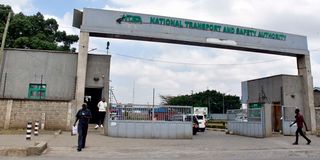
The National Transport and Safety Authority (NTSA) inspection yard along Likoni Road in Nairobi.
Photo credit: File | Nation Media Group
The gazetted regulations exempt tractors used exclusively for agricultural purposes, golf carts, motorised pedal cycles and all-terrain vehicles from routine annual inspections.
However, the exemption is limited because these vehicles must still undergo inspection before they are driven on public roads. Likewise, tractors used to transport agricultural produce must undergo annual inspections once they are more than four years old.
Public service vehicles, commercial vehicles, school buses, driving school vehicles and vehicles owned by the national and county governments remain subject to annual inspections regardless of age. Newly registered buses, matatus, taxis and commercial trucks must therefore continue undergoing yearly inspections, while school buses must also be inspected annually before transporting learners.
The regulations also require all new commercial vehicles, public service vehicles, school buses, driving school vehicles and locally assembled vehicles to undergo inspection before registration to ensure they comply with Kenya's safety standards before entering service.
For motorists who ignore the new rules, the consequences begin long before they appear in court.
A vehicle that requires inspection but has not undergone the mandatory test will effectively be operating illegally on Kenyan roads. The regulations also prohibit motorists from displaying inspection stickers issued for another vehicle or tampering with inspection reports.
The risks become even greater when a vehicle fails inspection. Inspectors will issue a defect inspection sticker together with a defect inspection report identifying the faults that must be repaired before the vehicle can be certified as roadworthy.
The regulations expressly prohibit the continued use of such vehicles except for the purpose of repairs.
"The owner of a motor vehicle that failed an inspection test shall not operate the motor vehicle on any public road after the failed inspection test except for the purpose of taking the vehicle to a place where the repairs specified in the defect inspection report shall be undertaken."
Commercial operators face even tighter restrictions because buses, matatus, taxis and other commercial vehicles that fail inspection cannot continue carrying passengers or goods until repairs have been completed and the vehicles pass another inspection.
Motorists who repair defects promptly will receive one concession. Where a failed vehicle is returned to the same inspection centre within 14 days, the re-inspection will be conducted free of charge. However, motorists returning after 14 days or using another inspection centre must pay another inspection fee.
The regulations also introduce a visible enforcement mechanism by requiring every vehicle that passes inspection to display a valid inspection sticker.
"No person shall operate a motor vehicle on a public road unless the motor vehicle is affixed with a valid inspection sticker."
This means police officers and NTSA enforcement officers will be able to determine compliance simply by checking whether a vehicle displays the inspection sticker.
Some motorists also risk losing their vehicles permanently, with the regulations introducing a legal framework governing salvage vehicles. Vehicles extensively damaged through collisions, floods, fires or similar incidents will now be classified as either Category A or Category B salvage vehicles.
Category A vehicles, classified as actual losses, are considered beyond repair and unsuitable for use on public roads. Once so classified, NTSA will deregister the vehicle and permanently withdraw its number plates, effectively removing it from Kenya's vehicle register.
Category B vehicles, whose structural integrity has been compromised but can still be repaired, cannot return to the road until repairs have been completed, the vehicle has passed another inspection and its salvage status has been endorsed in NTSA records. Insurance companies and vehicle owners who fail to report salvage vehicles to the authority also commit offences under the new regulations.
Vehicles involved in accidents will also be inspected to determine whether they remain roadworthy. Inspection will also become mandatory whenever significant alterations are made, including changes to the engine, colour, height, width, length, maximum payload or other structural and mechanical components.
Similarly, vehicles being re-registered, transferred through alternative ownership processes or missing from NTSA's online records must undergo inspection before their registration details can be updated.
The new regulations also open up the inspection sector to private investors by allowing privately owned motor vehicle inspection centres to operate under NTSA supervision. However, it is important to note that this has yet to materialise.
"NTSA has not yet licensed any private entity to offer motor vehicle inspection services," the NTSA boss clarified.
Under the new rules, motorists who ignore the regulations ultimately face criminal sanctions. Anyone who operates a vehicle that requires inspection without undergoing the mandatory test, uses an inspection sticker issued for another vehicle, alters an inspection report or deliberately attempts to circumvent the inspection requirements commits an offence.
"A person convicted of an offence shall be liable, in addition to any other penalties prescribed under the Traffic Act, to imprisonment for a term not exceeding six months or a fine not exceeding twenty thousand shillings or to both," the regulations state.