For more than 2,500 members of the Mamukii Society, home is a place they know intimately but cannot legally claim — 5,048 acres of ancestral land in Makueni County, valued at over Sh3 billion.
Their lives unfold in makeshift structures along the railway line in Makindu, where they live as squatters close enough to see the land they call theirs, yet far enough to feel its loss every day.
The community elders recount how their grandparents lived freely across Yoani, Kisesini, Mwea, Kawenye, and Ndaatai — farming, grazing livestock, tending shrines, and burying their dead in this land they considered sacred.
But the rupture came in the 1920s. As their chairman, Joseph Mutuku Kalii explained in court, colonial farm manager Robin Woodcraft Stanley — “born in South Africa in 1879 and later migrated to Kenya,” according to his grandson, Robin Allan Stanley — took over the land under a European settler named Kitala, marking the beginning of what Mr Kalii described as terror and dispossession.
Nearly a century later, the descendants of those evicted are still fighting back. On April 26, 2021, over 2500 Mamukii squatters filed ELC Petition No. 004 of 2021, asking the Environment and Land Court to recognise them as the rightful owners of L.R. 1748 Kiima Kiu under indigenous customary law and native title. They also asked for compensation for the historical injustices that, they say, condemned them to generations of poverty along the Makindu railway reserve.
In the petition, Mamukii has sued the National Land Commission (NLC), the Chief Lands Registrar, the Attorney General, Makueni County government and Stanley & Sons Limited as respondents. In their petition, they averred that in 1928 Mr Stanley allegedly seized the community’s livestock — some 20,000 cattle, 100,000 sheep, and 22,000 chickens — effectively crippling their economy. Between 1931 and 1946, the community endured brutal attacks by Stanley and colonial police.
The petitioners recounted to the court that on one night in 1946, at around 3am, the community was forcibly evicted. Homes were razed, villages burned, and families driven toward the Kiu Railway Station, where many struggle to survive to this day. Two years later, in 1948, the colonial government formally granted the land — all of 5,048 acres — to Mr Stanley.
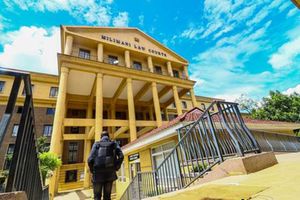
Some Mamuki Society members follow proceedings during the hearing of their case against Robin Woodcraft Stanley at the Makueni Laaw Courts on January 17, 2023. They are laying claim on a 5,000 acre ranch at Yoani Village in Makueni County.
Photo credit: Pius Maundu | Nation Media Group
In defense of the ownership, Mr Allan informed Justice Theresa Murigi that on October 1, 1947, his grandfather, Mr Stanley, acquired an indefeasible title to the suit property measuring 5,048 acres under the Crownlands Ordinance, in consideration of a premium of Sh37,860.
He further testified that on May 29, 1947, Mr Stanley transferred the suit property to Stanley & Sons Limited, following which the government of Kenya issued them a title under the Registration of Titles Act (repealed). Mr Allan maintained that the title is conclusive proof that the purchaser is the absolute and indefeasible owner of the land.
He further argued that Mamukii have no proprietary rights over the suit property as there is no evidence to show that the petitioners, their parents, grandparents or ancestors ever occupied or possessed any part of the suit property at any relevant time. He denied the allegations that his grandfather committed atrocities against the petitioners’ ancestors in 1928 since he was serving as a 2nd Lieutenant in the Natal Caribbean in South Africa at the time.
He testified that his grandfather had arrived in Makueni district in 1937, and therefore, the accusations of cattle raiding are meant to evoke the court’s sympathy. He also confirmed that he obtained court orders prohibiting the NLC from investigating his land, which paved the way for Kiamuka Society to withdraw its complaint and file a claim for historical land injustices.
Inside the packed courtroom at the Makueni High Court, 14 witnesses relived memories that have haunted them for decades. Joseph Kalii told the court of his father and grandfather, both buried in Yoani village — graves the families still visit within the disputed property. “Our ancestors rest there,” he said, “yet we live in shacks by the railway line.”
He described his community’s life in displacement — without schools, toilets, or hospitals — forced to travel long distances to Machakos or Nunguni for basic services. Despite the hardships, he said, “We have never stopped agitating for our land.”
Another witness, David Muema Mbungu, born in Kiima Kiu in 1942, recalled being only four years old when colonial police stormed their village. “They came at night, led by Stanley,” he testified. “We fled barefoot to the railway line, where we have stayed ever since.”
Attempts to return, he said, have been met with force. On December 4, 2021, their efforts to access the land were blocked by police officers from Salama Station. Yet, he insisted, “we are the rightful owners — our shrines are at Yoani, Mambiti, Mwea and Kwa Mwitiki, while our ancestors’ graves are all dispersed within the disputed property.” The court heard that his grandfather died in 1935, and his father in 2002, and that both are buried on the suit property.
For others, like Kalekye Kilonzo, who was born in the 1920s, the memories are far more personal and painful. Born in Yoani, Ms Kalekye told the court she was among the women that Robin Woodcraft Stanley raped during the colonial attacks. Now elderly, she lives with her grandchildren along the railway in Ulu.
Another woman, Grace Katunge Mutava, said her father told her that two of her brothers were killed by Stanley. She was born in 1948 — the same year the title was granted — and still remembers being shown her grandmother’s grave in Kiima Kiu. She, too, resides along the railway line in Kiu.
Their lawyer, Kilonzo Wambua, argued that the petition meets the threshold for historical land injustices under Section 15 of the Land Laws (Amendment Act 2016), and that the title issued to Stanley & Sons Limited is “null and void.”
He told the court that the NLC’s investigation was never completed because Stanley & Sons Limited obtained an injunction, and that a judicial site visit on March 19, 2024, confirmed the presence of Mamukii shrines, graves, boundaries and homestead traces. Also, the court observed homesteads and other surrounding villages, which indicates that other natives occupied the entire area.
He argued further that the government and Stanley & Sons Limited violated the community’s rights under Article 43 of the Constitution and international human rights standards because they were “forcefully removed from their land and left at the railway line in Kiu without any food or shelter, where their children’s rights to education are abused and girls are continually sexually violated.”
Farmer Robin Stanley on his farm in Makueni County in 2023.
Photo credit: Pius Maundu | Nation Media Group
Mr Wambua had asked the court to rule the case in favour of the petitioners, urging the court to acknowledge that before colonial rule, “no titles were being issued as all land was communally owned.” He informed the judge: “The petitioners are entitled to ownership of the suit property because they occupied the land for many years before 1895 and acquired customary rights that persisted after the establishment of Kenya as a British colony in 1920, and these rights have not been extinguished.”
But Justice Murigi in her 53-page judgment dismissed the petition, ruling that the claimants failed to prove ownership of the land by presenting a title document or providing evidence of torture by Mr Stanley, forceful eviction, or violation of property rights. She faulted the petitioners for not providing evidence to support the argument that Mr Stanley, along with the colonial police, brutally attacked their ancestors, resulting in some being killed.
She found the matter sub judice, noting that a rival group — Kiamuka Society — had filed similar claims in ELC No. 8 of 2018.
She therefore proceeded and dismissed the case as being devoid of merit. “In the end, I find the petition is devoid of merit, and the sale is hereby dismissed. Each party to bear its own costs.”
This is even though Mr Wambua had asked the High Court not to dismiss the petition based on legal technicalities, as the constitution requires that rights of litigants be alluded to regardless of technical omissions.
Dissatisfied with the judgment, over 2500 Mamukii squatters have moved to the Court of Appeal to seek redress and be declared the rightful owners of the 5,048 acre-parcel L.R. No. 1748. For these families, as the case continues in court, they hold on to hope that one day, the land their ancestors walked will once again bear their footprints — not as squatters, but as rightful owners.