Junior police officers are the biggest beneficiaries of a sweeping salary review that will see constables and mid-ranking officers receive the sharpest percentage increases in their basic pay under the ongoing security sector reforms.
The adjustments are part of the recommendations made by a taskforce on police reforms that was chaired by former Chief Justice David Maraga, which submitted its report to President William Ruto in 2023.
The final phase of the increment takes effect in July, marking the completion of a three-year salary restructuring programme for officers in the National Police Service, the Kenya Prisons Service and the National Youth Service.
President William Ruto (right) receives the security agencies welfare reforms task force report from former Chief Justice David Maraga at State House Nairobi on November 16, 2023.
Photo credit: Wilfred Nyangaresi | Nation Media Group
The reforms, overseen by Interior Principal Secretary Raymond Omollo, who chairs the National Steering Committee on the implementation of reforms in the three services, will bring relief to thousands of officers, whose plight of low pay was highlighted by the Maraga taskforce.
In a statement dated March 4, 2026, the committee reviewed progress and confirmed that the final phase of salary adjustments would be effected in July.
The salary review forms part of a broader four-pillar transformation framework focusing on institutional capacity, operational preparedness, oversight and accountability, and human resource management. Within that framework, welfare improvements — including pay, medical cover and housing — feature prominently.
The figures show a decisive tilt in favour of lower cadre and mid-ranking officers in the police service. A police constable, the lowest cadre in the service, will now earn a maximum basic salary of Sh57,700, up from Sh38,975, representing a 48 per cent increase. At the entry level, newly graduated constables will start at Sh29,296, up from Sh20,390 before July 2024, representing a 44 per cent rise.
Beyond the entry-level category, the PG9 category stands out as one of the most significant beneficiaries of the review. Officers in this grade move from a previous minimum of Sh68,720 to a new minimum of Sh111,906, an increase of more than Sh43,000. Their maximum salary rises from Sh98,380 to Sh148,538, adding over Sh50,000 at the upper limit.
In all terms, PG9 officers are among those experiencing the most substantial uplift, reinforcing the emphasis on strengthening remuneration at a key supervisory level within operational policing.
Other mid-level ranks also record marked improvements. PG8 officers see their minimum salary rise from Sh57,060 to Sh101,711, while PG7 increases from Sh53,570 to Sh65,103. PG6 climbs from Sh47,290 to Sh59,742, and PG5 from Sh42,940 to Sh53,246. PG4 and PG3 move to minimum salaries of Sh51,546 and Sh48,114 respectively, while PG2 rises from Sh26,500 to Sh36,040. The cumulative effect narrows the gap between the lowest and middle bands.
Senior officers record more moderate percentage gains. Once fully effected, the highest serving police officer will earn a maximum monthly basic pay of Sh345,850, up from Sh289,090, representing a 20 per cent increase. Although the nominal gains remain significant, the proportional rise is lower than that recorded in junior and mid-tier ranks.
President Ruto last week reiterated that prison officers would equally benefit from the salary adjustments. In the Kenya Prisons Service, the highest-paid officers will now earn between Sh301,548 and Sh584,903, compared to a previous range of Sh292,765 to Sh576,120.
Lower prison grades reflect similar upward adjustments, aligning their remuneration more closely with that of the police.
The review of salaries for uniformed officers in the National Youth Service presents a more varied outcome across its grading structure. Junior NYS officers emerge as clear beneficiaries, with PG1 to PG5 recording notable increases in both minimum and maximum salaries. PG1 officers see their minimum salary rise from Sh19,800 to Sh26,222, while the maximum increases from Sh32,315 to Sh37,912. Similar upward adjustments extend through PG3, PG4 and PG5.
Mid-level NYS officers in PG6 to PG9 register modest gains. However, the restructuring introduces reductions in parts of the salary bands for several senior cadres. Grades PG10 to PG14 record decreases, particularly at the maximum levels, with PG14 officers experiencing a reduction in the maximum salary from Sh262,420 to Sh201,816. At the top tier, PG15 officers are the exception, posting a substantial increase in the maximum salary to Sh584,903.
Speaking to the Nation on the salary raises, Dr Omollo said that police officers, like any other Kenyan, deserve to work in a good environment and that their welfare must be properly looked into.
“Police officers must also be facilitated through equipment, provision of vehicles for their mobility and also through use of technology. We owe a lot to our officers because out of what they do every day and every night. The country has remained fairly stable and the administration of President Ruto just as it committed is fully following through to make sure these security reforms are implemented,” he said.
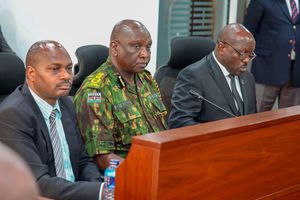
Principal Secretary for Internal Security and National Administration Raymond Omollo speaks during the launch of the induction, paralegal and security management training for Chiefs and Assistant Chiefs at the National Police College, Embakasi A, in Nairobi on August 15, 2025.
Photo credit: Bonface Bogita | Nation Media Group
The PS further added that government is on track with implementing several reforms in the security sector and “the salary increase is one of the tangible results of our efforts to improve the security sector.”
Beyond the pay raises, the NPS recently concluded the recruitment of 10,000 officers to address policing gaps. Recently, the NYS also advertised for cadet officers “meaning we want to bring in more professionals in our security services. The government is also constructing over 47,000 housing units as part of the reform efforts to address accommodation shortages for our security officers.” Dr Omollo said.
In addition to chairing the National Steering Committee on reforms, Dr Omollo also chairs the Governance and Public Administration Sub-Committee of the National Development Implementation Committee, which reviewed and announced progress under the National Institutional Housing Programme on Monday (March 2, 2026).
The GPA Sub-committee confirmed that the security cluster now represents the largest and most advanced institutional housing pipeline under the Affordable Housing Programme, comprising 165 projects nationwide and delivering a total pipeline of 47,464 housing units.
Of these, 2,092 units have been completed, 9,555 are under active construction and 24,720 are under procurement. Major police housing developments are underway at the General Service Unit headquarters in Ruaraka, the Kiganjo Training School and the GSU Training School in Embakasi, among other sites aimed at reducing accommodation deficits in high-demand operational areas.
However, implementation of the police reforms has not been without legal hurdles. Last April, a petition was filed in court seeking to block the implementation of some proposals made by the task force. The court granted interim orders.
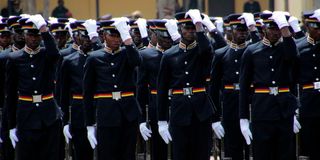
Police recruits follow proceedings during the official opening of their training course at the National Police College – Main Campus Kiganjo in Nyeri County, on December 16, 2025.
Photo credit: Joseph Kanyi | Nation Media Group
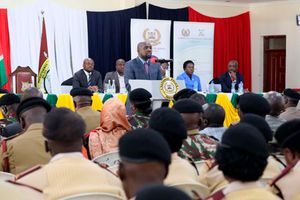
Speaking on the matter at the launch of the new Kisumu East Sub-county Headquarters, Dr Omollo said that at the time of the court ruling, the ministry was almost halfway through implementing key strategic interventions proposed by the Maraga Task Force.
The National Police Service had implemented 47.2 per cent of the reforms, while the Prisons Service and the NYS had completed 42.9 per cent of the proposed changes, the PS revealed.
Beyond the pay rise and housing, other milestones achieved for the security officers are the rollout of a comprehensive medical scheme for police officers, which includes a mental healthcare plan covering officers and their dependents. The police are also covered under a group life insurance policy providing financial protection to families in the event of death or permanent disability.
The Maraga Task Force presented a total of 598 recommendations highlighting a range of issues, including a harsh working environment, inadequate tools, weak leadership, under-funding and outdated policies among others. It strongly called for a combination of salary adjustments, medical cover, insurance and housing access as part of a broader welfare package.
Officers began receiving phased increments from July 1, 2024, with this July marking the final stage of implementation. The government has described the cumulative three-year adjustment as the highest consecutive salary increase for officers since independence.
With the final phase set to take effect, the pay rise represents a central pillar of the reform programme, with officers’ morale boosted as they execute their mandate.