It is early morning on June 14, 2004, and John Githongo, a Permanent Secretary for Governance and Ethics in the Office of the President, receives a letter from the Minister for Lands and Settlement, Amos Kimunya.
Mr Kimunya, in the letter, tells Mr Githongo that a 20-acre piece of land in Roysambu, Nairobi County, was formally handed to the Ministry of Defence on June 25, 1986 after compulsory acquisition by the government.
Both bureaucrats are at this time under the President Mwai Kibaki administration, which is barely two years into office, and has inherited a governance mess in nearly all sectors, including lands.
The compulsory acquisition of the land from its Israeli owner was intended to help the Kenya Defence Forces (KDF) set up the Kenya Army School.
Mr Kimunya goes on to state that the KDF took possession of the land before it was paid for, but that the military folk moved out shortly afterwards, stating that the property was too expensive.
The letter is one of many documents with conflicting accounts that continue to cause confusion over ownership of the land.
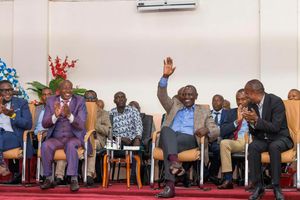
The prime property gained prominence, once again, last Sunday when President William Ruto pledged to rally a Sh120 million donation to Jesus Winner Ministry, which is building a new church on a three-acre portion, as the KDF sits on the other 17 acres.
Last Wednesday, Jesus Winner Ministry founder and leader Edward Mwai said in an interview with the Nation that President Ruto had helped the church get three acres.
“I can tell you that we were on the verge of losing that land and money were it not for the intervention of President William Ruto and the land was reverted to us,’’ Mr Mwai said in an interview with the Nation.
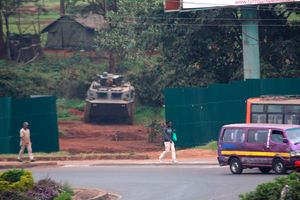
In an unprecedented show of might, military personnel drove onto the land in April 2019, effectively dashing the hopes of three separate groups claiming ownership.
They parked an armoured personnel carrier at the entrance, and started fencing it afresh with green iron sheets.
Sections of the iron sheets were labelled “restricted area, no photography allowed” — an indication that the rules in other military installations also applied to the land.
Armed soldiers patrolled the property day and night — perhaps to ward off squatter groups that had in the past stood their ground in trying to avoid eviction by police.
On one hand, Uchumi Supermarkets Ltd hoped to revive its operations, which were hampered by corrupt executives whose mismanagement allowed opportunists to loot the retailer dry, by selling the prime land.
Jewel Complex, the investment arm of the Jesus Winner Ministry in Roysambu, had paid a Sh330 million deposit to Uchumi as it planned to acquire the property for Sh2.8 billion and set up both religious and business activities on the land.
After the KDF takeover, Uchumi and Jewel agreed to convert the Sh330 million into a purchase price for three acres.
Former Uchumi Chief Executive Officer Mohamed Ahmed Mohamed said that a case in court is intended to determine the fate of the remaining 17 acres.
Amid the Uchumi-Jewel Complex transaction, two squatter groups claiming to be former workers of the land’s original owner, Mayer Jacob Samuels, still hoped that they could get ownership despite losing court cases to the retailer.
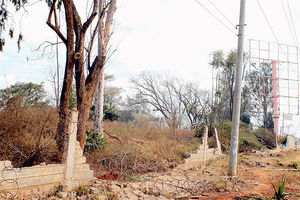
Iron sheets fence on a 20 acres of prime land in Roysambu, Kasarani.
Photo credit: File | Nation Media Group
Uchumi sued the KDF in 2022 after several negotiations brokered by the Trade ministry failed to produce white smoke. The case is still before the High Court in Nairobi, and is the fourth that Uchumi has over the years filed to retain ownership.
Despite two of those cases against squatter groups affirming that Uchumi is the legal owner, the retailer has come up empty handed following military-supervised developments on the property which indicate that the occupants have no intention of ever letting go.
After the KDF takeover, then Uchumi CEO, Mohamed Ahmed Mohamed, said that talks were being brokered by the Trade ministry, and that the matter would soon be resolved.
Mr Mohamed left the retailer in 2022, three years after the standoff started.
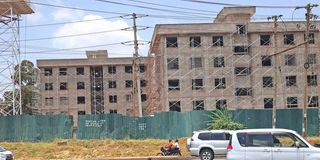
KDF is about to complete 3,069 apartments on the property, intended to be occupied by military personnel, under the Kenya Kwanza administration’s affordable housing scheme.
“This project, a phased approach, is part of a broader initiative to address the housing shortage among KDF personnel, with a total of 3,069 modern and affordable housing units being constructed across various locations in the country,” the Ministry of Defence said in December, 2024 when Cabinet Secretary Soipan Tuya toured the site.
KDF spokesperson Paul Njuguna did not respond to our text messages asking what acreage the military has occupied, and whether the activity on the land risks undermining the ongoing court case.
The buildings are located at the entrance opposite the Thika Road Mall (TRM). On the opposite end, neighbouring Thika Road Baptist Church, Jesus Winner Ministry is constructing a new chapel.
Despite being civilians, the church’s officials and personnel have been granted access as they construct the new chapel.
The saga dates back to 1985, when the mess in Kenya’s land sector was starting to grow.
Commissioner of Lands James Raymond Njenga published gazette notices indicating that the government would acquire a 20-acre land in Roysambu on behalf of the military.
But on January 26, 1987 the Defence ministry wrote to Mr Njenga, stating that a military technical team had found the land unsuitable on account of its proximity to residential areas, unless surrounding properties were also acquired.
From available records, the military’s inspection team did its feasibility study several months after the land was formally handed over to the Ministry of Defence.
All this, including the handover to the military, was happening despite the fact that the land’s registered owner had objected to acquisition of his property, and even sued the government.
Kenya Defence Forces officers stand guard at the entrance of 20 acres of prime land that has been disputed between Uchumi and Kenya Defence Forces in Roysambu, Kasarani, in 2019.
Meshumor Jacob, an Israeli national who inherited the land from his half-brother, Mayer Jacob Samuels, had demanded Sh25 million in compensation, whereas the government was willing to part with Sh3.5 million — more than seven times less.
Insistent on pushing the deal over the line, the government convinced Mr Jacob to enter into out-of-court talks. The negotiations were never concluded, and Mr Jacob left Kenya, with the land’s ownership status in limbo.
During a National Assembly probe in 2019, the Kenya Defence Forces presented a receipt showing that it paid Sh3.53 million to the Commissioner of Lands.
The National Assembly’s Committee on Lands, however, noted that there was no evidence to show that the money was released to Mr Jacob.
Somehow, on June 26, 1999 the Lands ministry issued Solio Construction Company Ltd an allotment letter in respect to the 20-acre property.
Solio Construction was incorporated on August 18, 1999. This means that the company acquired the land two months before it existed.
Another set of records showed that Solio Construction was allocated the land in May, 1992 — seven years before it was incorporated. Those records also show that Solio Construction took a loan from Barclays Bank, now Absa, using the land as security in October, 1993 — six years before incorporation.
Whichever set of records were to be applied, the allocation was irregular as Solio Construction had not been incorporated yet.
A tank owned by the Kenyan military sits on a disputed land in Roysambu on May 6, 2019.
Photo credit: File | Nation Media Group
Solio Construction was owned by Joshua Kulei, who was at the time President Daniel arap Moi’s personal assistant. Still, Solio Construction obtained another title deed in 2001.
That year, Uchumi purchased the 20-acre land from Solio Construction for future expansion, with the 2001 title deed being used in the transaction.
Kasarani Mall Ltd, a wholly-owned subsidiary of the retail chain, acquired the land for Sh85 million.
Uchumi Supermarkets’ annual report for 2002 shows that it loaned Kasarani Mall Ltd an interest-free Sh109.8 million so as to acquire the land.
The retailer’s books in subsequent years do not indicate why the loan was significantly higher than the purchase price. The title deed was transferred to Uchumi, which left the land undeveloped.
Following a collapse in 2004, Uchumi sold some of its assets to rescue operations. Sidhi Investments Sh118 million bid for the Roysambu land was accepted, before the government placed a caveat on the property to stop a group of directors accused of selling assets on the cheap.
The firm sued in 2005 to have its sale agreement enforced, and Justice John Osiemo two years later struck out Uchumi’s bid to dismiss the case.
Uchumi appealed that decision, but the Court of Appeal upheld Justice Osiemo’s decision in 2019 after the retailer had entered into a new sale agreement with Jewel Complex Ltd, the trading arm of Jesus Winner Ministry.
This meant that the case would go back to the High Court. But Uchumi instead engaged Sidhi Investments in out-of-court talks. In those negotiations, it was resolved that Sidhi Investments would get Sh800 million from the sale to Jewel Complex.
Before the ink had dried on that agreement with Sidhi Investments, the KDF forcibly took over the land.
For now, the land remains in the possession of the military and the church.