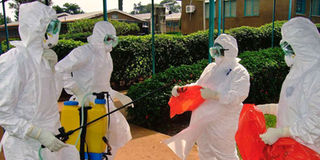
Kenya has activated a national incident management system through the Kenya National Public Health Institute, with rapid response teams on standby 24 hours-a-day due to an Ebola outbreak in the Democratic Republic of Congo and Uganda.
Public health emergency operations centres at national and county levels are also on alert.
“More than 34,500 travellers have already been screened at various points of entry, including 18,552 international passengers, 5,848 local travellers, 2,514 truck drivers and 4,729 conveyances,” said Health Cabinet Secretary Aden Duale.
Health Cabinet Secretary Aden Duale.
Photo credit: File | Nation Media Group
In a statement, the CS said an online passenger surveillance system has been deployed and population mobility mapping is underway in high-risk border regions. Laboratory preparedness has also been strengthened through designated testing facilities at KEMRI Kisumu, KEMRI Nairobi, the National Public Health Laboratory, and mobile laboratory platforms.
Additionally, cross-border coordination is ongoing with Uganda, the DRC, WHO, the East African Community and the Africa CDC.
“Kenya has not reported any Ebola virus cases linked to the current outbreak. However, given Kenya’s close regional connectivity, the government has activated enhanced surveillance and preparedness measures across the country,” CS Duale said.
However, the preparedness picture across Kenya’s counties is uneven.
In Turkana, which borders both Uganda and South Sudan, Kanam Kemer Sub-County Hospital has been earmarked for managing suspected Ebola cases.
Additional isolation points have been identified at Lokiriama near the Kenya-Uganda border, Nadapal near the Kenya-South Sudan border and at Kalobeyei Integrated Settlement.
Turkana County Health Executive Joseph Epem flagged the Moroto and Nadapal trade routes as transmission risks, noting that most retail goods arriving in Lodwar originate from Kampala.
In Trans Nzoia, screening is underway at the Suam border point, with Ministry of Health officials working alongside county teams.
In Busia, authorities have intensified screening in both Busia and Malaba towns, targeting passengers arriving from Rwanda, Congo and Uganda. Isolation centres that remained operational after Covid-19 are being prepared for potential reactivation.
Homa Bay has activated its emergency response team and deployed health officials to strategic locations, including Sena and Mbita, where movement across Lake Victoria is difficult to control.
However, Facilities in Homa Bay that served as isolation centres during the Covid-19 pandemic have been converted for general healthcare use, and officials are holding meetings to establish new centres.
Nakuru has been flagged as a high-risk county due to its status as a transit hub serving over six neighbouring counties. Several isolation units from the Covid-19 era remain available at Nakuru County Teaching and Referral Hospital, Naivasha Sub-County Hospital and Gilgil, with Elburgon and Molo hospitals on standby.
“As a county, we have launched and activated a community-based surveillance and sensitisation drive on Ebola prevention and control,” said Nakuru County Executive for Health Roselyne Mungai.
Medical workers check on an Ebola patient in the Democratic Republic of Congo.
Photo credit: AFP
Baringo has activated emergency preparedness systems and translated educational materials into local vernacular languages for community distribution. Community Health Promoters have been briefed and deployed.
However, a spot check by the Nation found no active screening at county entry points at the time of reporting.
In Kisumu, the isolation centre that once operated at Jaramogi Oginga Odinga Teaching and Referral Hospital has been converted into a private wing. Isolation centres at other public facilities in the lakeside city have also ceased operations.
In Makueni, a campsite that was repurposed during the pandemic has been decommissioned, with its bedding being distributed to hospitals and its grounds being handed over to the Kenya Medical Training College. There is no dedicated isolation centre in Kericho. Dr Japheth Cheruiyot, the county's Chief Officer for Health, said that a ward would be designated if an Ebola case were to be detected.
The pattern across several counties is the same: the infrastructure that existed during the Covid-19 pandemic has either been dismantled or repurposed, or has simply been allowed to lapse, based on the reasonable assumption that the immediate crisis had passed. This assumption is now being tested.
The current Ebola outbreak has been caused by the Bundibugyo strain, a rare and deadly strain for which no approved vaccine or treatment is available. The Africa CDC has classified the current outbreak at Grade 3—its highest risk category—citing confirmed cross-border transmission, delayed detection, high regional mobility and the absence of any medical countermeasure.
The World Health Organization (WHO) has declared it a Public Health Emergency of International Concern. On May 18, the Africa CDC went further, declaring it a Public Health Emergency of Continental Security.
As at May 18, more than 336 alerts and suspected cases were under investigation across the DRC and Uganda, with 87 deaths reported. Thirteen cases had been laboratory-confirmed, including two in Uganda. Four of the confirmed cases involved healthcare workers.
Health officials in the Democratic Republic of Congo.
Photo credit: File | AFP
In Kampala, an index patient from the DRC died at Kibuli Muslim Hospital on May 14. A second imported case is currently being treated at the Ebola treatment unit in Mulago Hospital. Ugandan authorities have since traced and quarantined 127 health workers and contacts who interacted with the deceased patient.
“The contacts are mostly health workers who were treating him and the driver who took them to the hospital. They have all been traced and are under quarantine. None of them has tested positive,” said Alan Kasujja, the executive director of the Uganda Media Centre.
The Bundibugyo strain has an incubation period of between 2 and 21 days. Early symptoms include fever, severe headache, extreme fatigue and reddening of the eyes. As the illness progresses, patients may develop severe sore throat, chest and abdominal pain, vomiting and diarrhoea.
Health officials are urging Kenyans to wash hands regularly with soap and clean running water, avoid contact with sick persons or bodily fluids, and seek immediate medical attention if they develop symptoms, particularly following recent travel to eastern DRC or Uganda.
By Mercy Chelangat, Tonny Abet, Eric Matara, Vitalis Kimutai, Waikwa Maina, Angeline Ochieng, George Odiwuor, Winnie Atieno, Pius Maundu, Sammy Lutta, Evans Jaola and Florah Koech.