Kenya’s human rights record remained deeply troubling over the past year, with security force abuses, shrinking civic space, and entrenched impunity dominating the country’s political and social landscape- the latest annual survey by the Human Rights Watch (HRW) report has shown.
The report documents a sustained pattern of abuses including extrajudicial killings, enforced disappearances, arbitrary arrests, media censorship, and intimidation of activists and government critics, against a backdrop of economic hardship and growing public anger.
HRW reported that authorities continued to violently suppress peaceful protests in 2025, deploying both uniformed and plainclothes officers to target demonstrators and perceived organisers.
“Plain clothed security forces reportedly abducted, tortured, and forcefully disappeared individuals suspected of organizing and supporting anti-government protests and social media activists,” the report stated, adding.
Protests throughout the year were driven by several unresolved grievances, including outrage over tax hikes introduced in 2024, anger over corruption and misuse of public resources, the death in police custody of blogger Albert Ojwang in June 2025, and demonstrations commemorating the deadly 2024 anti-Finance Bill protests.
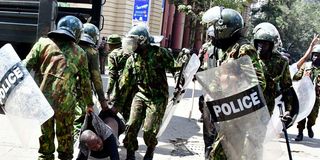
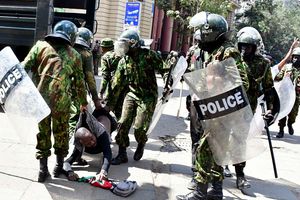
Police beat a demonstrator at a previous protest.
Photo credit: Nation Media Group
Despite repeated calls for reform, HRW notes that the government failed to meaningfully address these underlying issues, further inflaming public resentment.
The killing of Albert Ojwang emerged as a defining moment in Kenya’s human rights crisis. On June 7, 2025, plainclothes officers from the Directorate of Criminal Investigations arrested the 31-year-old high school teacher and blogger over a blog post deemed critical of Deputy Inspector General of Police Eliud Langat.
The officers drove him for more than eight hours to Nairobi’s Central Police Station, where he died the following day. The autopsy cited by HRW showed that Ojwang was “confirmed dead allegedly due to torture on June 8,” a revelation that sparked nationwide protests.
“It was just one of the many alleged cases of killings, abductions, disappearances, and arbitrary arrests by state security forces reported by media and human rights organizations… since the beginning of the 2023 cost of living protests and the 2024 anti-Finance Bill protests,” part of the report stated.
The demonstrations that followed Ojwang’s killing were met with further lethal force. During protests in Nairobi on June 17, a video circulated online that appeared to show a police officer shooting a street vendor, Boniface Kariuki Mwangi, at close range.
Media and human rights organisations reported that police killed at least 31 people during protests over Ojwang’s death alone. Meanwhile, the Kenya National Commission on Human Rights reported that “at least 26 and 15 people are still missing from the 2024 and 2025 protests respectively,” exposing the scale of enforced disappearances.
A photo of teacher and blogger Albert Ojwang, who died while in police custody.
Photo credit: Pool
Despite the gravity of these abuses, HRW says accountability remains virtually nonexistent.
“Kenyan authorities have not investigated or prosecuted security forces in most cases of excessive and lethal force during protests from 2023 to 2025,” the report stated.
A joint Human Rights Watch and Amnesty International Kenya report released in November 2024 found that authorities had failed to investigate or prosecute any police officer or government official over the killing of at least 31 people during the 2023 cost-of-living protests.
In April 2025, the Independent Policing Oversight Authority (Ipoa) acknowledged registering 60 killings linked to the 2024 protests, stating that it had completed 22 investigations, was actively pursuing 36 others, and had charged just two cases in court.
However, HRW points out that IPOA failed to address allegations of abductions and enforced disappearances, even though the state-funded KNCHR confirmed that dozens of victims were still missing. The report further notes that the authorities have yet to investigate or prosecute anyone for at least 65 killings and at least 400 others who sustained life-threatening injuries during the 2025 protests as documented by local media.
In an apparent attempt to deflect mounting pressure, President William Ruto in August 2025 appointed an 18-member panel “to design and establish an operational framework to verify, categorize, and compensate eligible [protests] victims” dating back to 2017.
This initiative, however, collapsed after legal challenges. In September 2024, the High Court in Kerugoya halted the panel’s activities, and in December, ruled it unconstitutional, directing the Kenya National Commission on Human Rights to take over the role instead.
Alongside police violence, the report documented an aggressive assault on freedom of expression and media independence.
“Authorities escalated formal and informal attacks against activists, civil society groups, and the media, particularly during periods of protest,” the report stated.
A police officer aims his gun at protesters on Old Namanga Road in Kitengela during the Saba Saba protests on July 7, 2025.
Photo credit: Billy Ogada | Nation Media Group
On June 25, 2025, as demonstrators took to the streets to commemorate the June 2024 protests, the Communications Authority of Kenya ordered media outlets and social media blogs to halt live coverage. The regulator later switched off the signals of three television stations—KTN, NTV, and K24—over their reporting.
A High Court subsequently ordered the restoration of the stations’ signals and declared the ban on live coverage illegal, but the damage had already been done. HRW noted that security forces physically attacked journalists covering protests, injuring at least five in 2025. Among the journalists targeted was NTV journalist Ruth Sarmwei, who was hit by a rubber bullet while reporting from Nakuru County.
The climate of intimidation extended beyond newsrooms. On July 6, a day before the annual Saba Saba protests commemorating Kenya’s struggle for democracy, an armed gang attacked activists and journalists gathered at the Kenya Human Rights Commission offices. The activists had convened to call for “an immediate end to arbitrary arrests, enforced disappearances, and extrajudicial killings.” No meaningful accountability for the attack was reported.
Social media activists were also increasingly targeted. HRW noted authorities arbitrarily arrested and charged government critics on platforms such as Facebook, TikTok, and X, often invoking cybercrime and terrorism laws.
In June, police raided the home of 35-year-old software developer Rose Njeri, arresting and detaining her for three days after she developed a platform allowing Kenyans to send messages to their members of parliament opposing proposed tax hikes.
Although police charged her with cybercrime-related offences, the charges were later dropped, reinforcing HRW’s assessment that such arrests were intended to intimidate rather than prosecute genuine crimes.
The report also raises serious concerns about economic governance and transparency. While acknowledging that domestic revenue mobilisation can support the realisation of rights, HRW noted that Kenya’s tax policies have been implemented “despite public concerns about lack of transparency and difficulties accessing services.”
The housing levy introduced in 2024, the report says, “has no mechanism for management and oversight of the fund or criteria for determining beneficiaries of the houses to be built from the levy.”
In June 2025, parliamentarians questioned the government’s decision to invest housing levy funds in treasury bills and its failure to account for over KSh4.2 billion in accrued interest. Meanwhile, despite contributions to the Social Health Authority increasing more than tenfold, patients continued to struggle to access affordable healthcare.
Audit reports cited by HRW revealed mismanagement and alleged fraud, with several hospitals linked to influential individuals accused of defrauding the authority.
On women’s rights, the report notes that the government established a 42-member Technical Working Group on Gender-Based Violence in January 2025 following a record number of femicides in 2024 and heightened public outrage. Although the group briefed senior officials in August, its report remains unpublished, leaving its impact uncertain.
Consensual same-sex sexual acts remain criminalised in Kenya, punishable by up to 14 years in prison. While President Ruto publicly supported restrictive gender policies abroad, HRW notes that in August 2025 the Eldoret High Court ordered the government to enact legislation protecting the rights of transgender people.
In contrast, the enactment of a new Persons with Disabilities Act in May 2025 is cited as a positive step, replacing the outdated 2003 law and adopting a rights-based framework aligned with the Constitution and international standards.
“Without genuine accountability for security force abuses, respect for media freedom, and transparent governance, the cycle of protest and repression is likely to continue,” HRW cautioned.