The Kenya Ports Authority (KPA) is spending Sh8.3 billion on a 1.4km road according to new details, raising eyebrows over exact works in the project and the value for money.
KPA awarded the contract for “widening of Port Road from Gantry Workshop to Gate No. 18/20” in August 2024, paving way for works that were scheduled to end this month. The project’s budget sets the cost of constructing a kilometre of the road at Sh5.96 billion, one of the most expensive in the country.
Recent road constructions in Mombasa have cost way below, including the Dongo Kundu bypass (about Sh1.8 billion/km), Kwa Jomvu – Mariakani Road (Sh342 million/km), while the ongoing Rironi – Mau Summit Road averages Sh807 million per kilometre.
“The envisaged benefit is that it shall provide an expressway from Kilindini side to the second terminal avoiding the crossing at Gate 18 Junction and also the level crossing at the western side of the one-stop centre parking,” KPA says in its 2024/25 annual report.
A review of contract documents shows that about Sh1.6 billion of the road budget has been set aside for “contingencies and preliminary items”, as experts raise concerns over possible loopholes for wastage of public money.
The preliminary and general items have a Sh686.7 million budget, and include a requirement for the project contractors, Stecol Corporation and Miliki Development Company, to construct posh offices for themselves and engineers, buy high-end vehicles and purchase at least 20 latest android phones.
The technical specifications section of the contract requires the contractor to provide, erect and maintain a furnished, air-conditioned and equipped main office for engineers appointed by KPA.
“Unless the offices are accessible via an existing paved road, the contractor shall, if so required by the engineer’s representative, provide an access road at least 3m wide to the office, together with 100 square metres covered car parking area,” the contract states.
It adds: “10 mobile phones of the latest Android version shall be provided for the employer’s exclusive use, 10 mobile phones of the latest Android version shall be provided for the engineer’s representative exclusive use. The contractor shall be responsible for paying all the charges and fees related thereto and shall be reimbursed the same on production of proof of payment,” the contract adds.
KPA signed the two-year contract on November 21, 2024, breathing life into one of the most expensive projects for taxpayers.
A truck leaves the Kenya Ports Authority (KPA) container terminal at the port of Mombasa, Kenya.
Photo credit: Reuters
It requires that as part of equipping the engineers’ and staff offices, the contractor also grades toilets and washrooms to “staff seniority”.
“The contractor shall also provide 24 hours a day electricity and bottled water supply to the offices and shall allow for any water and electricity consumed and for any statutory charges associated,” the contract reads.
The costs of facilitating construction and running of offices are besides facilitating the housing of engineers and other staff, either through accommodation at high-end hotels or constructing staff houses.
“The contractor shall be deemed to have allowed in his rates for the temporary accommodation of the resident engineer, assistant resident engineer, materials engineer, highway engineer, senior surveyor, and three support staff during this mobilisation period and no separate payment will be made,” it says.
It also requires the contractor to provide brand new, diesel powered and air-conditioned vehicles, including a seven-seater 4WD station wagon with a 3.0l turbo-diesel engine, four 4WD double-cabin pick-ups and two 14-seater vans.
“The contractor shall provide comprehensive insurance for all the vehicles and shall provide competent drivers approved by the engineer during normal working hours and whenever required by the engineer,” it states.
A structural engineer in the roads sector says the items most likely constitute the Sh686.7 million budgeted in the contract as “preliminary and general items”, which form about 8.2 per cent of the project value.
“These are expenses that you will find mostly in government contracts but when dealing with private companies and individuals they will avoid such costs,” the engineer says.
The contract also has a Sh968 million budget for variations and contingencies, clauses that commercial law practitioner Ndong Evance flags as possible wastage areas. They raise the budget for items not specified to Sh1.89 billion, about 23 per cent of the Sh8.3 billion project.
“The easiest way that government tenders and contracts manufacture wastage is through avoiding particularity and precision. What they have done in this contract is to have a plethora of general items that have a potential of hiding a lot of human intervention within,” Mr Ndong says.
The structural engineer, who asked to speak anonymously since he participates in government tenders, says construction of a kilometre of road can cost anywhere between Sh20 million and Sh250 million, based on the particular site and amount of work involved.
He says that regions such as Mombasa require a huge level of earthworks and excavation due to the nature of soil and the region’s geography, though a normal road construction should not exceed Sh250 million for a kilometre.
“The list of costs classified in this project, while lacking a bill of quantities with particular costing to items, suggests that bridge works dominate more than half of this project. With costings of over Sh4 billion for bridge-related works alone, you would wonder why the scope of works makes no reference to it,” the engineer says.
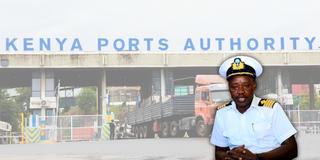
Kenya Ports Authority Managing Director Captain William Ruto.
Photo credit: Kevin Odit | Nation Media Group
Among the costs pointing to possible heavy bridge-related works, he says, include concrete works that have a Sh2.9 billion budget, piling works (Sh687 million) and miscellaneous bridge works (Sh223 million).
The Nation on Wednesday asked KPA to provide a broad overview of what the project entails, works involved and whether there have been any changes to the contract cost. We also asked the agency and its managing director, Captain William Ruto, to provide an update on the current status of its implementation, how much has been paid to the contractor so far with a breakdown of how the money has been used, and also provide justifications for the budgets classified as preliminary, miscellaneous and variations.
“We acknowledge receipt of your email requesting responses on the above Road Contract. Some of the questions are technical in nature and will require additional time to gather accurate and comprehensive information. We kindly request your patience as we work to compile the correct details. Once this is done, we will revert to you with a complete and appropriate response as soon as possible,” the authority said in a response by Aaron Mutiso, its senior communication officer, on Wednesday.
KPA had not issued any further responses by the time of publishing. Questions sent to Mr Ruto’s mobile phone through text messages were also not answered, and calls to him went unanswered.
In the 2024/25 annual report, however, KPA explains the scope of the project as “provision of an approximately 1.4km long road extending from the Gantry Workshop to Gate 18 exit via the one-stop centre” while the contract refers to “widening of port road from Gantry Workshop to Gate No. 18/20”.
In an assessment of the contract, Mr Ndong, a commercial law expert, says major legal risks in the contract revolve around areas where it avoids having particular information and huge budgets for variations. He argues that by providing specific information of what is being costed would make it easy to assess where there is overpricing and abuse.
“The contract provides a list of items and clauses that allows so much leg room for those who are involved, either contractors or engineers, to collude with government and justify the cost,” he says.
Under the contract, variations constitute things such as omission of any work, inclusion of additional works, changes to sequence or timing of execution, all of which are projected to trigger a rise in cost.
KPA budgeted Sh645.5 million for the variations, on top of Sh322.7 million for physical contingencies.
“Variations have always been the most abused clause in government tenders because all stakeholders can collude. Even things that should ideally not fall under variations through proper planning can be deliberately planned,” Mr Ndong says.
The commercial law practitioner also raises red flags in clauses addressing how cases of unforeseeable physical conditions and delayed payments.
“The contract has been signed and advance payment paid. Completion period is 24 months,” KPA says in its 2024/25 annual report, indicating that construction was at 1.2 per cent level by end of June last year. It says the project was expected to be completed this month.