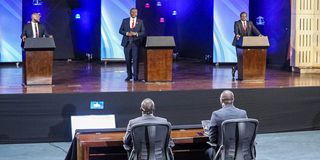
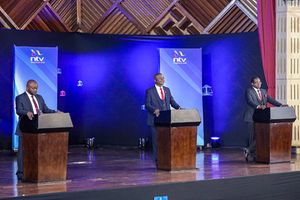
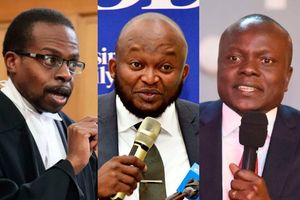
The ghosts of past clients became the focus of the presidential debate for the Law Society of Kenya (LSK) as the three contenders made their final submissions on Monday evening.
During the debate organised by Nation Media Group, the candidates turned their fire not just on policy, but on one another’s professional past.
Each candidate questioned the other’s loyalties, probing whether past representations might compromise future leadership.
Senior Counsel Charles Kanjama during LSK's presidential candidates debate at the Catholic University of Eastern Africa, Nairobi on February 16, 2026..
Photo credit: Lucy Wanjiru | Nation Media Group
Senior Counsel Charles Kanjama found himself first in the dock with rival Peter Wanyama questioning whether his perceived closeness to the Judicial Service Commission (JSC), which he has represented in court, could interfere with his independence.
LSK presidential candidates respond to lawyers' questions
But Mr Kanjama defended his legal representation, arguing that lawyers do not become their clients. Quoting Justice (retired) Albie Sachs, the former judge of South Africa’s Constitutional Court, he underscored the sanctity of professional duty.
Throwing back a jab at Mr Wanyama, Mr Kanjama accused his colleague of being too deeply entangled with county governments to offer independent leadership, citing his frequent courtroom appearances on their behalf.
“He is the foremost lawyer acting for county governments. The amount of money he gets from the county governments runs into tens of millions. Can you truly say that he will be independent now that we are approaching the 2027 general election?” he asked.
According to Mr Kanjama, the LSK needs an advocate who cannot be intimidated by the “withdrawal of his core source of income”.
Law Society of Kenya presidential debate candidate Mwaura Kabata during the debate at the Catholic University of Eastern Africa, Nairobi on February 16, 2026.
Photo credit: Lucy Wanjiru | Nation Media Group
Mwaura Kabata, the current LSK vice president, was not spared either. He faced sharp criticism over allegations that cases were withdrawn during his tenure.
“It cannot be withdrawn without the knowledge of the members of the council. Do you have the wherewithal to withstand the pressure from the Executive?” Mr Kanjama asked Mr Kabata.
Mr Kabata dismissed what he described as selective blame, where he was blamed when things go wrong but credit went to the council when things are good.
Mentoring young advocates
“If I were a senior counsel, I would be mentoring young advocates, and if I were getting millions from county governments like Wanyama, I would stick to representing my clients and not be interested in vying for the LSK president,” he said.
According to Mr Kabata, he alone was running purely to serve society.
Lawyer Peter Wanyama during LSK's presidential candidates debate at the Catholic University of Eastern Africa, Nairobi on February 16, 2026.
Photo credit: Lucy Wanjiru | Nation Media Group
Mr Wanyama did not shy away from the financial scrutiny and readily admitted receiving Sh1.2 million from the Narok County government and said part of the payment would go towards buying books for young advocates.
He rejected claims of proximity to the Executive, insisting that he had repeatedly challenged the national government in court and resisted attempts to withdraw cases.
He also acknowledged advising a fellow lawyer on the impeachment of former Deputy President Rigathi Gachagua .
“They simply asked me, looking at the allegations, whether the deputy president violated the provisions of Article 10 of the Constitution. I participated in that manner and as a lawyer,” he said.
Who carried the debate? | LSK presidential debate analysis
Casting himself as battle-tested, Mr Wanyama argued that he had long stood firm against Executive interference.
“I have for the last 15 years practised law by representing county governments in 47 constitutional petitions against the national government to strengthen and protect constitutionalism,” he said.
On corruption, Mr Wanyama said, “I will not be afraid to confront the JSC. We will be demanding a structured conversation with the JSC. We will fight corruption in a serious and consequential way. I will work with my council.”
He proposed publishing a “list of shame” for judicial officers implicated in corruption and partnering with anti-graft agencies at the Executive level.
For Mr Kabata, corruption flourishes because the system allows it to.
“Harnessing and leveraging on technology, we will remove human intervention that unnecessarily allows the clogging of the system and which allows corruption to thrive,” he said.
“For me, this is a critical issue. We are going to make noise, noise and more noise. The one person with a track record of fighting corruption is Charles Kanjama. We must continue in litigation. LSK must give regular feedback to the Judiciary. We shall engage with partners in the Judiciary and build institutions and not rely on individuals,” he said.
Asked whether his strong Christian and conservative views might affect his leadership, Mr Kanjama dismissed the concern, saying critics had “found no cases against” him.
On campaign financing, he said 40 percent of his funds came from him as a senior partner at his firm, 50 percent from colleagues, and 10 percent from non-advocate well-wishers, including former schoolmates.
Mr Wanyama denied dishing out handouts to young lawyers but confirmed he had helped some acquire books, partly using the Sh1.2 million he had received that day.
“I do this because I was also assisted. Someone paid my school fees,” he said.
He disclosed that he had spent Sh12 million on the campaign so far, while Mr Kanjama and Mr Kabata have spent Sh6 million and Sh5 million, respectively.
Mr Kabata promised continuity, modernisation, and sustained activism, while Mr Kanjama pledged institutional stability, ethics, and experienced stewardship. Mr Wanyama offered reforms, economic opportunity, and practical support for young lawyers.