Just two days after President William Ruto announced a triumphant end of the matatu strike, a cocktail of reasons pushed various categories of individuals on the streets on Monday, in what was largely sporadic and largely unpredictable in both manner and form.
Online ride-hailing motorists were on the streets in Nairobi protesting in Nairobi. In Thika, the roads were impassable, particularly at Witeithie area. In sections of Kiambu Town and Limuru Road, motorists reported tension and blockage of roads. In Nyeri, as was in most towns in central Kenya, the roads were deserted.
Transport was paralysed in Embu, Chuka, and Nyahururu towns, and sections of Thika road as protestors demonstrated against the hike in fuel prices despite resolution between government and public service vehicle operators to suspend demos.
But in one way or another, they were related to the fuel situation that the transport sector meeting with President Ruto was meant to cure.
While the immediate relief was achieved and the impending strike called off, it appears that a section was left disillusioned.
Transport sector officials call off matatu strike
The final deliberations on Sunday had representatives from truckers, cabs and taxis, tours and tourism, bodabodas, matatus and their various matatu sacco representatives, commuters and a representative of “everyone using diesel”.
The final deliberations on Sunday that paved the way for the transport sector strike had representatives from truckers, cabs and taxis, tours and tourism, bodabodas, matatus and their various saccos representatives, commuters and a representative of “everyone using diesel”, those present said.
The nearly 100 stakeholders from various sub-sectors in the transport economy had held numerous deliberation meetings, hoping against hope that they would eventually succeed as a whole. However, for the meeting with President Ruto, only a fraction was present.
According to the Matatu Owners Association chairperson, Albert Karakacha, the Mombasa meeting had approximately 30 people, with about 20 people drawn from the matatu sector from across the country, including the central region, which mostly witnessed the strike on Monday.
“I went to Mombasa with my team of about 20 people because as a leader, I told myself that I won’t enter into that meeting alone,” Mr Karakacha said.
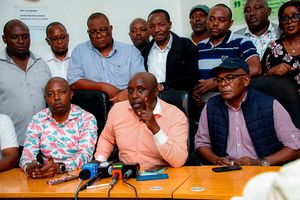
Matatu Owners Association (MOA) Chairperson Albert Karakacha (centre) spaeks to the media after President William Ruto met with transport stakeholders at the State House, Mombasa on May 22, 2026.
Photo credit: Kevin Odit | Nation Media Group
He explained that, in fact, there was an initial list that only featured a selected few. And at first, they were locked out of the meeting and were kept out. It was only moments later that the additional list was admissible.
“There was a group that had given a list without us,” Mr Karakacha said. “…and if you look very keenly, no matatus are on strike.”
Private motorists, taxis, workers' association, cargo transporters and commuters’ association were all locked out of the Mombasa meeting, another representative said.
The sector had held several meetings and agreed to win as a whole. However, the Motorists Association of Kenya chairperson, Peter Murima, said the meeting was hijacked by a sub-sector, most of which were for personal pursuits or sub-sectarian interests.
There were some members of the transport sector who, against the initial agreement, started conversing with the government officials “behind our backs,” said one representative.
In the end, Mr Murima said, most of the transport stakeholders were left out of the crucial meeting with the president.
Those who were present at the meeting told Nation that the President offered solutions to their concerns. Those who were locked out claimed that “hands were oiled”. And the matatu sector, they said, took over the whole thing, rendering it sub-sectarian and not about the whole course of the transport sector
But in their defence, Mr Karakacha said, they were the loudest about the strike and the most affected were his members.
“It was the matatus who started [the conversation about high fuel prices] and we brought all other stakeholders on board,” he explained.
He also dismissed as rumours allegations that they were bribed to sell out the whole plan. The meeting, he said, lasted for four hours, and when there was a stand-off, that is when they included other sub-sector concerns, such as police bribes and fraudulent insurance claims.
“There’s nothing that people were given in Mombasa in terms of bribery. We went into the meeting for close to 4 hours, just negotiating about the fuel prices. For those who are spreading rumours that we were bribed, let them bring the evidence. It is impossible for us to call a strike just to be bribed later.”
Motorists Association of Kenya Chairman Peter Murima during a press briefing in Nairobi on April 15, 2026.
Photo credit: Wilfred Nyangaresi | Nation Media Group
Most roads in the central region were impassable as a result of the unrest, and Mr Murima argued that it was a result of the faction whose needs were not addressed.
Bolt acknowledged Monday’s demonstrations by a section of our EV boda riders on Monday in Nairobi, adding they were open to dialogue.
“We hear the concerns raised and understand that questions around earnings and fairness matter deeply to the riders who depend on our platform every day. We remain fully open to dialogue,” Dimmy Kanyankole, the Senior General Manager, East Africa, Bolt said.
“We would like to clarify that there was a longstanding pricing anomaly where EV trips had historically been priced higher than petrol (ICE) equivalents, which did not reflect the lower running costs of electric vehicles,” Kanyankole added. “We, therefore, corrected this by aligning EV pricing slightly below ICE, as a fairness adjustment, and not a reduction in earnings. On commissions, nothing has changed.”
But there was also a group of boda boda riders is reportedly moving from Westlands toward Nairobi CBD to stage protests over alleged harassment by county enforcement officers, with possible disruption expected along routes leading into the City Centre,” Securex Agencies Limited, a private guard company, cautioned on X, advising pedestrians and motorists to consider alternative routes where possible.
For the better part of the day, tension gripped Nyeri and Karatina towns as businesses remained closed and transport paralysed after public service vehicles kept off the roads due to roadblocks mounted outside the towns.
Passengers arriving at the towns' stages were forced to return home after matatu operators said the highways had become too risky to use.
Matatu operators using the Nyeri-Nairobi highway also counted losses after demonstrators blocked the highway at Karatina town as early as 6 am.
Businesses remained closed, and the towns deserted, with some traders standing outside their premises, uncertain whether it was safe to reopen.
James Maina, a driver plying the Nyeri-Nyahururu route, said he arrived at Nyeri town's upper bus terminus at 4 am only to be advised by his colleagues to abort the trip.
“I was told there was a roadblock just before Nyahururu town and that rioters had blocked the highway. I therefore had to retreat and ask my passengers to return home,” he narrated, estimating his losses at more than Sh10,000, given that each trip earns him Sh7,000.
Reporting by Daniel Ogetta, Kevin Cheruiyot, and Mercy Mwende