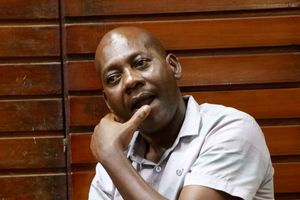
Shakahola murder suspect Kelvin Sudi Asena has died while in police custody, shortly before the conclusion of the high-profile trial linked to cult-related killings that left more than 450 followers of the Good News International Church (GNI) dead.
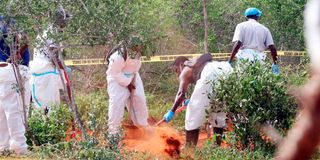
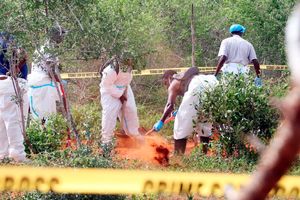
His death has sparked fresh controversy after a document emerged in which he reportedly set out a final wish to be buried inside Shakahola Forest, a site declared a crime scene by the State following mass graves uncovered during investigations into the Shakahola tragedy linked to the activities of controversial doomsday preacher Paul Mackenzie.
The request now raises complex legal and constitutional questions over whether a court can enforce such a wish, given that Shakahola was declared a crime scene and remains under 24-hour State surveillance.
The burial grounds, which remain a crime scene, form part of the larger Chakama Ranch land whose ownership is under investigation and whose occupation remains contested.
The case potentially pits individual burial rights and religious conviction against State authority over a protected and disputed site, where one of the most heinous crimes in recent history was committed in pursuit of salvation.
Asena, a close associate of Mackenzie, was among the suspects facing prosecution over the Shakahola deaths and radical teachings associated with the group.
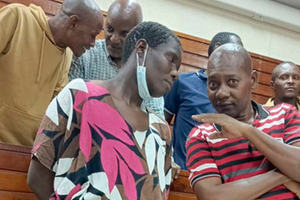
His wife, Joyce Miriam Atem, told the court on Thursday that her husband died two weeks ago after a short illness.
“I was told he died two week ago. I am not sure about his ailment, but I heard from fellow inmates that he had been ailing,” Ms Miriam told the Shanzu Court.
According to a police brief, Asena, 44, died on May 17, 2026, at around 5:45am while under detention and receiving treatment at the Coast General Teaching and Referral Hospital in Mombasa, where he had been admitted.
The report identifies him as Kelvin Sudi Asena, also known by several aliases including Alfred Asena, Baba Ashley, and Shitemi Alfred.
He had been remanded as an unconvicted prisoner in connection with multiple criminal cases arising from the Shakahola investigations.
Pastor Paul Mackenzie, with other accused persons, is charged with the murder of 191 children in Shakahola.
Photo credit: Kevin Odit| Nation Media Group
He faced murder charges before the High Court in Mombasa, manslaughter charges before the Chief Magistrate’s Court in Mombasa, as well as charges related to organised criminal activity, radicalisation, and allegedly subjecting a child to torture in separate courts in Shanzu and Tononoka.
The police report further states that Asena hailed from Kisenya village in Mungoma location, Vihiga Sub-County, and named Mary Jalenga Ombaji as his next of kin.
Authorities directed local administrators and police officers in Vihiga to trace and notify his relatives to report for identification of the body and postmortem arrangements within 21 days.
Failure to do so would result in a postmortem proceeding in their absence, after which the body would be disposed of by the State.
Police also confirmed that an inquest file had been opened at Tononoka Police Station to investigate the circumstances surrounding his death.
Asena’s death brings to four the number of suspects linked to the Shakahola crimes who have died in custody since the trial commenced in 2024.
They include Edison Safari Munyambo (alias Baba Sifa), Mary Charo Mbita, who passed away in hospital after brief illnesses, and Joseph Juma Buyuka, who died following a hunger strike.
On Thursday, his wife tabled a will in court indicating that Asena wished to be buried inside the Shakahola forest.
In the document, described as a “Deed of Act,” Asena set out his final wishes, offering a personal reflection on his life, faith, and what he believed to be the circumstances of his death.
“When I reflect on the love of Jesus, the far He has brought me and even how far I have come, it is not worth it to live a life of hardship, suffering, and oppression here on earth when heaven exists and is awaiting a hero. At this moment, I feel that I do not have much time left to live on earth,” he wrote.
He further expressed his belief that his time on earth was nearing its end and that he was ready to go to the Father, adding that his joy had already been fulfilled even as he bid farewell.
“I fold my mat; my journey is to the Father, and that is why my joy is fulfilled even as I speak to you today,” he said.
Asena also stipulated that upon his death, he should be buried in Shakahola, the area at the centre of the wider investigations.
“At the fulfilment of time, when I die, my body should be buried in Shakahola so that my joy may be completed for the glory of the name of Jesus Christ,” he stated.
He concluded his message by urging his family and followers to remain steadfast in faith and perseverance.
“My brothers, I leave you with the peace of Jesus. Also, receive the strength to pass through the narrow gate, for many will desire but will not be able. Strive hard, let us meet in the New Jerusalem. Amen,” he added.
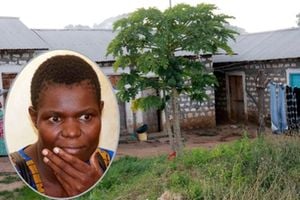
His widow, Ms Miriam, called as a defence witness, supported the authenticity of the document and urged the court to ensure the wishes are respected and enforced.
Not saddened by his death
She told the court that she was familiar with the handwriting and signature on the will, which was dated January 10, 2026.
“I was in Shakahola with Asena. We were married in 2006. When he died, I came across his will, which I wish to present to the court as his final wishes,” she said.
She added that the document reflected her husband’s deeply held faith and conviction, noting that he had previously purchased land in Shakahola where the family lived together.
“He loved Shakahola and he bought the land where we lived together with our children. That is why he wished to be buried there,” she said.
She further urged the court to honour Asena’s request for burial in Shakahola, stating that it represented his final wish.
She explained that Asena had anticipated his death months earlier and remained firm in his beliefs until the end.
While expressing acceptance of his passing, she said she was not troubled by the cause of death and maintained that she believed he had gone to heaven.
“I am not saddened by his death, because I believe he is in heaven,” she said.
In her testimony, she also stated that their children were alive, although the prosecution maintains that four children linked to the couple died in the Shakahola tragedy.
The will, however, makes no reference to the whereabouts of the children.
Asena’s last wishes are likely to deepen the already delicate questions surrounding the ownership of the land where more than 450 bodies were exhumed.
This development places the government in an awkward position, given that Shakahola has been declared a crime scene and remains under 24-hour security surveillance, effectively restricting access and any activity within the area, including burials.
The request also revives the long-running land dispute involving ownership of the section of Chakama Ranch, where the Shakahola tragedy occurred.
The ranch’s owners have previously accused Mackenzie of encroaching on their land and unlawfully subdividing or using portions of it for settlements linked to cult activities.
In a further layer of complexity, Asena is said to have bought his parcel from Mackenzie, raising legal and administrative questions over transactions conducted on land whose ownership and occupation remain contested.
The overlap of a declared crime scene, disputed land ownership, and a burial wish tied to the same location is likely to present authorities with a sensitive legal and operational dilemma as they determine the next course of action.
Whether the Shanzu court will heed the request to ensure Asena’s last wish is respected remains to be seen.
Ms Miriam is among the 16 witnesses that Mackenzie and 95 others had lined up to defend radicalisation charges and offer the court alternative explanations as to whether what transpired in the forest was a crime or merely an expression of freedom of worship.
Preacher Paul Mackenzie (right) and self-styled priestess Shallyne Anindo Temba when they appeared before the Mombasa High Court on February 11, 2026.
Photo credit: Brian Ocharo | Nation Media Group
The prosecution called 96 witnesses in this case, whose evidence the court found sufficient to place all the accused on their defence.
The witnesses included massacre survivors, experts and investigators, and the prosecution produced about 500 assorted exhibits.
The church, associated with Mackenzie, allegedly provided a platform for radicalising hundreds of followers who later perished while observing a deadly fast.
According to the prosecution, the fasting was meant to culminate in the followers and Mackenzie ascending to heaven to meet Jesus.
In this case, Mackenzie, his wife Rhoda Mumbua Maweu and 93 others have denied four terror-related offences.
They also face charges of engaging in organised criminal activity that endangered lives and led to the deaths of 429 members and followers.
They also face charges of radicalisation, with the state alleging that they promoted an extreme belief system to facilitate ideologically based violence through fasting to death under the guise of religious change.
Another group comprising Baron Chahenza and 63 others faces similar radicalisation charges. The state accuses them of adopting an extreme belief system to facilitate ideologically based violence through fasting to death.
Mackenzie and his deputy Smart Deri Mwakalama also face separate charges of facilitating the commission of a terrorist act.
Mackenzie and his wife face an additional charge of possessing compact discs, DVDs, books and pamphlets intended to instigate the commission of a terrorist act by endangering the lives of their followers.
The state alleges that they committed these offences in Furunzi, Malindi, on various dates between 2020 and 2023.