Did Kenya adhere to international forensic best practice during the exhumation of bodies in Shakahola Forest?
This question emerged during the final phase of the murder trial of controversial preacher Paul Mackenzie, who is charged over the deaths of 191 children in Shakahola Forest between 2020 and 2023.
Mackenzie closed his defence after calling expert witnesses who challenged the manner in which forensic investigations were conducted, from the moment investigators first arrived at the shallow graves to subsequent processes such as grave identification, mapping, excavation, exhumation, and mortuary handling.
Forensic specialist Myrna Kalsi raised a series of critical questions. She told the court that if these concerns were satisfactorily addressed, the entire process relating to the Shakahola deaths could be considered compliant with international forensic best practice.
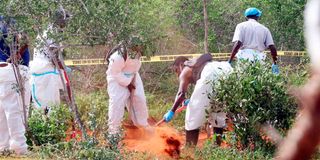
Bodies exhumed from mass graves in Shakahola forest, Kilifi County are loaded into a vehicle during the operation on May 12, 2023.
Photo credit: Kevin Odit | Nation Media Group
Dr Kalsi is a qualified forensic specialist with experience in the management of human remains for the purposes of forensic human identification and forensic death investigation.
She questioned the availability and adequacy of field reports, noting that it was unclear whether comprehensive documentation of the recovery process existed for specialist review.
She also raised concerns about forensic archaeology reports, including whether detailed exhumation records and corresponding photographic documentation for all graves and remains had been prepared by qualified forensic archaeologists.
“A forensic archaeologist should be present during exhumation to supervise the process. The expert should lead the operation, and ideally there should be at least two,” she said.
According to Dr Kalsi, forensic archaeologists are essential in cases involving mass burials and concealed graves. Their expertise lies in locating such sites, assessing them, and applying archaeological methods to recover human remains and associated evidence in a controlled and scientifically sound manner.
“Grave opening must be handled delicately to avoid damaging forensic evidence. A process that does not involve this specialist raises questions of reliability. It becomes an issue of probability if an exhumation is not conducted or led by a forensic archaeologist,” she told the court.
The court heard that the State deployed forensic experts from the Directorate of Criminal Investigations and other relevant agencies to conduct the exercise. However, it was not clarified whether Kenya has distinct forensic archaeologists, as defined under international best practice, or whether such specialists led the process.
Dr Kalsi further highlighted the need to establish whether forensic photographs and their descriptions were systematically reviewed, analysed, and properly linked to post-mortem documentation, as required under standard forensic procedures.
She also pointed to the importance of confirming whether reports from key specialists, including forensic anthropologists, odontologists, and geneticists, were prepared and incorporated into the overall forensic analysis.
Graves discovered at Kwa Bi Nzaro area, within Shakahola Forest, Kilifi County on August 15, 2025.
Photo credit: File | Nation Media Group
In addition, she raised the issue of documentation relating to clothing and associated artefacts recovered from the remains, noting that such material is often critical in the identification process.
Dr Kalsi emphasised the need to establish the qualifications and credentials of all forensic personnel involved, to ensure that each stage of the investigation was handled by appropriately trained experts.
She explained that in cases involving skeletal remains, a forensic anthropologist is essential, particularly where pathologists are unable to determine the cause of death due to advanced decomposition.
In many Shakahola cases, pathologists reported that the cause of death could not be established because the remains were severely decomposed and largely skeletonised.
“A forensic anthropologist is trained to analyse skeletal remains, whereas a pathologist primarily examines soft tissue,” she said.
According to the expert, the scale of the deaths and the condition of the remains in Shakahola would place much of the work within the domain of forensic anthropology.
She clarified, however, that she did not have details of the qualifications of the pathologists involved and therefore could not comment on their competence, although she noted that she did not doubt their credentials.
In practice, she noted, specialists maintain clear professional boundaries and avoid encroaching on the disciplines of others.
“A pathologist can examine a body and form an opinion. However, where remains are skeletonised, the appropriate expert is a forensic anthropologist,” she said when asked whether pathologists could still form conclusions in such cases.
Dr Kalsi also underscored the importance of a structured and well-documented forensic peer review process. She said clarity was needed on whether such a system existed to ensure that findings were independently reviewed and validated.
“Peer review is essential to demonstrate how analysis was conducted, as well as its accuracy, verifiability, and reliability. Without it, it becomes difficult to confirm whether the correct procedures were followed,” she said.
Some of the bodies exhumed from mass graves in Shakahola, Kilifi County, on May 18, 2023, in the investigation into cult leader Paul Mackenzie and his Good News International Church.
Photo credit: Kevin Odit | Nation Media Group
She maintained that answering these questions would provide a proper basis for determining whether the Shakahola exhumation process met internationally accepted forensic standards.
A further concern centred on the 360 DNA profiles that have yet to be matched. Dr Kalsi questioned whether this was due to a lack of corresponding samples from relatives or whether matches exist but have not been confirmed.
“If DNA profiles exist, what has the State done to ensure that relatives come forward under a structured missing persons programme to support identification?” she asked.
The court has previously been told that many victims remain unidentified due to the absence of DNA samples from relatives. This has been compounded by delays attributed to a shortage of reagents, slowing down the identification process.
This situation has raised broader public concern, with families who have already submitted DNA samples questioning why they have not been contacted, and why resources appear insufficient for such a critical process.
In her final advisory, which was adopted by the court as part of her evidence, Dr Kalsi stated that there are grounds to challenge the State’s handling of the Shakahola case when measured against international forensic standards for the management of skeletal human remains.
She noted that most of the bodies were significantly decomposed, placing them firmly within the category of skeletal remains, which requires specialised handling by a forensic anthropologist.
“In line with best practice, have the defence, prosecution, and the court been provided with all the necessary information for a case of this magnitude? It appears highly unlikely,” she said.
Dr Kalsi concluded by arguing that, ideally, a country’s forensic system should be independently structured to ensure scientific integrity, objectivity, and impartiality in the handling and analysis of evidence.
“Where the structure may not be independent, the management of evidence will be confined to the level of knowledge of its custodians, such as forensic management of skeletal human remains, and there may be selective interpretation in the handling of the same as a result,” she said.
First Deputy Chief Kadhi of Kenya, Rashid Ali Omar, also testified in the case, offering expert opinion in the Shakahola trial.
He was called by the defence to assist the court in understanding key issues, including the criminal liability of a spiritual leader who guides followers to death through fasting.
Dr Omar, a part-time lecturer at South Eastern Kenya University in the Department of Sociology, Anthropology and Social Development, structured his testimony around Islamic legal principles, presenting a detailed framework on how such conduct is treated under Sharia law.
“Whoever kills a soul, it is as if he had slain mankind entirely,” he quoted from the Quran, emphasising that this principle forms the foundation of Islamic law on life and death.
He told the court that whether death is caused directly or indirectly, Islamic law treats the destruction of human life as one of the gravest offences.
“A spiritual leader who orchestrates fasting unto death cannot escape scrutiny under this framework,” he said.
He further explained that Islamic law is guided by the concept of Maqasid al-Sharia, the higher objectives of the law, which prioritise the protection of life, religion, intellect, property, and lineage.
“The preservation of life is non-negotiable and overrides any individual interpretation or spiritual directive,” he stated.
“There is no obedience to a creature in disobedience to the Creator,” he said, citing a classical legal maxim.
He explained that this principle invalidates any command that contradicts divine law, including instructions that may lead to self-harm or death.
“A follower’s sincere belief does not extinguish the liability of the leader if the command itself is forbidden,” he added.
On the question of criminal liability and indirect causation, Dr Omar introduced the Islamic legal doctrine of causation, known as al-tasabbub.
“A person who causes death indirectly, through commands, inducement, or manipulation, may still bear criminal responsibility,” he told the court.
He cited classical juristic authority to reinforce the point, stating that one who causes harm through another’s hand is not absolved of liability.
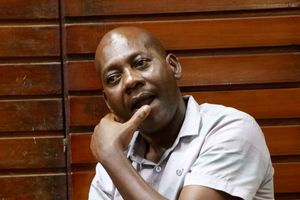
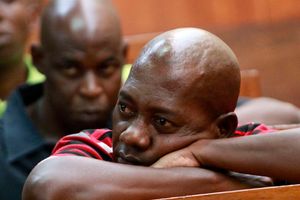
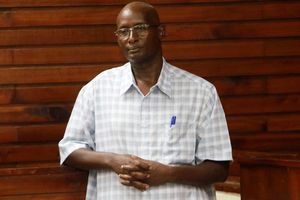
Pastor Paul Mackenzie when he appeared before a Mombasa court on November 10, 2025.
Photo credit: Kevin Odit | Nation Media Group
Dr Omar explained that when a preacher frames fasting unto death as a path to spiritual salvation, while exploiting the trust and reverence of followers, this amounts to wrongful causation under Islamic law.
“Fasting is not illegal; it is practised by both Christians and Muslims. In Islam, legal fasting is that which is prescribed by God through His Prophet. There is no compulsion,” he said.
According to the Muslim scholar, both the Qur’an and the Bible share common foundational principles. He holds that anyone who follows the teachings of these holy books faithfully, without adding to, subtracting from, or misinterpreting them, is upholding a sound example and doing what is right.
University of Nairobi Senior Law Lecturer Dr Evelyne Owiye Asaala, in her testimony, asked the court to clarify the scope of individual criminal responsibility in complex cases such as the Shakahola tragedy.
Dr Asaala told the court that criminal liability generally arises through two principal modes: commission and assistance, aligning Kenya’s framework with that of the International Criminal Court under the Rome Statute.
She explained that commission takes three forms: direct perpetration, joint commission, and commission through another person, all anchored on the element of control over the crime.
“Commission through another person often applies to those in positions of authority who exercise control over subordinates,” she said.
On assistance, Dr Asaala noted that liability arises where an individual offers substantial support to the commission of an offence.
This includes aiding, abetting, acting as an accessory before or after the fact, and participation in conspiracies, even where the intended crime is not ultimately carried out.
While Kenyan law recognises individual responsibility, Dr Asaala observed that it also accommodates limited forms of collective criminality.