Shakahola forest, under the leadership of controversial preacher Paul Mackenzie, operated like a government, with a formal structure reminiscent of a tightly controlled theocratic regime, a witness has disclosed.
It had a team of gatekeeping elders, a central authority figure, and a designated seat of power, much like a palace, where decisions were made and disputes heard and resolved.
Through the testimony of Andrew Baya Charo, a witness in the ongoing Shakahola manslaughter case against Mackenzie, the prosecution painted a picture of a man who established a leadership structure mimicking the operations of a secluded kingdom.
According to Mr Baya, the reason for this structure was to ensure that anyone seeking an audience with Mackenzie had to go through an approval process.
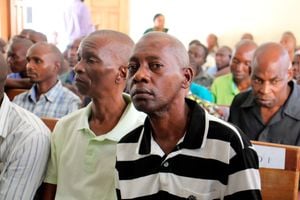
Prosecution Witness Andrew Charo Baya testifies at the Mombasa Law Courts on July 30, 2025 in a case manslaughter case against Preacher Paul Mackenzie and his associates.
Photo credit: Kevin Odit | Nation Media Group
He recounted that sometime in July 2020, his family and neighbours clashed with Mackenzie’s followers after a group of people, who he later discovered were affiliated with the preacher, invaded their ancestral land.
"I found people clearing bushes and, upon inquiring, I was directed to a group in the distance. That’s where I was introduced to Mackenzie, who was referred to as Mtumishi," he told the court, adding that this was how he first met the doomsday preacher.
When Baya questioned what was happening, Mackenzie claimed they were preparing the land for irrigation farming and had already brought in a drilling machine to start the work. He also claimed that the land had been sold to him by one Samuel Panda.
At the time, Mackenzie was accompanied by his driver, Smart Deri Mwakalama. After the brief tour of the farm, the witness was offered a lift back home.
But in August 2021, Mr Baya said Mackenzie and his team began encroaching further into their family land and set up temporary structures made from polythene bags.
Alarmed, he sought help from the local chief, MacDonald Mwaringa, who visited the area alongside members of the peace committee. There, Mr Baya showed them the structures erected on their land.
"Those we found living there claimed they had bought the land from Mackenzie. The chief, however, told them to vacate since the land belonged to someone else," he told Mombasa Chief Magistrate Alex Ithuku.
Following this, Mr Baya and two companions, David Katana and Stephen Katana, planned a meeting with Mackenzie at his homestead within the forest. As they approached, they were intercepted by Mackenzie's elders, Evans Sirya and Stephen Muye, who informed them that an appointment was required to meet the preacher.
"I was told I needed an appointment to see Mackenzie. Sirya and Muye then booked the meeting for me," he said.
The meeting took place at a designated location described as a palace-like setting about 200 metres from Mackenzie's official residence. Here, Mackenzie was known to preside over disputes from both within and outside the forest.
Shortly after, Mackenzie arrived with a team of eight individuals. The meeting opened with a word of prayer led by Sirya.
However, the attempt to resolve the land dispute was unsuccessful. Mr Baya eventually decided to abandon his own farm, demolish his house, and relocate.
Armed with pangas and whips
"We couldn’t reach an agreement. We resolved to report each other to the authorities. But I chose to walk away and avoid conflict, so I moved further from the area Mackenzie had encroached," he said.
Mr Baya relocated his livestock to the riverbank. At the new location, he observed that many of Mackenzie’s followers came to Shakahola village daily to buy food and fetch water. He also started selling cereals to them and noted that the business was thriving.
"There was a time I sold over 30 sacks of maize to these people. Business was booming," he said.
But by December 2022, he noticed a sharp decline in the number of Mackenzie’s followers visiting the trading centre. In January, he began to spot emaciated women emerging from the forest.
"In January 2023, a 13-year-old boy came to me asking for the homestead of a village elder. He told me how Mackenzie’s followers were fasting to death and that those caught eating were punished severely," Baya said.
He took the boy to the elder, who asked him to take the child in, saying he was already housing another boy who had escaped the forest.
Paul Mackenzie at Shanzu Law Courts in Mombasa on November 20, 2023.
Photo credit: File | Nation Media Group
Five days later, the boy’s mother arrived with her six-year-old child. She asked Baya to help return the boy to his father in Nairobi.
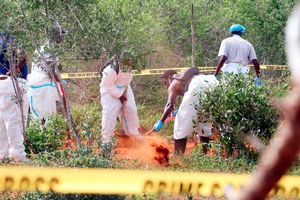
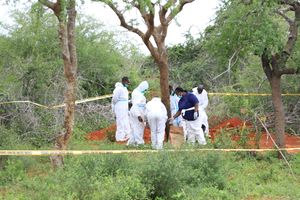
"Both the mother and child were weak. Three months later, news broke of Mackenzie’s arrest. I joined the search and rescue mission for other victims. We began by discovering decomposing bodies of women," he said.
A 15-year-old, identified in court as GN, also gave testimony that revealed the strict discipline and protocols that governed life in the forest. He explained how Mackenzie had instructed them to fast and the brutal consequences of disobedience.
"Mackenzie claimed that Jesus had indicated he would not return physically, and that people must follow him through death," he said.
Under the guidance of prosecutors Jami Yamina, Victor Owiti, and Betty Rubia, the teenager described how these teachings were disseminated during Saturday meetings, one of which he attended with his mother and brother.
The fasting schedule was dictated in a chilling order of children aged one to ten, followed by Mackenzie’s own children, then women, and lastly the men, with Mackenzie himself being the last. Mackenzie had assigned roles to a village elder, a discipline team, and a security team to enforce this.
"I was given a thorough beating by Sirya," he said, naming those in the security team, who now face charges alongside Mackenzie.
The security team, armed with pangas and whips, acted both as guards and enforcers. They also gathered intelligence and warned of approaching police officers to help Mackenzie’s followers escape.
The witness recalled an attempted escape after fasting for 11 days. He and his friend were caught by the security team and taken to Mackenzie’s residence.
Michael Omweri, another associate, would read the Bible verses Mackenzie selected. Followers were discouraged from visiting each other and were told to wait on God to provide, even when food was unavailable.
However, during cross-examination, Mackenzie’s lawyer, Lawrence Obonyo, sought to discredit the testimonies as hearsay. But the witnesses stood their ground.
The minor also reiterated that Mackenzie would glorify the dead, calling them heroes or heroines during burials. Crying or displaying sadness during these burials was considered unholy.