Two years ago, they lined up, one after another, and provided their DNA (Deoxyribonucleic Acid), drawn not just from their veins and cheek swabs, but from wounds of unspeakable loss — in some cases, entire families.
They handed over their genetic material in desperation, clinging to the hope that the bodies of their loved ones, who disappeared into the forest in Kilifi county after being radicalised by controversial preacher Paul Mackenzie, would be found and released for a dignified burial.
Ever since all they have received is silence. Their kins' remains continue to lie cold in the Malindi Hospital morgue, tagged and numbered.
Mr Suleiman Nyanje Zero is among the many families left in limbo, grieving without closure.
To him, the promise of identification has become a prolonged agony, more painful than death itself.
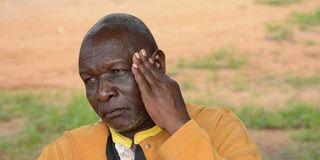
Suleiman Nyanje at his home in Mtondia, Kilifi County, on June 18, 2025. He lost his wife and five children in the Shakahola tragedy but has not buried any of them.
Photo credit: Wachira Mwangi| Nation Media Grup
The Nation team met him at his home in Tezo, near Mikingirini Primary School in Kilifi county, about 20 minutes’ drive from the Mombasa-Malindi road.
Frustration is clearly written on his face. What was once a family of eight is now only two. He lost his wife, Mbeyu Chombo, 42, and five children aged 22, 20, 18, 12, and one and a half.
He jokes that his household almost remained with "zero" children, as his surname suggests.
"I am left with my eldest son. He escaped from Shakahola when life became unbearable in the forest. I was lucky. I almost lost everyone," he says. He has not buried any of his loved ones and does not know their whereabouts. He stays home alone as his son is away trying to earn a living.
"My son and I gave DNA in 2023, but I have never received confirmation. So I do not know whether they are in the morgue or still buried in the forest," he says.
"The government only wanted my testimony but has done nothing to help me recover my family or bury them if they are dead. The last time I spoke with investigators was when they wanted me to testify against Mackenzie. It has been quiet since then," he says.
Zero last saw his family in 2019. As a mason, he was mostly working away from home in places such as Ukunda. During their stay in Furunzi, his wife joined Good News International Church and became close to Mackenzie.
Paul Mackenzie at Shanzu Law Courts in Mombasa on November 20, 2023.
Photo credit: File | Nation Media Group
"She took care of Mackenzie's children and was receiving a stipend. I never stopped her from attending the church as I thought everything was fine," he says.
Concern grew when she vanished into the forest with their children. His search was fruitless until he saw in the media that bodies were being exhumed and survivors rescued in Shakahola.
"With the government silent, I have no one to ask about my family. I assume they are dead because they would have returned. My wife is not among those facing charges," he says.
He adds, "I want to know where my family is. We cannot suffer twice—the loss and the endless waiting."
Ms Zueni Ali’s stepfather, Stephen Shoboi, died while waiting to bury the remains of her mother, who vanished into the forest.
She says he was frustrated and left instructions on where to bury her mother, Jumwa Chea, once the government releases her remains.
"He told us she should be buried at her parents' land," she says.
She and her brother submitted DNA samples, but they still await results. She and her mother had joined Mackenzie, but she escaped and later testified in court.
Pastor Paul Mackenzie in Court
Photo credit: Kevin Odit
Over 150 kilometres deep into Kamale Village from Malindi town, we met Titus Ngonyo Gandi, who lost seven family members—his two sons, their wives, and his grandchildren. He was in his maize farm guarding crops from monkeys.
"I am tired of burying people in phases. I want to bury all of them at once and find peace. I have buried four so far on different dates; three remain. Each burial reopens the wound," he says.
"DCI called me last August, saying they had identified my son Isaack Ngala. They promised to release his body in two weeks. I am still waiting," he says, adding he has received no explanation for the delay despite confirmation of identity.
The same is true for Gerishon Musau, who lost his daughter Ruth Minoo. He gave DNA in May 2023 and is still waiting.
"I want to know where she is. If she is dead, let us bury her. We urge the government to act swiftly," he says.
In court, victims have revealed that repeated inquiries about missing relatives have gone unanswered, with officials citing lack of materials for DNA processing.
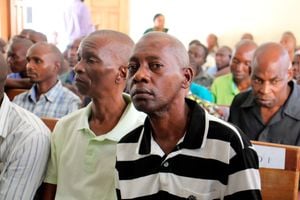
Pastor Paul Mackenzie and his alleged 29 associates at the Shanzu Law Courts during the mention of the case in this file photo.
Photo credit: File I Nation Media Group
Jimmy Mganga is looking for his father, Moses Kahindi, mother, Joyce Kachi, and three siblings, all still missing.
"To date, I have not received any results. Whenever I ask, they say there are no reagents to complete the process," he laments.
The Kenya National Commission on Human Rights, a state-funded agency, estimates that over 600 people remain unaccounted for and that fewer than 10 per cent of Shakahola victims have been returned to families, leaving many in anguish.
Families are urging the government to speed up the process to allow for closure and emotional healing.
At the Malindi morgue, activity is ongoing, but the bodies being collected are not of Shakahola victims.
Other than the 34 released, over 400 bodies remain uncollected, with the majority unidentified.
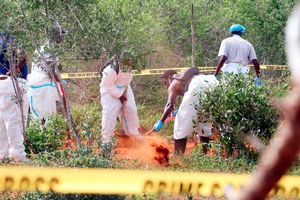
Bodies exhumed from mass graves in Shakahola forest, Kilifi County on May 12, 2023.
Photo credit: File | Nation Media Group
"These bodies are still here. We are still struggling with them," said a worker who requested anonymity.
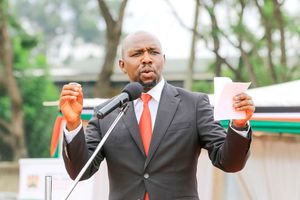
In April, Interior Cabinet Secretary Kipchumba Murkomen visited Kilifi and acknowledged that a dedicated budget is essential to resolve the Shakahola investigation.
"There is competition for resources, but this is not just about money. It is about coordination, proper sampling, and better capacity," he said.
While avoiding admission of funding shortages, Mr Murkomen stressed the need for investment in modern DNA testing, especially at the Government Chemist and the Directorate of Criminal Investigations forensic laboratory.
"There is urgent need for a one-off budget that supports sample collection and final investigations. We are trying our best, but perhaps the next financial year should have a specific allocation to bring this case to a close," he said.
He has also raised the issue of unidentified victims, noting the challenges in cases where no relatives have come forward for DNA matching.