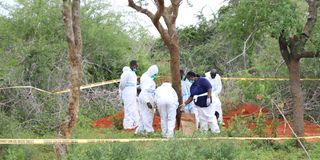
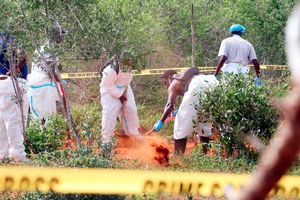
After almost a year of activity, silence is now the hallmark of Shakahola Forest, the site where over 450 bodies of followers of Good News International Church associated with doomsday preacher Paul Mackenzie were exhumed.
The days of forensic experts in heavy boots combing the thickets, long convoys of government officials and journalists trooping to the forest, and grieving families searching for loved ones are long gone.
Today, the only sounds that break the silence are the rustle of dry leaves, chirping of birds, and footsteps of police officers patrolling the expansive forest where the graves were spread.
A map showing villages that were carved out of Shakahola Forest by adherents of a suspected cult, many of whom were allegedly convinced by their leader to fast to death or murdered.
Photo credit: File | Nation Media Group
Less than five metres’ drive from the Malindi-Sala Gate road is a temporary station holding police officers. A thin presence of about 30 police officers in this area serves as a quiet reminder of the tragedy that unfolded deep in the forest. A deputy officer commanding police station is in charge of the team at any given moment.
Different teams patrol the forested crime scene at scheduled intervals throughout the day. The officers disclosed that they only stay here for a month before being replaced by another group.
The makeshift tent along the road, which once served as a bustling command centre during all five phases of the exhumation, now stands in quiet desolation.
When the Nation team visited the tent, only two police officers were present, idly passing time, mostly trying to locate a strong network signal for communication.
“The network signal is stronger here compared to inside the temporary tent located in the forest, but we also have to remain here to monitor any activity outside,” says one of the officers.
The rest of the officers are stationed at the temporary police post set up within the forest, a few metres from the main road. The tents that once housed the General Service Unit (GSU) officers have since been dismantled after their withdrawal from the area.
Amid the silence, one thing is still certain—that Shakahola Forest remains an active crime scene, its graves, exhumed or untouched, now resting beneath the haunting watch of nature as she slowly reclaims her own.
The government’s clearest signal so far has been its intention to transform the forest where bodies were exhumed into a national memorial to honour the victims of the cult.
When he toured Kilifi County in April this year, Interior Cabinet Secretary Kipchumba Murkomen hinted at a long-term solution regarding the Shakahola grave sites.
“Can we turn it into a memorial to honour victims of religious extremism and radicalisation? It should serve as a reminder of our collective failure as a society to protect vulnerable citizens,” he said.
Deputy President Kithure Kindiki made it clear during the exhumation, when he was the Interior CS, that the government was to take over 4,000 acres of the Chakama Ranch where the Shakahola deaths occurred to put up a memorial.
This memorial area will be used to bury bodies that will not have been identified by their families at the end of investigations and the DNA processes currently ongoing at the government chemist.
The government last year declared the exhumation exercise over during the last phase of the operation, announcing plans to take over the affected area and then fence it off.
The state also said bodies that would not be collected from the morgue by relatives for burial would be taken back to the forest and interred in a mass burial. A memorial service will also be conducted on-site for the bodies that will not have been exhumed.
The government has assured that the graves in Shakahola have been precisely documented to allow families to trace where their loved ones were buried.
Chief Inspector Kigen Sawe, a forensic imaging expert with the DCI, told the court during the ongoing hearing of the criminal cases facing Mackenzie and his 94 co-accused that Global Positioning System (GPS) technology was used to record the exact coordinates of each grave, with detailed maps created showing their length, width, and depth.
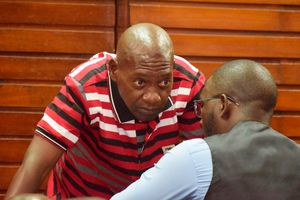
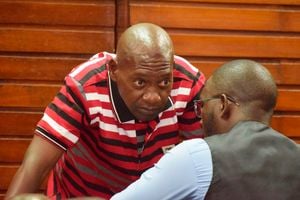
Pastor Paul Mackenzie and his alleged 29 associates at the Shanzu Law Courts during the mention of the case in this file photo.
Photo credit: File I Nation Media Group
Each grave and body was uniquely numbered, making future identification possible even as homesteads collapse due to weather. In total, 265 homesteads and 22 canopies were documented.
Sources familiar with affairs within the government say that the Shakahola exhumation is a done deal and that there are no indications that more excavation in the forest will be done.
“The state already has all the material it needs to support the ongoing court case about the massacre. More exhumation means additional evidence to the ongoing cases, which is an unlikely occurrence,” says a source who sought anonymity.
For now, he says the government has channelled its efforts to ensure that bodies already exhumed are identified, released to the families for burial, and that those which will not be claimed or identified are returned to the forest for mass burial.
“That is the headache for now. Any further exhumation is not on the table as far as I know,” he says.
Given the challenges the government is currently facing in identifying the already exhumed bodies, as some families are not coming forward to provide DNA samples for matching, the source says it is unlikely that the state will return to the forest to dig for more bodies.
“I believe all the bodies were exhumed because of the serious marking of disturbed soil and the areas suspected to be burial sites. But in the unlikely event that anybody is still in the forest, that chapter of exhumation is already closed,” he says.
Bodies exhumed at Shakahola Forest are loaded into a Police van after today's exercise in this file photo. Some lawmakers are alleging that the deaths were planned and the bodies transported to Shakahola.
Photo credit: File I Nation Media Group
However, the locals the Nation team met in Shakahola spoke of a high-profile visit by top security officers in the Coast who were accompanied by at least two white foreigners.
The team arrived in a convoy of about seven vehicles. “They snaked their way into the temporary police station and spent hours there before we saw them leave,” said a local who requested anonymity.
Residents say there is talk that plans might be underway to establish a permanent police station at the current temporary holding area where officers manning the forest are based.
Sources familiar with activities in the forest claim that part of the Shakahola land could already be in the hands of private developers, despite the government's earlier announcement that it intended to take over some acres of the property.
Locals from Shakahola Centre help dig up graves at Shakaola forest part of the 800 acres linked with cult leader Paul Mackenzie of Good News International Church on June 6, 2023.
Photo credit: Wachira Mwangi | Nation Media Group
The villagers, however, have welcomed any initiative that could transform the area into agricultural land to improve food security for the local population, rather than allowing it to remain tainted by its tragic past as a place where hundreds died while fasting in the hope of seeing Jesus.
“Shakahola has a bad name out there, as the place where hundreds of people, radicalised into believing they could see Jesus through fasting, lost their lives. If this land can be turned into a serious agricultural farm to support national food security, then we highly welcome the idea,” says Kazungu Jumwa, a local resident.
The locals say they have not observed any significant developments taking place in Shakahola Forest, apart from the occasional visits by security teams.
“The forest was declared a crime scene, and it is still a no-go zone. Access is restricted as security personnel do not allow anyone beyond the designated areas,” Jumwa adds.
A Senate Ad Hoc Committee was informed that the land where the Shakahola massacre occurred was unoccupied and forms part of the 50,000-acre Chakama Ranch.
The committee was also told that government records do not show doomsday preacher Mackenzie as the owner of the 800 acres in Shakahola that he and his followers occupied.