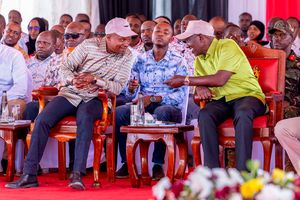
Long before President William Ruto arrived with an apology and a bag of goodies for the people of the northern Kenya to mark the 63rd Madaraka Day celebrations on Monday, Wajir had already made history.
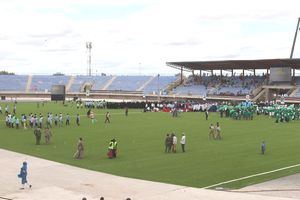
Residents began arriving at the new 10,000-capacity stadium as early as 4:30am, many from far-flung parts of the county, to witness the first national celebrations held in the north.
By 6:30am, all the seats had been occupied and thousands more stood on the terraces as the sweltering heat in Wajir intensified.
Hawkers, children, elders and local leaders mingled in an atmosphere of excitement and anticipation, aware they were witnessing a moment that would be etched into the region’s history.
President William Ruto arrives at Wajir Stadium for Madaraka Day celebrations
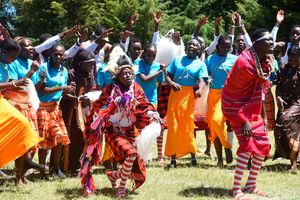
The colourful celebrations were heavily anchored on the theme of education. Hundreds of learners drawn from schools across Wajir dazzled the crowd with performances on the stadium’s pristine green turf.
In one of the most striking displays, the children assembled themselves into the shape of the map of Kenya before seamlessly transforming into the word “WAJIR” and later “ELIMU” – the Kiswahili word for “education”.
The formations drew applause from the crowd and reinforced the central message of the day that education would be the foundation of Kenya’s development.
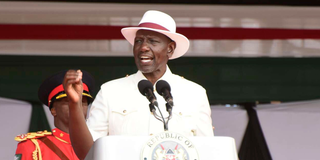
When he stood to speak, the President repeatedly returned to the themes of inclusion and equal opportunity as he confronted the legacy of policies that consigned northern Kenya to the margins of national development.
President Ruto singled out Sessional Paper 10 of 1965, which prioritised investment in perceived high-potential areas while leaving swathes of northern Kenya underdeveloped.
That policy, he said, resulted in decades of poor roads and healthcare, limited access to education and exclusion from mainstream economic opportunities.
“Communities were pushed to the fringes of their own republic. Their patriotism was questioned, their citizenship doubted and their aspirations undermined,” the President said.
President William Ruto delivers his speech during the Madaraka Day celebrations at Wajir Stadium on June 1, 2025.
Photo credit: PCS
“As I stand here as President and leader of our great nation, I wish to address the people of northern Kenya. On behalf of the people and the Republic of Kenya, I offer sincere apology for the marginalisation you have endured over the years. Poleni sana ndugu zetu (We are very sorry our brothers). It was never meant to be this way,” he said.
The crowd was euphoric, with the shouts rivalling the cheers made moments earlier when the skies came alive in a spectacular show of military precision and prowess.
The Kenya Air Force conducted an elaborate fly-past involving Grob 120A and Grob 120TP trainer aircraft, a Huey helicopter and fighter jets, which roared above the stadium in coordinated formations.
The aerial display reached its climax when a jet – christened Tiger 5 – sliced through the sky and executed a roll.
Four F-5 fighter jets then followed with a series of manoeuvres, including a vertical roll, roll-off-the-top, a four-point roll and a high-speed pass.
The performance concluded with the helicopter flying over the stadium, with a giant “Happy Madaraka 2026” banner.
The apology came as President Ruto reflected on decades during which many residents of northern Kenya had difficulties obtaining national identity cards, birth certificates and other important documents due to discriminatory vetting.
The President said such experiences were common among thousands of residents of northern Kenya who were subjected to additional scrutiny based on ethnicity and place of birth.
Last year, the President abolished the additional vetting for people of northern Kenya and other border counties to simplify the issuing of identity cards, birth certificates and other documents.
It is for that reason that he said his administration took the decision to host the Madaraka Day celebrations in Wajir.
“This is not a mere ceremonial gesture. It is a national declaration. Madaraka belonged, still belongs and will forever belong equally to every Kenyan,” President Ruto said.
While the apology drew attention, education was the focus of his address and the broader theme of the celebrations – “Education, Skills and the Future”.
He described education as the most powerful tool available to any nation, adding that Kenya’s next phase of liberation would not be through political struggles but investments in knowledge, innovation and skills.
“Unlike in 1963, the next frontier of Kenya’s liberation will not be fought on conventional battlefields. It will be won in classrooms, laboratories, workshops and innovation hubs,” the President said.
He defended the Competency-Based Education (CBE), describing it as a transformative system designed to equip learners with practical skills instead of merely preparing them for national examinations.
Members of the public Wajir Stadium during the Madaraka Day celebrations on June 1, 2026.
Photo credit: Billy Ogada | Nation Media Group
Kenya, he said, is witnessing encouraging signs, particularly after 52 per cent of learners in the first Grade 10 cohort selected the Science, Technology, Engineering and Mathematics (STEM) pathway.
The President compared Kenya’s ambitions with countries like South Korea, Singapore and Finland, “which transformed their economies through sustained investments in education and human capital”.
He also outlined “unprecedented government spending on education”, saying the education budget has risen from Sh500 billion in 2022 to more than Sh702 billion today, while more than 100,000 teachers have been hired in three years.
Another 20,000 teachers are to be recruited this year, he added.
Northern Kenya, which is often affected by teacher shortages, featured prominently in the President’s speech.
Dr Ruto said the shortages are being addressed through affirmative action, focusing on training and hiring teachers from the region.
The making operational of Kotulo, Mandera and Wajir Teachers Training Colleges has enabled the recruitment of 1,800 teachers from Wajir, Garissa and Mandera counties.
Additionally, 4,616 young people from the region are enrolled in teacher training colleges, the highest number recorded in the history of northern Kenya.
The government, the President said, has expanded infrastructure in education by building 23,000 classrooms and 1,600 laboratories nationwide, many in arid and semi-arid areas.
President Ruto said more than 850,000 learners are enrolled in Technical and Vocational Education and Training (TVET) institutes.
Describing northern Kenya’s educational needs as unique, the President announced plans to integrate Duksi, Madrassa and the Programme for Pastoral Instruction into the national education framework.
He directed the Ministry of Education to engage stakeholders and develop a framework that recognises alternative learning systems and ensure children from pastoralist communities are not left behind.
He pledged government funding for the construction of Wajir University and urged residents to provide land for it.
President Ruto spoke of projects aimed at improving livelihoods in northern Kenya. He said the government has invested Sh15.6 billion in affordable housing in Wajir, with 4,600 units at various stages of construction and procurement.
Across Wajir, Garissa and Mandera counties, projects valued at Sh38.5 billion are underway, including housing, hostels, classrooms, markets and police houses, he said.
Among the projects is the Sh100 billion Northern Kenya Gateway Corridor – a 750-kilometre road linking Isiolo, Wajir and Mandera counties.
“Distance was used to justify exclusion for decades. We are defeating distance,” he said.
The President said livestock is the backbone of the region’s economy, adding that the sector contributes 12 per cent of Kenya’s GDP.
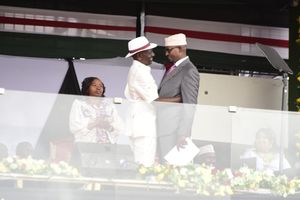
President William Ruto and First Lady Rachel Ruto leave Wajir Stadium in Wajir County after attending the 63rd Madaraka Day celebrations on June 1, 2026.
Photo credit: Billy Ogada | Nation Media Group
He said the government distributed more than 52,000 animals to drought-affected households, vaccinated at least 10 million animals and expanded local vaccine production.
He announced a Sh5 billion County Livestock Investment Company, targeting more than 350,000 pastoralists in 21 dry and semi-dry counties.
Water also featured in the President’s speech. He said there are plans to build 50 mega dams, 200 medium and small dams and thousands of micro-dams to boost irrigation and food production.
Key projects include Bute dam in Wajir, a mega dam on River Daua in Mandera and the Isiolo dam on the Ewaso Nyiro basin.
President Ruto directed that Wajir stadium be renamed Ahmed Khalif Wajir stadium in honour a political leader from the region. It followed a request by Wajir Governor Ahmed Abdullahi.
“Wajir is not the edge of Kenya. Wajir is Kenya. North Eastern is Kenya and Kenya belongs to us all, “ he said.
Deputy President Kithure Kindiki praised President Ruto’s decision to abolish the vetting the residents of northern Kenya and other border counties were subjected to when applying for important documents.
“You have brought unity and advanced our agenda of inclusive development. The people of northern Kenya now feel fully part of the Kenyan story,” Prof Kindiki said.
He added that locals are eagerly awaiting the completion of the road linking Mandera, Rhamu, Elwak, Kobo, Kotulo, Wajir, Samatar, Modogashe and Isiolo, describing it as a transformative project.
The event ended at 10.53am, making it the earliest conclusion of a national holiday celebration in Kenya.