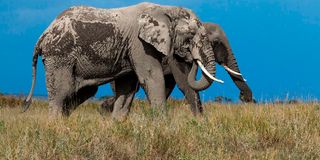
The Kenya Wildlife Service (KWS) is investigating the mysterious deaths of 14 elephants in Amboseli National Park in June, a development that has triggered concern among conservationists and local leaders, who are demanding answers.
The carcasses, which belonged to elephants of various ages and sexes, were found at different locations within the park over a period of two weeks. KWS veterinary officers collected samples for laboratory analysis to determine the cause of death.
A KWS ranger, who spoke to the Nation on condition of anonymity, said that the elephants had been under close veterinary observation after displaying symptoms of illness, before eventually dying.
Elephants at Amboseli
Photo credit: POOL
According to the ranger, the carcasses were buried within the park following post-mortem examinations.
“The vets tried to treat the animals, but they did not respond. Initially, muscle fatigue was suspected, but the treatment was unsuccessful. After carrying out all the necessary veterinary procedures, including collecting additional samples, the carcasses were buried inside the park. This is the highest number of elephants to die within such a short period in the Amboseli ecosystem,” the ranger said.
Former Assistant Director in charge of the Amboseli Ecosystem, Paul Wambi, who now heads the Southern Conservation Area, confirmed there had been a suspected disease outbreak but said the situation had been contained.
He, however, disputed the reported number of deaths without giving official figures.
KWS Head of Communications Duncan Juma also confirmed that the samples had been submitted for analysis.
Kajiado Governor Joseph ole Lenku, accompanied by locals, during an inspection of the final infrastructural works for the planned Maa Cultural and Tourism Festival at Amboseli National Park on October 24, 2025.
Photo credit: Stanley Ngotho | Nation
Local leaders, led by Kajiado Governor Joseph Ole Lenku, have expressed alarm at the deaths and are demanding the immediate release of the investigation report. They are warning that the incident could signal a wider threat to the thousands of elephants living in the ecosystem.
“KWS should release the report on what caused the deaths of the 14 elephants. Communities have coexisted with these animals for decades, and we have never witnessed such a large number dying within such a short space of time,” Mr Lenku said during a meeting with residents on Saturday, July 25.
Kajiado Senator Samuel Seki also criticised KWS, accusing the agency of using the court process to delay the transfer of Amboseli National Park to the Kajiado County Government.
The dispute centres on KWS's failure to remit 50 per cent of the park's revenue for the 2025/26 financial year, as required under the three-year Transition Implementation Framework.
Under the agreement, KWS was expected to remit 50 per cent of the revenue beginning July 1, 2026, rising to 80 per cent in the 2026/27 financial year before handing over 100 per cent of the revenue in the 2027/28 financial year.
However, three days before President Ruto formally handed the transfer deed to Kajiado County on November 14, 2025, conservationists filed a petition at the High Court in Nairobi challenging the transfer.
Tourists enjoy a game drive at the Amboseli National Park.
Photo credit: Shutterstock
Amboseli National Park, which covers 392 square kilometres in Kajiado County, derives its name from the Maasai word Empusel, meaning "salty, dusty place".
The park is internationally renowned for its elephant population, with at least 2,065 individual elephants, according to the Amboseli Trust for Elephants.
Amboseli Land Owners Conservancies Association (ALOCA) chairman Samuel Kaanki said another mature elephant is currently receiving veterinary attention after falling ill in Lemongo Village.
The deaths come barely seven months after Amboseli lost one of its most celebrated elephants, Craig, the iconic super tusker and Tusker beer ambassador.
Craig died on January 3, 2026, aged 54, after suffering a twisted large intestine caused by dietary changes and age-related complications, according to a KWS post-mortem.
Craig the legendary elephant famed for its immense, ground-sweeping tusks, passes on at the Amboseli National Park, aged 54.
Photo credit: Pool
His remains are currently undergoing taxidermy preservation for use in scientific research, education and public exhibition in recognition of his ecological and cultural significance.
Craig became only the second Amboseli elephant to undergo taxidermy after Tim, another legendary super tusker, who died of natural causes in 2020 aged 50. Tim's preserved remains are displayed at the National Museums of Kenya.
Born in January 1972 to the famous matriarch Cassandra of the CB family, Craig was among the few remaining super tuskers in Africa—elephants whose tusks each weigh more than 45 kilogrammes.
Over the course of five decades, he fathered numerous calves, thereby helping to preserve his genetic lineage. His calm temperament made him a global ambassador for Amboseli and a symbol of successful wildlife conservation through scientific monitoring and community partnerships.