Civil rights organisations and individual citizens have initiated a fresh bid in court to outlaw the mandatory housing levy, adding to the list of government policies that are being challenged in court.
In the two separate lawsuits filed at the High Court in Nairobi, the petitioners have applied for orders declaring the levy unlawful and nullify President William Ruto's decision to allocate the housing units to a section of public service workers and professional groups. The petitioners allege the President is using the project for political favour.
Since taking office in August 2022, most of President Ruto's policies deemed to be unpopular with the people have been facing legal headwinds, a move that has also increased tensions between the Judiciary and the political class.
The introduction of "Affordable Housing Levy" by the Kenya Kwanza administration, through Finance Act 2023, had been challenged earlier by a consolidated case of seven petitions led by Busia senator Okiya Omtatah.
In a November 28, 2023 verdict the High Court in Nairobi declared the levy unconstitutional, citing a lack of a proper statutory framework, inadequate public participation and unfair discrimination against formally employed workers.
The court, however, allowed the government to continue implementing the policy.
The legal dispute escalated to the Supreme Court, which on October 29, 2024 overturned the decision by the Court of Appeal to declare the Finance Act 2023 unconstitutional.
The apex judges found that there was no law governing the public participation and urged Parliament to put in place a legislative framework through statute for public participation as anticipated under Article 118(1)(b) of the Constitution.
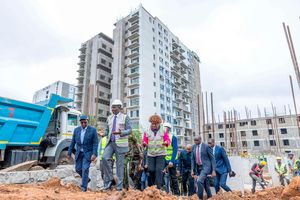
President William Ruto addresses wananchi after inspecting the Limuru Affordable Housing Project in Kiambu County on August 10, 2025.
Photo credit: PCS
The Supreme Court's ruling was a significant win for the government and meant that the contentious levy would continue to be collected.
The levy had also been challenged in 2024 through another case, which was a consolidation of six petitions led by Dr Magare Gikenyi, questioning legality of the Affordable Housing Act, 2024 but the same was dismissed by the High Court in a verdict dated October 22, 2024.
The court dismissed the petition, finding that the Affordable Housing Act was lawfully enacted and that the housing levy was a valid taxation measure within the government’s constitutional mandate.
Dr Gikenyi immediately moved to the Court of Appeal over this judgement, maintaining that it is unconstitutional and ought to be quashed.
However, the levy is facing a fresh legal challenge anchored on claims that the President has turned the housing units into a political tool to woo voters ahead of the 2027 General Election.
The case comes less than two years to the elections with presidential campaigns already underway and President Ruto's quest for a second term facing increased opposition from various political leaders led by his former deputy Rigathi Gachagua.
"The mandatory housing levy by Kenya Kwanza regime is driving Kenyans deeper into poverty while being repurposed as a political tool to woo voters," says the civic organizations led by the Kenya Human Rights Commission.
They contend that the housing levy deduction has overburdened payslips, pushed Kenyans into poverty, and the housing projects funded by the contentious tax are being used for political favours.
Though the main purpose of the levy was to address the country's housing shortage, stimulate economic growth and create jobs, the petitioners argue the President has since turned the project to a political reelection vehicle, while the salaried workers being compulsorily deducted the funds are not direct beneficiaries of the houses.
The petition was triggered by President Ruto's recent announcement that 20 per cent of the government houses, about 34,000 units from 170,000 ongoing projects, would be allocated to teachers.
This followed a meeting between leaders of teachers' associations at State House Nairobi in mid September. The deal was formalized through a Memorandum of Understanding.
In August the President Ruto had also announced that the government would subsidize half the cost of two-bedroom houses for Harambee Stars players during the CHAN football tournament.
Earlier in June, the President directed that another 20 percent of the housing units be given to members of the disciplined forces, including the Kenya Defence Forces and the police.
This effectively leaves a balance of 60 per cent to be sold to interested home owners. The civil society groups have argued that these directives were made without the approval of Affordable Housing Board or public tendering.
“These acts suggest misuse for political patronage ahead of the 2027 elections,” the petition says.
Disputing President's pronouncements that construction of the government houses has reduced unemployment and expanded the housing sector, the petitioners contend that data from the Kenya National Bureau of Statistics (KNBS) 2024 Economic Performance report does not support President Ruto's arguments.
Evidence from the KNBS shows that construction sector, central to housing delivery, contracted by 0.7 percent in 2024, reversing a three per cent growth in 2023. KNBS attributes the downturn to higher costs of input, reduced private investment, and the levy’s drain on household spending.
President William Ruto during the handover of 1,080 homes built under the Affordable Housing Programme in Mukuru, Nairobi on May 20, 2025.
Photo credit: PCS
Cement consumption fell by 7.2 percent to 8.5 million tonnes, the steepest drop in two decades, while steel imports dipped 12 percent. Employment in construction shrank 4.2 percent, contrary to claims by the government that the levy is creating jobs.
"More than a third of Kenyans live below the poverty line, with food inflation and stagnant wages eroding household incomes," says the petitioners.
The petitioners -KHRC, Transparency International Kenya, The Institute for Social Accountability, Inuka Kenya Ni Sisi! and Siasa Place - describe the levy as "socially retrogressive".
"It unfairly targets salaried workers already weighed down by statutory deductions," they argue.
Two individuals named John Maina and Marshalls Ongaya in their case have told the court that the President's actions are entrenching discrimination.
"Millions of Kenyans who contribute to the housing levy and other public funds have not been afforded equal opportunity to access the housing programme, thereby creating inequality contrary to Article 27 of the constitution," reads the petition.
Allocation of affordable housing units
They want the court to issue a declaration that the right to housing under article 43 of the constitution applies equally to all Kenyans and cannot be ring-fenced to specific groups, without lawful justification.
They also want the court to compel the Affordable Housing Board to design and publish a transparent, inclusive and non-discriminatory allocation of criteria for affordable housing units.
"The actions of the President amount to usurpation of the mandate of the Affordable Housing Board, which under the Affordable Housing Act, 2024, has the authority to manage and oversee the allocation of the units," they state.
The Attorney-General is yet to file government response in court to the petitioners' claims though in previous cases, the Treasury defended the levy as necessary for economic growth and job creation.
The housing levy is among several government policies facing legal hurdles as Kenya’s human rights organizations, activists and individual citizens continue challenging the ambitions of President Ruto’s administration.
Observers says this signals a robust check on the executive power, a development that has gone well with government.
At some point in January 2024 President Ruto accused the Judiciary of frustrating his programs and reforms. The outbursts stemmed from several rulings against the government.
Early this month two petitions were lodged in court challenging President Ruto's establishment of a team -Panel of Experts on Compensation of Victims of Demonstrations and Public Protests - to develop a framework for compensating victims of protests and demonstrations.
The panel has since been stopped by court from carrying out the exercise pending determination of case, though team has since lodged an appeal against the conservatory order.
Similarly, the government is entangled in a legal dispute over its policy on compulsory use of the contentious electronic Government Procurement System (e-GPS) by all public entities. The case was filed two individuals and the Council of Governors against the National Treasury.
The e-GP system was part of the International Monetary Fund (IMF)-backed reforms to streamline government procurement.
Still at the National Treasury, a legal dispute is ongoing over the government’s decision to use road maintenance levy funds as collateral for a Sh175 billion loan from the African Development Bank, Trade and Development Bank, and United Bank for Africa.
Legality of the health laws
Two citizens want the decision nullified on grounds that the the being borrowed was not in the annual budget.
Last month two petitions were filed asking court to examine legality of the Presidential Multi-Agency Team on the War Against Corruption (MAT-WAC). The court suspended implementation of the Presidential proclamation pending the hearing of the constitutional petition.
The government is also embroiled in another case involving mandatory contribution of workers to the Social Health Insurance Fund (SHIF) scheme.
The dispute concerns legality of the health laws -Social Health Insurance Act, 2023, the Digital Health Care Act, 2023 and the Primary Health Care Act, 2023 -and is pending determination in two separate cases at the High Court and the Court of Appeal.
Recently, on September 10 the High Court quashed the government's plan to reform the mining sector through introduction of new regulations to govern the sector and raising of application fees for large-scale prospectors and miners nine-fold from Sh50,000 to Sh500,000 for some minerals.
The judgment potentially denied the government millions of shillings in form of anticipated revenues from royalties, licences and taxes on mineral extraction as the applicable rules will those in the previous legal regimes.
The court said the Mining Regulations 2024, which comprised five key regulations, were unconstitutional as the principle of public participation was not complied with during the regulation's enactment.
Legal experts say these cases reflect growing scrutiny of executive decisions ahead of the 2027 elections.