The National Transport and Safety Authority (NTSA) has cautioned women against sitting sideways while riding on boda bodas.
Officials from the road safety agency stated that this style of sitting increases the chances of sustaining serious injuries in the event of an accident.
For decades, most women have adopted one style of sitting while riding a motorcycle as passengers. Their legs rest on one side of the bike, and this tradition has persisted for generations.
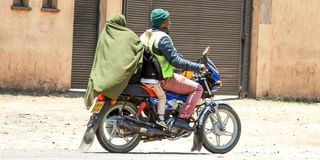
A boda-boda rider ferries a passenger in Eldoret town, Uasin Gishu County.
Photo credit: File | Nation Media Group
Instead of facing the direction in which the motorcycle is moving, they either face left or right, depending on their choice.
Some argue that this sitting style is modest, especially for women who wear skirts. However, road safety experts caution against using this posture.
South Nyanza NTSA Manager Adan Adow explained that riding a motorcycle involves a lot of physics. He clarified that objects and machines such as motorcycles have centers of gravity —the average point where an object's weight is concentrated. The center of gravity is the point where the object is balanced in all directions.
"Should someone interfere with the center of gravity, the machine can fall. When riding a motorcycle, weight should be equally distributed," he said.
The NTSA official stated that it is easier for a passenger to help a boda boda operator maintain the center of gravity when seated directly behind the rider and facing forward with both legs on either side of the motorcycle.
He added that a passenger positioned sideways is also more likely to sustain severe injuries in motorcycle crashes.
"When an emergency brake is applied, a passenger on a motorcycle is likely to lose balance and fall either backwards or forwards," Mr Adow said.
Studies have found that sudden braking often causes side-saddle passengers to be ejected or slide off because they cannot anchor themselves effectively.
Such passengers often lack secure handles or properly positioned footrests and are more vulnerable to loose garments becoming entangled in the motorcycle’s wheels.
The sitting position is one of several safety requirements that the NTSA is advocating for when riding boda bodas.
The agency also emphasises the importance of passengers wearing helmets while riding motorcycles, which is a key safety precaution outlined in the Traffic Act.
"Riders are supposed to carry only one passenger," Mr Adow said.
The NTSA official spoke when he met staff at the Huduma Centre in Homa Bay ahead of the World Day of Remembrance for Road Traffic Victims, marked on Sunday. He expressed concern about the high number of traffic accidents.
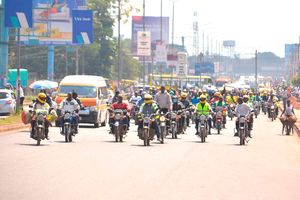
A boda-boda rider ferries a woman and a child in Ngara, Nairobi.
Photo credit: Evans Habil | Nation Media Group
According to the NTSA, the country recorded 4,748 road traffic fatalities in 2024, a significant increase from the previous year's figure of 4,513 deaths. The agency recorded more than 10,000 injuries during the same period.
Mr Adow noted that this data only represents what was reported, as there are cases that never reach the agency.
“We encourage road users to be responsible because safer roads start with you. Always be careful and exercise self-control,” the NTSA official said.
He pointed out that accidents mostly affect vulnerable groups such as pedestrians, who make up 40 per cent of fatalities. Boda boda riders and their passengers are also affected by traffic accidents.
"We must reach out to the public to ensure we disseminate information on road safety. Pedestrians are vulnerable because their first contact in an accident is their bodies, unlike people in vehicles who are in cabins that may offer some protection," Mr Adow said.
During the meeting, officials from different ministries were informed about various traffic rules and how they can share them with others.
The NTSA also pointed out that placing children on the steering wheel and using mobile phones while driving are major causes of traffic accidents.
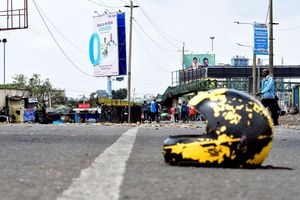
Boda boda riders protest in Kisumu on August 25, 2025. Police linked violence to a bitter rivalry between two groups fighting to control Kisumu’s Bus Park and the boda boda sector.
Photo credit: Alex Odhiambo | Nation Media Group
Last month, the agency partnered with the Kenya National Highways Authority (KeNHA) and Go Beyond Limited to raise awareness about mental health on the road.
KeNHA Nyanza Regional Director Julius Mak'Oderoh noted that studies have found that many accidents occur because the people involved are not in a good mental state.
“Human factors play a major role in traffic accidents. It is not just the road design as some people might think,” he said.
According to the KeNHA official, up to 80 per cent of accidents are caused by people who are preoccupied with other issues while on the road.
“The mental well-being of road users should be stable for them to be safe. Everyone should take responsibility for ensuring their mental health is in good condition before using the road,” Mr Mak'Oderoh said.
Mental health issues can lead to accidents by impairing concentration, slowing reaction times, and affecting judgment and decision-making.
Sometimes, conditions like depression and anxiety can increase the risk of injury and accidents by altering cognitive function, increasing distraction, and affecting the ability to make judgments about when to overtake or cross the road.
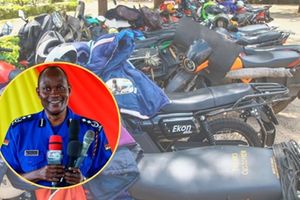
Motorbikes belonging to boda boda operators.
Photo credit: File | Nation Media Group
Go Beyond Limited Chief Executive Officer Damaryce Ndira stated that her organisation runs a program called "Walk and Talk," which is a collaborative platform used to promote mental wellness.
The organisation also promotes an initiative called "Safari Salama," spearheaded by KeNHA.
“Our mandate is to engage the public on behavioral change and promote safe road use. A shift in mindset and behavior change is closely related to mental health,” Ms Ndira said.