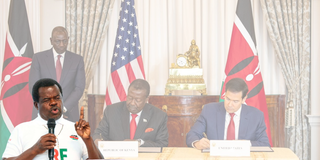
Busia senator Okiya Omtatah has moved to court to block the implementation of a multibillion-dollar health deal signed between Kenya and the USA on December 4.
The Kenya–United States Health Cooperation Framework was signed on behalf of Kenya by Prime Cabinet Secretary Musalia Mudavadi and witnessed by President William Ruto.
The framework is a binding bilateral arrangement committing approximately $1.6 billion (about Sh208 billion) over a period of five years to Kenya’s health sector, to support universal health coverage.
US Secretary of State Marco Rubio and Kenyan Foreign Cabinet Secretary Musalia Mudavadi sign the US-Kenya health pact as President William Ruto looks on.
Photo credit: PCS
Mr Omtatah, however, says the process leading to the signing of the Framework, the reported nature of its commitments, and its integration into Kenya’s public finance and health governance systems violate express provisions of the constitution and the law, thereby undermining national sovereignty, the principle of public participation, and the constitutional right to the highest attainable standard of health.
“The petitioner is aggrieved that the decision to endorse and sign this Framework was executed unilaterally by the Executive, without parliamentary oversight, public consultation, or transparent fiscal impact assessment,” Mr Omtatah said.
The Busia senator says the deal was negotiated and executed in violation of the constitutional principles of public participation, transparency, and accountability.
This is a second petition challenging the deal after Consumer Federation of Kenya (Cofek) sought conservatory orders, stopping the implementation of the framework, pending the determination of the case.
Busia Senator Okiya Omtatah speaks to journalists during a press conference at Taj Towers in Nairobi on July 12, 2025.
Photo credit: Bonface Bogita | Nation Media Group
Mr Omtatah further said the creation of a major extra-budgetary funding stream for the health sector outside the framework of the Public Finance Management (PFM Act, 2012) is unconstitutional.
He is further seeking a declaration that the Framework constitutes a treaty or international agreement requiring ratification by Parliament under Article 132(4) of the Constitution and the Treaty Making and Ratification Act.
“An Order of Prohibition restraining the Respondents, their agents, servants, assigns, or any person acting under their authority, from implementing, operationalizing, disbursing any funds under the Framework including the purported US$1.6 billion commitment over five years, or taking any step whatsoever to give effect to the said Framework,” Mr Omtatah stated in an affidavit supporting the petition.
Mr Omtatah pointed out that the objectives of the Framework include the supply of medical equipment to hospitals, delivery of health commodities, upscaling of the health workforce and expansion of health insurance coverage.
He said he is opposed to the move as it exemplifies executive overreach, potentially exposing public health resources to inefficiency, corruption, and conditionalities that prioritise foreign policy alignments over domestic needs.
In its petition, Cofek has also sought an order blocking the government of Kenya from transferring or sharing medical or epidemiological data to the USA or any of its agencies or representatives, pending the hearing and determination of the case.
The lobby said it has reasons to believe that the government has already commenced operational steps toward implementing the Framework, including preparation of data-exchange mechanisms and institutional arrangements that could imminently activate the transfer of Kenyan citizens’ sensitive medical information to the USA.
Cofek said the execution and operationalisation of the Framework occurred without compliance with the Data Protection Act, the Digital Health Act, the Health Act, and the Digital Health (Data Exchange Component) Regulations, 2025, all of which require stringent safeguards before any transfer of health data to a foreign entity.
The lobby further said the Framework requires Kenya to share extensive medical and epidemiological data, including information on HIV/AIDS, TB, malaria, maternal health and disease surveillance.
“Such data consists of sensitive personal information belonging to millions of Kenyans and forms part of the country’s strategic health-security infrastructure. The agreement therefore directly implicates individual privacy rights and national sovereignty,” Mr Stephen Mutoro said in an affidavit.
He further said that despite its significant implications, the Framework was not subjected to the constitutional principles of good governance under Article 10 of the Constitution.
“This omission occurred even though the agreement involves cross-border transfer of sensitive health information and touches on national-security interests. By failing to adhere to the values of accountability, transparency, public participation, and integrity in governance, the Respondents acted contrary to Article 10. The process was therefore opaque and constitutionally improper,” he said.
The lobby said the government was preparing to operationalise the Framework, including activation of data-exchange systems with USA entities.
Mr Mutoro says this creates an imminent risk of disclosing sensitive health data in violation of Article 31 of the Constitution and the Data Protection Act.
“The impending transfer has not been preceded by adequacy assessments, lawful safeguards or compliance with statutory conditions. The threatened disclosure is therefore both unlawful and unconstitutional,” the consumer lobby group said.
Mr Mutoro added that once Kenya’s medical and epidemiological data is transferred abroad, the harm becomes permanent and irreversible and that the court or Kenyan regulators will not have the power to recall, restrict or oversee the foreign use of such data.
“This exposes citizens to lasting privacy violations, stigma and potential misuse of their information. The irreversible nature of the harm elevates the urgency of the matter,” he said.
He alleged that Kenyans will thereafter face a real risk of discrimination, stigma, profiling and misuse of their private health information, all of which constitute grave violations of their constitutional rights and national health-security interests.
“I verily believe that the actions of the Respondents amount to procedural impropriety, illegality, unreasonableness and opacity, thereby justifying immediate intervention by this Honourable Court to avert irreparable harm,” Cofek said.