The Judiciary has scored a first by publishing data on the number of cases that judges and magistrates decided on in the year ended June 2026.
In a matter that drew controversy due to a stop order that was issued by the High Court on Thursday then vacated by the same judge on Friday morning, this year’s “The State of the Judiciary and the Administration of Justice” named names and put figures.
The 328-page report also outlined performance of the individual judicial officers, listing the number of decisions they made over the period. The decisions comprise judgments, rulings and other resolutions they handled during the year.
The Judiciary, however, warned that this was in no way an effort to rank the judges.
“The figures are a basis for understanding performance and for dialogue. They are not a standalone ranking of individual judges, judicial officers, Kadhis or adjudicators,” said a section of the report.
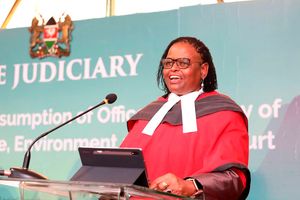
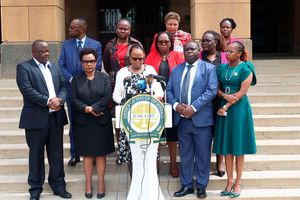
CJ Martha Koome releases state of the Judiciary report at the Supreme Court
At the High Court, Justice Reuben Nyakundi recorded the highest total of matters decided with 1,791 cases. These comprise 170 judgments, 825 rulings closing cases, 555 interlocutory rulings and 241 other resolutions.
He was followed by Justice Alfred Mabeya, who decided 968 matters, comprising 160 judgments, 279 final rulings, 63 interlocutory rulings and 466 other resolutions.
After Justice Mabeya was Justice Teresa Odera, who recorded 956 decisions, followed by Justice Richard Mwongo with 913.
Justice Teresia Matheka pronounced herself on 906 matters, while Justice Kizito Magare had 904.
The next four among the 10 highest totals were Justices Diana Kavedza who decided 824 cases, Mwanaisha Saida (778), Lucy Gitari (745), while Helene Namisi and Florence Muchemi tied at 744 each.
Justice Reuben Nyakundi.
Photo credit: Jared Nyataya | Nation Media Group
At the Court of Appeal, the report says 2,394 matters were determined by appellate benches, comprising 1,094 judgments, 149 final rulings, 363 interlocutory rulings and 788 other resolutions.
At the Kisumu Court of Appeal – a bench comprising Justices Hellen Omondi, Luka Kimaru and Milton Makhandia – recorded the highest output with 172 cases, while the Mombasa bench comprising Justices Grace Ngenye, Kibaya Laibuta and Agnes Murgor decided on 100 cases.
In Nairobi’s Civil Division, a bench of Justices Mumbi Ngugi, George Odunga and Daniel Musinga recorded 49 matters, while the Malindi bench of Justices Grace Ngenye, Kibaya Laibuta and Agnes Murgor handled 37.
At the Eldoret Court of Appeal, the bench of Justices Linnet Ndolo, Weldon Kipkorir and Paul Gachoka recorded 34 decisions, while another bench comprising Justices John Mativo, Weldon Kipkorir and Paul Gachoka applied its mind on 13 matters.
At Kakamega, Justices Stephen Radido, Rachel Ngetich and Pauline Nyamweya jointly handled 26 matters, while a panel of Justices Abida Ali-Aroni, Rachel Ngetich and Pauline Nyamweya recorded one.
The Meru station had two listed panels: Justices Odunga, Hedwig Ong’udi and Stephen Kairu handled eight matters, while Justices Ong’udi, Stephen Kairu and Munyao Sila recorded two.
The Court of Appeal schedule, however, captures only matters decided upon by individual judges under their single-judge jurisdiction, not the full number of appeals they determined as members of panels.
Justice Luka Kimaru recorded the highest number, with 75 matters, followed by Justice John Mativo with 62 and Justice Abida Ali-Aroni with 60. Justices Milton Makhandia and Hellen Omondi recorded 58 and 55 matters respectively, while Justice Sankale Ole Kantai handled 48.
The other four among the 10 highest were Justices Daniel Musinga and Mohamed Warsame (now a Supreme Court judge), with 39 each, Mumbi Ngugi with 37 and Paul Gachoka with 34.
Justice Daniel Musinga.
Photo credit: Dennis Onsongo | Nation Media Group
The figures, the Judiciary said, are recorded outputs, not a formal ranking of judicial performance. The report does not assess the quality or complexity of the decisions, and one case may generate several rulings.
It also notes that some judges served for only part of the year or carried administrative responsibilities. Court of Appeal decisions made by panels, it said, are reported separately and cannot be attributed to individual judges.
The report also outlines the decisions made by judges at the special divisions: the Environment and Land Court (ELC) and the Employment and Labour Relations Court (ELRC).
At the ELRC, Justice Jemimah Keli recorded the highest output with 499 decisions, followed by Justice Monica Mbaru and Justice Stella Rutto, who each handled 484. Justice Kebira Ocharo recorded 476, while Justice Hellen Wasilwa handled 421.
The other judges among the ten highest were Christine Baari with 358, Nzioki Wa Makau (356), Maureen Onyango (342), Onesmus Makau (336) and Bernard Matanga (335).
In the ELC, Justice Emmanuel Washe decided 456 matters, followed by Fred Nyagaka (455), David Mugo (442) and Christopher Nzili (428).
Other fast fingers in the court included Joseph Oguttu with 386, Charles Mbogo (383), Evans Makori (377), Mohamed Kullow (356), Anne Yatich (351) and Grace Kemei with 350.
Whereas it wasn’t a ranking, the numbers told a story of sharp disparities in delays across court stations and among judicial officers, with some clearing cases faster while others carry heavier backlogs and leave litigants waiting longer for justice.
A case is classified as backlog when it remains unresolved for more than one year after being filed in court.
The report said there 561,580 new cases in the period under review and 576,702 resolutions, a 103 per cent clearance rate. The courts therefore resolved 15,122 more cases than they received during the year.
Chief Justice Martha Koome attributed this clearance rate to improved case management and targeted backlog-reduction initiatives.
However, the reduction in the overall pending caseload did not mean that old cases had been cleared. The backlog fell from 405,486 cases to 341,412, a reduction of 64,074 cases, or 15.8 per cent.
The remaining backlog accounted for 58.9 per cent of all pending cases. Of these, 175,360 had remained unresolved for more than three years, including cases that had been in court for over five years.
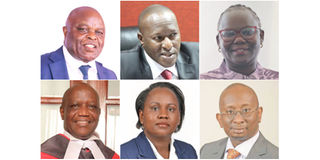
Top from left: Bottom from left:
CJ Koome acknowledged that, despite the Judiciary resolving more cases than were filed for the second consecutive year, the gains had not sufficiently addressed the backlog.
She warned that the figures exposed continuing pressure on the courts, particularly amid shortages of judicial staff.
“Nevertheless, we must recognise that these positive aggregate results do not tell the whole story. As at June 30, 2026, 341,412 pending cases, representing approximately 59 per cent of the pending caseload, had remained unresolved for more than one year,” she said.
The magistrates’ courts carried the largest share, with 274,177 backlog cases. This represented 80.3 per cent of the national total. The High Court followed with 40,673 cases, while the Environment and Land Court had 11,942 and the Court of Appeal 7,322.
The figures show that the pressure is concentrated in courts handling large volumes of disputes. Magistrates’ Courts had 444,107 pending cases, while the High Court had 69,239.
At the High Court level, Nyeri recorded a 148 per cent clearance rate, resolving 992 cases against 672 filed. Its backlog fell from 960 cases to 691, a reduction of approximately 269 cases.
Nyeri’s average time to dispose of a case was nevertheless 1,423 days, or nearly four years. The figure illustrates that resolving more cases than a station receives does not necessarily mean that litigants are getting decisions quickly.
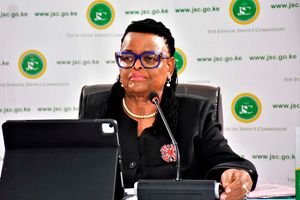
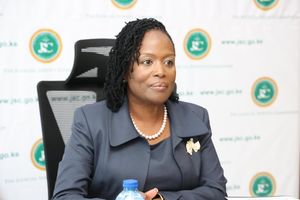
Chief Justice Martha Koome.
Photo credit: File | Nation Media Group
Nyamira also performed above the 100 per cent clearance mark, resolving 564 cases against 503 filed. Its backlog fell from about 146 cases to 131, a reduction of 15 cases.
Other stations such as Nyahururu High Court moved in the opposite direction. It resolved 369 cases against 454 filed, representing an 81 per cent clearance rate. Its backlog, however, increased from 106 cases to 206, a rise of 100.
Kwale High Court resolved 690 cases against 886 filed, a clearance rate of 78 per cent. Its backlog rose from about 355 cases to 497, an increase of 142.
Garsen resolved 413 cases against 555 filed, a 74 per cent clearance rate, while its backlog increased by 59 per cent to 227.
Kajiado also struggled, resolving 642 cases against 880 filed. Its backlog rose by 15 per cent to 1,068. At Kwale, the court resolved 357 cases against 452 filed, with its backlog increasing by 86 per cent to 188. These examples show how stations that resolve fewer cases than they receive can accumulate older disputes.
There were also stations that performed better. Nyamira cleared 564 cases against 503 filed, achieving a 112 per cent clearance rate. Its backlog fell by 10 per cent to 131. Kisii resolved 1,228 cases against 1,044 filed, while its backlog declined by 19 per cent to 736.