The courts handled more than 15,000 cases involving children in the 2025/26 financial year, with the bulk relating to custody, guardianship, maintenance and other matters concerning their welfare and protection.
The latest State of the Judiciary and Administration Annual Report (SoJAR) shows that courts received 15,272 cases involving children during the year, comprising 14,200 cases that involved children in contact with the law and 1,072 involving children in conflict with the law.
Children in contact with the law include those who appear before courts as victims, witnesses or parties in family and care proceedings, while those in conflict with the law are children accused of committing offences.
The figures underscore the significant role played by courts in protecting children and ensuring that those who enter the justice system are treated fairly, safely and in a manner that takes into account their age, welfare and developmental needs.
Of the cases received, those involving children in contact with the law accounted for approximately 93 per cent, while cases involving children in conflict with the law made up seven per cent.
The report shows that courts resolved 16,010 child-related cases during the year, exceeding new filings by 738 cases.
Of these, 15,029 involved children in contact with the law, while 981 concerned children in conflict with the law.
This means courts resolved more cases than were filed in the category involving children in contact with the law. However, in cases involving children in conflict with the law, 1,072 were filed against 981 resolved.
The report says most children's cases handled by the courts related to family welfare, care and protection rather than criminal proceedings.
Guardianship, custody, maintenance, care and protection, and adoption accounted for a substantial share of the caseload, reflecting the courts' role in safeguarding children's rights and determining their best interests.
High Court has declined to stop the execution of an order requiring a retiree to share his pension income with his former lover for the maintenance of their children.
Photo credit: Shutterstock
Criminal cases involving children accounted for a smaller proportion but remained an important part of the justice system, requiring interventions that take into account the circumstances of young offenders and promote rehabilitation.
The report also identifies defilement and stealing among the offences involving children in conflict with the law, with boys accounting for 99 per cent of those involved in defilement cases and 83 per cent in stealing cases.
The Judiciary says the volume and distribution of children's cases across court stations demonstrate the need for child-sensitive procedures that protect their rights and welfare while ensuring timely resolution of disputes.
It adds that every child entering the justice system, whether as a victim, witness, party in care proceedings or accused person, should be handled in a manner that recognises their particular needs.
Meanwhile, the Judiciary is increasingly using alternative dispute resolution mechanisms to ease pressure on courts and provide parties with faster, cheaper and less adversarial ways of settling disputes.
Article 159(2)(c) of the Constitution requires courts and tribunals to promote alternative forms of dispute resolution, including reconciliation, mediation, arbitration and traditional dispute resolution mechanisms.
The Judiciary implements this mandate mainly through Court-Annexed Mediation (CAM) and Alternative Justice Systems (AJS).
Under Court-Annexed Mediation, judges and magistrates refer suitable disputes to accredited mediators for settlement outside the conventional court process.
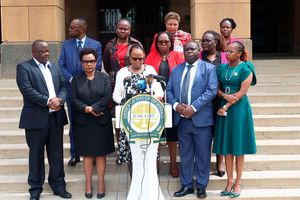
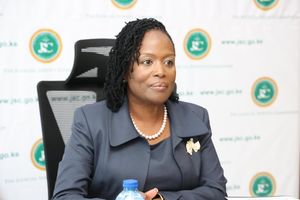
CJ Martha Koome releases state of the Judiciary report at the Supreme Court
Alternative Justice Systems, on the other hand, recognise community-based and traditional mechanisms of resolving disputes and link them to the formal justice system.
The mechanisms are particularly useful in disputes involving family members, neighbours, business partners, and employers and employees, where maintaining relationships may be as important as resolving the immediate disagreement.
During the 2025/26 financial year, a total of 2,780 matters were recorded under Alternative Justice Systems, of which 2,107 were resolved, representing a case clearance rate of 76 percent.
Magistrates' Courts accounted for the largest share of matters recorded and resolved under the system.
Walk-in matters, where parties directly approached the alternative justice mechanisms without being referred by a court, recorded a clearance rate of 91 percent.
The Judiciary says this demonstrates that AJS is gaining traction not only through court referrals but also as a direct avenue through which members of the public can seek justice.