The Judiciary resolved more cases than were filed for the second consecutive year, but persistent staffing shortages, inadequate court infrastructure and a Sh12.95 billion funding gap continue to undermine efforts to improve access to justice.
Chief Justice Martha Koome said the latest State of the Judiciary and Administration of Justice Report (SOJAR), covering the 2025/2026 financial year, will show measurable progress in case resolution and expansion of court services, while exposing institutional weaknesses that require urgent attention.
The report, which will be unveiled on Friday, shows that the Judiciary resolved 576,702 cases against 561,580 filed during the year, representing a case clearance rate of 103 per cent.
The pending caseload declined by 2.5 per cent, from 595,076 cases to 579,954.
For the second year running, the Judiciary managed to clear more cases than were filed, an achievement Justice Koome attributes to ongoing reforms aimed at expanding access to justice, improving efficiency and strengthening institutional capacity.
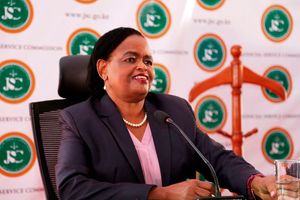
Chief Justice Martha Koome.
Photo credit: Billy Ogada | Nation Media Group
However, the gains are being made against a backdrop of financial constraints that threaten to slow down the pace of reforms.
Although the Judiciary's budget increased to Sh27.15 billion, it accounted for only 0.93 per cent of the national budget, leaving a funding gap of Sh12.95 billion.
The Chief Justice says the shortfall continues to affect the institution's ability to recruit adequate personnel, construct courtrooms, expand its geographical footprint and invest in technology.
This year's report, themed Expanding the Judicial Footprint and Strengthening Capacity for Effective Justice Delivery, will also assess the Judiciary's performance as the country prepares for the 2027 General Election, when courts are expected to handle disputes arising from electoral processes.
SOJAR is the Judiciary's annual accountability report, providing an account of how the institution has discharged its constitutional mandate, the performance of courts and tribunals, reforms undertaken, challenges encountered and resources required to strengthen the administration of justice.
Justice Koome said the report is more than a statutory obligation, as it allows Kenyans to assess whether the justice system is delivering on its constitutional promises.
Its foundation is Section 5(2)(b) of the Judicial Service Act, which requires the Chief Justice to prepare and publish an annual report on the state of the Judiciary and the administration of justice and submit it to Parliament.
The obligation is also anchored in Articles 1 and 159 of the Constitution, which establish that sovereign power belongs to the people and judicial authority derives from them.
"These provisions place the Judiciary under an obligation to exercise its authority responsibly and accountably. Although judicial independence protects Judges and Judicial Officers from improper interference in their adjudicative functions, it does not exempt the institution from accountability for its performance, administration or stewardship of public resources," the CJ said.
Parliament Buildings in Nairobi. Court found that a former Principal Sergeant-at-Arms was subjected to an excessively delayed disciplinary process by the Parliamentary Service Commission.
Photo credit: File | Nation Media Group
Through the report, Parliament also gets an opportunity to scrutinise the state of justice delivery, appreciate the Judiciary's institutional needs and make informed decisions on legislative reforms and resource allocation.
Despite the improved case clearance rate, the report reveals that 341,412 cases, representing approximately 59 percent of all pending matters, had remained unresolved for more than one year by the close of the financial year.
Of these, 190,779 cases resolved during the year had been pending for more than one year, including 37,757 that were more than five years old.
The CJ pointed out that at least 101 constituencies still have no Magistrates' Courts, while 69 per cent of court stations lack adequate courtrooms.
The institution had 8,017 employees against an approved establishment of 12,079, representing a staffing level of approximately 66 per cent.
CJ Martha Koome releases state of the Judiciary report at the Supreme Court
To address geographical barriers, Justice Koome said the Judiciary established two new Court of Appeal stations in Kakamega and Meru and also operationalised the Eldoret station.
The Judiciary also established five additional Magistrates' Courts, bringing their total to 148, while Small Claims Courts expanded to 55 stations.
The expansion is intended to bring judicial services closer to communities and reduce the cost and inconvenience associated with accessing courts.
Technology has also become an important component of the reforms, with initiatives such as Mahakama Popote allowing the virtual redistribution of cases across court stations.
The Judiciary is also increasingly turning to alternative dispute resolution mechanisms to ease pressure on conventional courts.
Justice Koome said Alternative Justice Systems (AJS) and Court-Annexed Mediation are gaining acceptance as Kenyans embrace less costly and time-consuming ways of resolving disputes.
The multi-door approach is anchored in Article 159(2)(c) of the Constitution, which requires courts and tribunals to promote alternative forms of dispute resolution, including reconciliation, mediation, arbitration and traditional dispute resolution mechanisms.
During the financial year, the Judiciary established 42 additional mediation registries, bringing the total to 128 and extending the programme to all 47 counties.
The report records 9,843 referrals to mediation, an increase of approximately 50 per cent from the previous year. Of the matters concluded, 5,418 resulted in full or partial agreements or consents.
The economic impact has also been significant. Disputes valued at approximately Sh20.88 billion were referred to mediation, with settlements covering Sh13.05 billion reached without the need for full trials.
AJS mechanisms were operational in 29 court stations, while 14 counties had developed county action plans.
The report records 2,780 matters handled through AJS, of which 2,107 were resolved, translating to a clearance rate of 76 per cent.
CJ Koome says the objective is not to replace formal courts but to give Kenyans multiple accessible and constitutionally compliant avenues for resolving disputes.
She, however, acknowledges that the mechanisms require stronger institutional support, sustainable financing, capacity building and public awareness to reach more people.
The report added that it will also detail the Judiciary's efforts to address corruption and strengthen public confidence in the institution through its partnership with the Ethics and Anti-Corruption Commission (EACC).
The collaboration has focused on identifying weaknesses in court operations that create opportunities for corruption and improving systems to minimise manipulation, extortion and interference with court processes.
An EACC monitoring exercise on the implementation of recommendations arising from an earlier examination of court registry operations established that the Judiciary had made substantial progress.
The measures include automation of registry processes, expansion of electronic filing, integration of court fee assessments into the Case Tracking System, improved staff identification practices and stronger financial controls through the Jumuika Enterprise Resource Planning system.
The Judiciary is also strengthening internal accountability mechanisms through disciplinary proceedings against judicial officers and staff.
During the year, the Judicial Service Commission handled 259 petitions against Judges, of which 168 were concluded. Sixteen disciplinary cases were initiated against Judicial Officers, including three involving allegations of corruption or bribery. Seven of the disciplinary cases were concluded.
Among Judiciary staff, 80 disciplinary cases were handled, of which 27 were concluded. Twenty involved allegations of soliciting or receiving bribes, while 13 concerned tampering with or falsification of court records.
Justice Koome cautions that the disciplinary figures cover the Judiciary's wider accountability processes and should not be mistaken for investigations or prosecutions arising specifically from the EACC partnership.
The report does not provide a separate consolidated tally of EACC-led investigations, criminal prosecutions or convictions attributable to the collaboration.
She said the fight against corruption must go beyond investigations and disciplinary action to address institutional weaknesses that create opportunities for wrongdoing.
The Judiciary has consequently strengthened Court Integrity Committees, complaints-handling mechanisms through the Office of the Judiciary Ombudsman, registry controls and public reporting channels.
"There is no place for corruption, bribery, favouritism or any form of misconduct in the Judiciary. No Kenyan should be required to pay a bribe to access justice or obtain a service to which they are entitled," she says.
The Chief Justice said the ultimate objective is to build a justice system founded on integrity, fairness, transparency and public trust.