Kenya's 2027 election has produced a situation that would be remarkable if the stakes were not so high: an incumbent president whose approval has eroded sharply, but who faces an opposition that has a genuine opening and still cannot agree on who walks through it.
President William Ruto enters the final stretch of his first term with a coalition held together more by political co-optation than shared conviction, an impeached former deputy president prowling his backyard with a grievance and a megaphone, and a generation of new voters politicised not by his vision but by a Finance Bill his government tried to pass over their protests.
His rivals, meanwhile, have spent the better part of a year debating nine criteria for selecting a joint candidate, produced two unregistered formations, five jostling principals, and precisely zero consensus.
While the principals maintain a public image of infallibility, insiders in the coalition are deeply worried that settling on a joint candidate is the real acid test for a loose arrangement that is less a coalition than a parliament of competing ambitions.
The opposition is currently operating in two distinct but unregistered formations — the United Alternative Government, housing Kalonzo Musyoka, Mr Gachagua, Martha Karua, Eugene Wamalwa and George Natembeya, and Linda Mwananchi, where Nairobi Senator Edwin Sifuna enjoys the distinction of being considered presidential material while not yet committing to it.
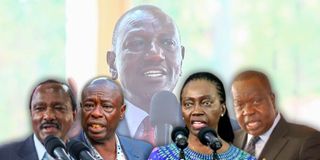
President William Ruto (background) and leaders of the United Opposition (from left) Kalonzo Musyoka, Rigathi Gachagua, Martha Karua and Fred Matiang'i.
Photo credit: File | Nation Media Group
Initial plans for a retreat to settle the candidate question have been shelved several times, with Mr Gachagua warning that unveiling their choice "this early" would expose them to Dr Ruto's missiles, with devastating impacts on that ticket.
And so the dilemma will apparently rise or fall on nine proposed formulas: public participation, scientific research, gender, age and experience, numerical strength in vote blocs, mobilisation skills, financial muscle, integrity and delivery targets, and proven results-oriented leadership. Nine criteria is not a selection process.
It is a negotiation disguised as a methodology, and political scientist Gasper Odhiambo sees it for what it is: "They all appear not to be agreeing behind the scenes to a point that they are individually coming out to prosecute their case in public. That spells conflict."
The contest within the coalition
Each principal, in the meantime, has already identified which of the nine criteria most conveniently produces their own name as the answer.
Mr Gachagua, speaking to the weight mobilisation skills and financial muscle should carry, said: "I consider myself to be the most ideal owing to my mobilisation skill, ability to assemble a war chest, and the benefit of controlling the biggest voting bloc." He added, however, that he was willing to submit to another choice if genuinely convinced it would make winning easier.
Former Deputy President Rigathi Gachagua at Milimani Law Courts on May 13, 2026 for the hearing of his legal challenge against his 2024 impeachment.
Photo credit: Billy Ogada| Nation Media Group
He also revealed the contours of the internal contest: "Mr Musyoka has insisted that he is the most ideal given his age — he is 72 — and experience."
Mr Musyoka, speaking in Nyanza on May 2 to a crowd he needs to persuade he can inherit, made that case directly: "I am the most ideal given that I have an experience of more than 15 years of trying to unseat governments," adding that he can mobilise the departed Raila Odinga's support bases, especially in Nyanza, Coast and Western, thereby bringing national diversity to the contest ticket.
Wiper leader Kalonzo Musyoka addresses the media at SKM Command Centre in Nairobi on December 30, 2025.
Photo credit: Wilfred Nyangaresi | Nation Media Group
What the polling data does not dispute is that Kalonzo's reach has been habitually underestimated. Mizani Africa polling from December 2025 places him at 39.6 per cent nationally — but the regional breakdown is the figure his rivals have not yet fully reckoned with: 42.9 per cent in Nairobi, 40.9 per cent in Rift Valley, 40.7 per cent along the Coast and 34.1 per cent in Mt Kenya, the president's own backyard.
These are not the numbers of a regional chieftain. They are the polling footprint of a moderate, experienced candidate absorbing the protest vote of a public that has given up on the government but not yet settled on an alternative.
Dr Matiang'i prosecutes criteria two, eight and nine — scientific selection, integrity and proven delivery — with the methodical confidence of a man more accustomed to running institutions than campaigns.
Jubilee Party Deputy Party leader Fred Matiang'i.
Photo credit: Ruth Mbula | Nation Media Group
In an interview with the Nation , he said: "The process must be scientific, transparent, inclusive and objective, where it is not about people sitting in a boardroom and deciding."
He was unambiguous about his terms: "Seriousness over political theatre — evidence-based selection that relies on data, regional balance and policy competence over popularity alone." Former President Uhuru Kenyatta, pushing his candidacy, was characteristically direct: "If it is someone who will get the job done, especially in the fight against corruption, that man is Matiang'i — even though I agree he is not a politician."
Jubilee Deputy Secretary General Zack Kinuthia pressed the internal polling case: "It was surprising to us all when seven of ten in Mt Kenya preferred Dr Matiang'i and nine out of ten outside Mt Kenya. It is only in Eastern region that Dr Matiang'i is second to Mr Musyoka."
These declarations have prompted former Starehe MP Maina Kamanda to issue a pointed reminder to Dr Matiang'i — that he should take Jubilee Party to Kisii region and build support there, rather than appear to compete for Mt Kenya with fellow principal Mr Gachagua.
Mr Gachagua, for his part, has already taken exception to Dr Matiang'i's cooperation pact with former Meru governor Peter Munya, calling it "a ploy to divide the Mt Kenya voting bloc for purposes of aiding President Ruto to win his second term" and claiming the divisions are "being sponsored by state mandarins."
Dr Matiang'i has played down the friction with a metaphor that reveals more than it conceals: "As of now we are like a polygamous family with sub-homesteads within the big compound," adding that because the homesteads' heads are in dialogue and negotiation, "all will end well."
Cracks, ambitions and competing visions
On her recent tour of Kirinyaga and Nyeri, she declared: "You should not listen to those who want to posture as superior to others." She added: "We are a union of equals and none is any other's boss. We will sit down, agree on who gets our joint ticket, and from there we start treating that person as our team leader — hopefully that being me, since the country is ripe for a female president."
People's Liberation Party leader Martha Karua speaks at Ambassador Church in Ciagiini village, Kirinyaga County.
Photo credit: George Munene | Nation Media Group
A similar tension is bedevilling DAP-K, where Mr Wamalwa, as party leader, is in an ideological contest with his deputy Mr Natembeya, who has threatened to form his own party if Wamalwa does not sanction urgent structural reforms to give the party "a national appeal as opposed to its current village look."
Mr Natembeya has also called on Senator Sifuna to unite the two formations, arguing the country needs "a behemoth sort of an alliance capable of creating a political implosion on the incumbent." Mr Sifuna, for his part, agrees.
On May 5, he said: "We will form a big movement that will thoroughly beat President Ruto. Our interest is in a candidate of high integrity who will commit themselves to the rule of law, fight corruption, respect institutions, follow meritocracy and unite the country." That candidate, he added, must be "one who cannot do evil for sport" — and the process must be people-centred.
Here is what the data says about the nine criteria, without sentiment. Age and experience — criterion four — is an argument addressed to the political class. The 43 per cent of unaffiliated Kenyan voters tell pollsters their top concerns are corruption, cost of living and accountability — not the accumulated biography of whoever is addressing them.
Numerical strength in vote blocs — criterion five — maps a 2022 electoral geography that is being dismantled by ODM's factional collapse, a party loyalty implosion that has reduced both UDA and ODM to minority forces, and 1.87 million new registrants with no prior political allegiance. Mobilisation skills — criterion six — presupposes inherited networks.
Raila Odinga spent five elections building his, and they were institutionally surrendered the day he joined the Broad-Based Government, their remnants now being contested by two ODM factions in unregistered formations named after competing visions of the same exhausted project.
President William Ruto and Raila Odinga at State House, Nairobi on August 27, 2024.
Photo credit: Photo | PCS
Financial muscle — criterion seven — has never, in the end, decided a Kenyan election. Money activates machinery. It does not build it.
What the nine criteria do not contain — what none of the five principals has yet directly addressed — is the only question the new voters are asking.
Not which of you has the longest experience, or the deepest war chest, or the most scientifically rigorous selection process.
Not which of you can claim the Nyanza inheritance, or hold Ukambani airtight, or bring the Rift Valley home.
The question is simpler and more clarifying than any of that: which of you knows who we are, and is running specifically because of us — not despite us?
The candidate who answers that question first, who looks at the new electorate not as a demographic to be mobilised but as citizens to be genuinely addressed, who builds their campaign language from the streets of 2024 rather than the coalition rooms of 2017, is the candidate who turns President Ruto's political vulnerabilities into an actual defeat at the ballot.
The question that will determine who leads Kenya from 2027 has not yet found its answer. The clock is running, and the new voters — patient, watching, and unimpressed so far by anyone — are still waiting.