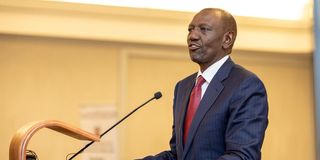
President William Ruto has revamped his Mt Kenya political power structure in a renewed push to secure the region’s support ahead of the 2027 General Election.
This comes amid pressure from his former deputy Rigathi Gachagua, who has sustained a fierce onslaught against the Kenya Kwanza administration across the vote-rich bloc.
The Head of State is utilising a team of politicians, led by his Deputy, Prof Kithure Kindiki, a mix of technocrats, including Cabinet Secretaries, Principal Secretaries, United Democratic Alliance (UDA) party bigwigs, opinion shapers, and regional business moguls, to reengineer his influence.
At the centre of the President’s revamped strategy is his deputy, Prof Kindiki, who has emerged as the anchor of a carefully assembled political and technocratic machine tasked with reengineering the government’s influence in a region that was pivotal to Dr Ruto’s 2022 victory but has lately shown signs of restlessness.
The President’s new approach combines political mobilisation, state-driven development messaging, party reorganisation, and strategic communication, all aimed at rebuilding trust, neutralising dissent, and consolidating gains in the Mt. Kenya counties.
The Head of State, according to insiders, is leveraging on his by-election victories in the region to demonstrate United Democratic Alliance’s (UDA’s) influence amid the growing popularity of Mr Gachagua’s Democracy for the Citizen’s (DCP) Party.
Deputy President Kithure Kindiki addresses a public rally at Mwatate Town in Taita Taveta County.
Photo credit: DPCS
Prof Kindiki, the UDA deputy party leader who has steadily grown in prominence within government ranks, now leads the President’s Mt Kenya “campaign machine”—a role that underscores both trust and political calculation.
His measured style, technocratic demeanour and perceived loyalty have increasingly positioned him as the face of continuity within the administration.
In recent public engagements, the President has openly praised his deputy, a departure from the frosty relations that defined his previous partnership.
During a tour of Murang’a and Tharaka Nithi last weekend, Dr Ruto repeatedly signalled confidence in Prof Kindiki’s leadership, even inviting public endorsement.
“Huyu Profesa anatosha hastoshi?” the President asked crowds, framing his deputy as a dependable organiser capable of steering development.
The endorsement has fueled speculation that Prof Kindiki could be Dr Ruto’s preferred running mate in 2027, particularly as the President navigates delicate negotiations with Orange Democratic Movement (ODM) over a possible pre-election alliance.
Beyond the Deputy President, the President has assembled a team of influential leaders drawn from both elective politics and the executive to spearhead his Mt Kenya strategy.
Kirinyaga Governor Anne Waiguru during an interview at her official residence in Kutus on December 17, 2025.
Photo credit: Evans Habil | Nation Media Group
Kirinyaga Governor Anne Waiguru has emerged as one of the administration’s most articulate defenders in the region.
Having appeared to have taken a sabbatical from active politics, Ms Waiguru has re-emerged, accompanying the Head of State to various functions in the Mt Kenya region.
Ms Waiguru argues that Mt Kenya voters are more interested in policy clarity than political rhetoric, dismissing opposition tactics as insufficient to sway the electorate.
“It is one thing to argue against President Ruto, but Mt Kenya voters need to hear what a future government will deliver programmatically,” she told Nation, adding that the region seeks integration into a national vision rather than dominance.
As a former Cabinet Secretary and Council of Governors chair, Ms Waiguru brings administrative experience and grassroots networks that are critical in shaping public perception and mobilising support at the county level.
National Assembly Majority Leader Kimani Ichung’wah plays a dual role—defending the administration’s legislative agenda in Parliament while acting as a key political mobiliser on the ground.
Mr Gachagua has, in recent days, trained his political guns on Mr Ichung’wah, faulting him for allegedly misleading the President—remarks that analysts link to the Kikuyu legislator’s vocal advocacy for the President.
His influence within the ruling coalition and his command of parliamentary processes make him central to aligning policy achievements with political messaging.
Laikipia East MP Mwangi Kiunjuri, leader of The Service Party (TSP), represents a strategic bridge to smaller political outfits in the region. His inclusion signals an effort to broaden the coalition beyond UDA and prevent fragmentation of the vote.
Behind the political front is a layer of technocrats tasked with aligning government delivery with campaign messaging.
Deputy Head of Public Service Amos Gathecha coordinates government programmes, ensuring that flagship projects—roads, markets, irrigation and housing—are visible and impactful at the grassroots.
UDA Elections Board chairman Anthony Mwaura is central to internal party organisation, overseeing nominations and electoral preparedness in a region where party primaries have historically triggered disputes.
Public Service Cabinet Secretary Geoffrey Ruku at a past event at the Kenya School of Government, Nairobi on September 21, 2025.
Photo credit: Lucy Wanjiru | Nation Media Group
Public Service Cabinet Secretary Geoffrey Ruku and her Lands counterpart Alice Wahome serve as key bridges between policy and politics.
While Mr Ruku drives public sector reforms and staffing decisions that shape perceptions of inclusivity, Ms Wahome handles the sensitive land docket—an emotive issue in Mt Kenya politics.
Energy Principal Secretary Alex Wachira is instrumental in rolling out electrification and energy projects, while Public Health PS Mary Muthoni oversees healthcare interventions—both sectors forming critical pillars of the administration’s development narrative.
Former Trade Cabinet Secretary Moses Kuria, now serving as a senior economic advisor, operates largely behind the scenes but remains one of the President’s most influential political strategists.
Mr Kuria has carved a niche as both an enforcer and a mobiliser, often engaging in grassroots politics while shaping broader economic messaging.
His outreach to groups such as the Akorino community and his vocal defence of the administration highlight his role in consolidating niche constituencies that could prove decisive in a tight electoral contest.
“We appreciate the gestures the president has made to the Akorino and they do not take it for granted. Akorino will continue to stand with you (Ruto),” Mr Kuria told President Ruto during the Akorino State House meeting on April 12.
At the party level, Embu Governor Cecily Mbarire, who doubles as UDA national chairperson, anchors the ruling party’s grassroots machinery in Mt Kenya.
Her role involves coordinating party activities, strengthening local branches and ensuring cohesion among leaders.
Supporting this core team is a second layer of politicians, including Mathira MP Eric Wamumbi, nominated MP Sabina Chege, Maragua MP Mary Wamaua and Murang’a Woman Representative Betty Maina.
Nyeri Senator Wahome Wamatinga during a press conference at Gatung'ang'a village in Nyeri county on December 9, 2022.
Photo credit: Joseph Kanyi I Nation Media Group
Others are Nyeri Senator Wahome Wamatinga, Tharaka Nithi Governor Muthomi Njuki and Meru Governor Mutuma M’Ethingia, all tasked with sustaining grassroots engagement and countering opposition narratives.
The President’s strategy has been reinforced through a series of high-profile engagements that double as political messaging platforms.
These include the UDA aspirants’ forum at State House, a Kenya Kwanza Joint Parliamentary Group meeting, the issuance of compensation cheques to victims of human-wildlife conflict at Meru National Park, and an extensive development tour of Murang’a County.
Across these forums, a consistent theme has emerged: public endorsement of Prof Kindiki, who is leading his Mt Kenya campaign machinery, and a call for unity within the region.
During the Murang’a tour, the President emphasised his deputy’s organisational skills and temperament, describing him as focused and devoid of political theatrics. In Chuka, he urged him to remain steadfast amid criticism, signalling both confidence and political backing.
According to Prof Gitile Naituli, a lecturer at Multimedia University, the Deputy President appears to have even changed tuck in his dealing with Mr Gachagua.
“Gachagua is taking command of the public in Mt Kenya, so Kindiki’s move to tone down his attacks against him is wise and intelligent,” Prof Naituli said.
Prof Naituli argues that while the Deputy President’s shift is tactically sound, it may not be sufficient to reverse entrenched political sentiments.
“It’s not easy to replace a Deputy President mid-term, and we know the President will likely go into the next election with Kindiki. But the question is whether it will translate into votes,” he said.
At the heart of Prof Kindiki’s new approach is a series of structured engagements at his rural home in Irunduni, Tharaka Nithi County, in what appears to be a move to build a grassroots machine.
Insiders say such meetings mirror the political playbook President Ruto deployed in the run-up to the 2022 elections at his Karen residence to win the election.
Over the past months, the DP has hosted several high-level delegations, each carefully curated to consolidate influence across different strata of Mt Kenya society.
The meetings have brought together grassroots leaders, professionals, clergy and opinion shapers from across the region.
Among the notable recent delegations include: leaders and professionals from Maara Constituency, grassroots mobilisers from Meru and Tharaka Nithi, youth representatives from Embu and Kirinyaga, business community figures from Nyeri and Murang’a and clergy and elders drawn from the larger Mt Kenya East bloc.
Sources familiar with the meetings say the discussions revolve around three central themes of securing President Ruto’s re-election, negotiating the region’s political future, and countering the growing influence of rival camps aligned to Mr Gachagua and former President Uhuru Kenyatta.
During these sessions, Prof Kindiki has consistently advanced a strategic argument—that backing President Ruto in 2027 is the fastest route to a Mt Kenya presidency in 2032.
The DP says the region will be in a better position to front a presidential candidate in 2032, which will only be five years away after the next polls.
“We have no option next year but to re-elect President Ruto. A cow that is heavy with a calf cannot be slaughtered. After the re-election of President Ruto next year, we will only wait for five years. Then in 2032, the calf will be born,” DP declared.
He frames the choice before Mt Kenya voters as a binary political calculation—either support President Ruto’s second term and wait five years for a shot at the presidency, or back an opposition candidate and potentially delay that ambition by a decade.
“Is it not easier and more strategic for our people to wait for five years than to wait for 10 years? We are sharp people. We know how to make political calculations,” he said during one of his recent public addresses in the region.
Lamu Woman Representative Muthoni Marubu argues that retaining Prof Kindiki as Dr Ruto’s running mate would provide stability.
“The stakes are too high for an experiment,” she said, describing the Deputy President as a “tried and tested” principal assistant committed to delivering government programmes.
Her remarks reflect a broader attempt by the administration to frame the 2027 election as a choice between steady progress and uncertain alternatives.
Even as the President consolidates his base, the shadow of Mr Gachagua looms large.
The former Deputy President has positioned himself as a champion of Mt Kenya interests, accusing the administration of neglecting the region.
His campaign has found resonance among sections of the electorate, forcing the President to reorganise both his messaging and his alliances.
ODM party leader Oburu Odinga addresses journalists during a press conference by the party’s committee at the Swiss-Belinn Hotel in Nairobi on April 16, 2026.
Photo credit: Bonface Bogita | Nation
By deploying a mix of seasoned politicians, technocrats and party operatives, the President appears determined to counter this narrative and reclaim the political initiative.
The reorganisation of Mt Kenya’s political machinery also comes against the backdrop of ongoing engagement with ODM, led by Dr Oburu Odinga.
Any potential alliance could reshape the national political landscape, but it also presents challenges in balancing regional expectations with coalition dynamics.
For Dr Ruto, the task is to maintain Mt Kenya’s loyalty while expanding his support base nationally—a delicate balancing act that will define the next phase of his presidency.
As the 2027 election approaches, the President’s strategy in Mt Kenya will likely remain a central pillar of his re-election bid.
By placing Prof Kindiki at the forefront, reinforcing his team with a blend of political heavyweights and technocrats, and anchoring his messaging on development and stability, analysts say, Dr Ruto is betting on a formula that prioritises continuity, delivery and disciplined political organisation.