Less than a year before Kenyans go to the ballot, a convergence of political, economic and institutional fault lines is raising fresh fears that the country could once again be heading towards electoral unrest.
A new report by the Kofi Annan Foundation estimates an 81.6 per cent probability of election-related violence during the 2027 General Election, warning that while Kenya has made significant democratic gains since the 2007 post-election crisis, many of the underlying triggers of conflict remain unresolved.
The report warns that a dangerous combination of rising political intolerance, ethnic mobilisation, economic hardship, youth frustration, weak public trust in institutions and increasing use of goons in politics is creating a recipe for chaos.
Although Kenya scores better than many countries considered highly vulnerable to election conflict, thanks to its relatively independent Judiciary, constitutional safeguards, vibrant civil society and improved electoral dispute resolution mechanisms, the report says these are increasingly being undermined by deep political divisions, unresolved grievances and growing scepticism about the neutrality of State institutions.
“The political environment since 2022 has been marked by economic hardship, tax protests, opposition mobilisation, debates over the cost of living and public anger over corruption and police conduct. Youth-led protests and civic activism have shown that grievances can mobilise beyond traditional party structures. The 2027 cycle may therefore combine conventional presidential competition with broader accountability demands,” the report states.
It recommends that police should receive clear guidance on crowd management, proportionality and neutrality and that election security planning should be transparent, rights-based and locally informed.
“The IEBC should prioritise early publication of its operational calendar, technology procurement safeguards, voter registration procedures and results-management protocols. Predictability is a central violence-prevention tool. International partners should support early technical assistance to the IEBC and strengthen local peace infrastructures in counties with histories of electoral violence or emerging protest risk,” it further states.
In recent months, opposition leaders have repeatedly accused the government of tolerating politically sponsored violence after a string of attacks on their meetings across the country.
Among the incidents cited are attacks targeting Wiper leader Kalonzo Musyoka , Democracy for Citizens Party (DCP) leader Rigathi Gachagua and DAP-Kenya leader Eugene Wamalwa while travelling to a political rally in Kikuyu.
Supporters of Democracy for Citizens Party (DCP) in Kikuyu Town attempt to put out an exploded teargas canister on April 11, 2026 before the rally was by disrupted by Anti-Riot Police officers.
Photo credit: Francis Nderitu | Nation
To opposition leaders, these incidents are not isolated acts of lawlessness but early warning signs of a deteriorating political environment.
Yesterday, leaders of the United Opposition said the report should serve as a wake-up call to both the government and the IEBC. They added that Kenya risks sliding into a dangerous culture in which violence becomes an accepted tool of political competition.
Mr Musyoka said the projected likelihood of electoral violence should concern every Kenyan because instability would extend far beyond politics.
“This has gone to the investment community. Anybody who wants to put their money in Kenya is guided by that kind of research. Eighty-one per cent likelihood of violence next year is terrible news for this country’s economy and, more importantly, for the livelihoods of Kenyans. We must all act together,” he said.
People's Liberation Party leader Martha Karua called on Kenyans to reject political violence, saying responsibility for preventing electoral unrest rests not only with political leaders but also with citizens. She condemned the use of hired gangs during political contests and appealed to police officers to uphold the Constitution by refusing unlawful orders.
“Power is transient. It is not a question of whether you will leave power; it is a question of when. Why don’t you accept competition and preserve our homeland so that whether you are in or out of power, you still have a country?” she said.
Democratic Party leader Justin Muturi said the resurgence of organised political gangs threatens not only Kenya’s democracy but also its economy and international standing. He warned that failure to hold perpetrators accountable risks normalising violence.
The report warns of a high likelihood of election-related unrest ranging from attacks on political rallies and localised ethnic clashes to violent demonstrations and confrontations with security agencies.
According to the report, Kenya’s elections have historically become volatile whenever highly competitive presidential contests intersect with ethnic politics, land disputes, youth unemployment and declining public trust in electoral institutions. Many of those conditions, it says, are becoming visible.
Unlike previous election cycles where violence was largely organised around ethnic mobilisation, analysts now believe economic frustration is becoming an equally powerful mobilisation tool.
With unemployment remaining stubbornly high and the cost of living continuing to bite, many young people are increasingly vulnerable to recruitment by politicians seeking to intimidate opponents or disrupt rival campaigns.
Recent scenes in Kisumu, Kisii, Nyahururu, Nyeri and other parts of the country, where armed youths have disrupted political meetings, have reinforced fears that political violence is becoming institutionalised.
The report warns that unless authorities decisively confront the growing culture of goons in politics, the violence witnessed during the early stages of political mobilisation could intensify once official campaigns begin.
Another source of uncertainty, according to the report, is the rapidly evolving political landscape. A recent Infotrak survey suggests that if elections were held today, no presidential candidate would secure the outright majority required under the Constitution, increasing the possibility of a fiercely contested runoff.
Political realignment following the death of veteran opposition leader Raila Odinga has added another layer of uncertainty, according to the report. For decades, he remained an influential opposition figure, providing cohesion to an otherwise fragmented opposition.
His absence has opened the field to coalition negotiations, succession battles and shifting political alliances that analysts believe could generate new political flashpoints at both national and county levels.
County politics also feature prominently in the assessment. Gubernatorial elections have become some of the most fiercely contested races. The report warns that in counties where elections are closely fought, local patronage networks, ethnic rivalries and competition over devolved resources could easily trigger violence.
The report argues that whether Kenya experiences a peaceful election or descends into instability will largely depend on how its institutions respond over the next 12 months. Foremost is the IEBC, whose credibility, it says, will determine public confidence in the entire electoral process. It identifies voter registration, procurement of election technology, staffing, results transmission and public communication as the areas most likely to shape public trust ahead of the polls.
Election technology, the report adds, can either strengthen confidence or become a source of suspicion if it is not procured, tested and deployed transparently.
Independent Electoral and Boundaries Commission (IEBC) chairperson Erastus Edung Ethekon.
Photo credit: Wilfred Nyangaresi | Nation Media Group
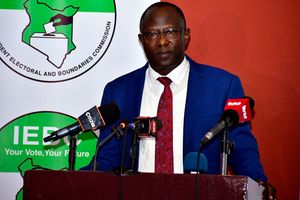
Yesterday, IEBC Chairperson Erastus Ethekon insisted the commission has learnt lessons from previous elections and is committed to restoring public confidence.
While acknowledging the police’s constitutional responsibility to maintain law and order, the report cautions that heavy-handed responses to political rallies, demonstrations and post-election protests could easily inflame already tense situations, particularly in urban centres and opposition strongholds where relations between communities and law enforcement remain fragile.
It recommends rights-based policing, professional crowd management and strict political neutrality by security agencies throughout the electoral period.
Inspector-General of Police Douglas Kanja has sought to reassure Kenyans that the National Police Service is preparing early to secure future elections. Director of Criminal Investigations Mohamed Amin has similarly pledged that detectives will investigate all cases of political violence without fear or favour.
The National Cohesion and Integration Commission has expressed concern over what it describes as an alarming rise in ethnic profiling, inflammatory rhetoric and incitement by political leaders. Chairperson Kepha Nyamweya Omae has appealed to political leaders to exercise restraint.
Law Society of Kenya President Charles Kanjama warned that increasing political intolerance, use of goons and violations of civil and political rights by both State and non-State actors pose a serious threat to Kenya’s democratic future.
Beyond security and electoral management, the report argues that the Judiciary will once again play a critical role in preserving stability. However, it cautions that judicial decisions can only prevent violence if political actors respect the rule of law and if the public has confidence in the electoral process.
Yesterday, Judiciary Spokesperson Paul Ndemo said preparations for the 2027 General Election are already underway. He said the Judiciary Committee on Elections has been conducting specialised training for judges and magistrates to strengthen their capacity to hear and determine election petitions within strict constitutional time frames.