For decades, ODM thrived on clarity of purpose and the singular force of its late founder Raila Odinga.
Today, that certainty has given way to a fog of competing agendas, as the party struggles to balance its historical identity against the realities of an emerging alliance with President William Ruto’s United Democratic Alliance (UDA)—raising profound questions about its future direction.
At the heart of the turmoil lies veiled threats over possible collapse of the UDA-ODM union, despite ODM delegates recently giving its greenlight for 2027 coalition talks.
There is also bitter disagreement over zoning, with some ODM legislators favouring the move, while others vehemently opposing it, terming it a secret plot “to give their rivals direct tickets.”
The party has also witnessed the rise of rival factions— “Linda Ground” and “Linda Mwananchi”—each claiming to be the true custodian of ODM’s grassroots soul, but in reality exposing a party increasingly at war with itself.
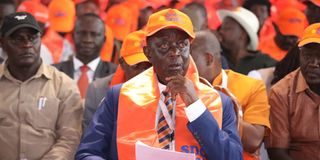
ODM Secretary General Edwin Sifuna addresses delegates during the People’s Delegate Convention organised by the Linda Mwananchi faction of the ODM at Ufungamano House in Nairobi on March 27, 2026.
The confusion is further deepened by behind-the-scenes jostling over the deputy president slot in a possible power-sharing arrangement, even as some members protest what they see as a steady haemorrhage of ODM’s political identity into UDA.
That anxiety has been amplified by an unseemly scramble for the influential Secretary General post as a plot to finally kick out embattled Nairobi Senator Edwin Sifuna from the coveted post gathers steam.
Grassroots anger has also been inflamed by the circulation of President Ruto-branded merchandise at ODM events—an image some officials have viewed as symbolic of creeping political capture.
At the same time, whispers of external interference, with fingers pointed at former President Uhuru Kenyatta, have only deepened mistrust within the ranks.
Compounding the unease are claims by sections of the United Opposition that the UDA-ODM deal is less a partnership and more a calculated takeover—leaving ODM staring at an identity crisis that could redefine its place in Kenya’s shifting political landscape.
All these brought together, analysts say, depict a party that is at war with itself, with no coherence that supporters can believe and trust.
National Assembly Minority Leader Junet Mohammed, one of the major proponents of the broad-based government, has kicked up a storm in the party, alleging a “coordinated effort to undermine ODM party’s influence within the coalition government.”
“There are people in government who are fighting this union,” Mr Mohamed told Nation , warning that continued hostility could collapse the partnership and threatening that the party “does not lack options.”
From Left: ODM Secretary General Catherine Omanyo, Junet Mohamed and Homa Bay Governor and ODM National Chairperson Gladys Wanga during the Linda Ground political rally at Mkunguni Square in Lamu Old Town on Thursday, February 12, 2026.
Photo credit: Kalume Kazungu | Nation Media Group
“We are not in government by mistake. We joined to foster unity and inclusivity,” he said, warning that the party could reconsider its role if sidelined.
President Ruto was on Monday forced to weigh in on the matter, insisting that cooperation between the two parties ODM and UDA serves a greater national good.
“The underhand forces driving division between our two parties will not succeed. Our country is better when UDA and ODM are together.
The United Democratic Alliance (UDA) and the Orange Democratic Movement (ODM) will unite and work together,” he said in Nyamira County.
ODM’s National Delegates Convention (NDC) marked a significant turning point. Under the stewardship of Dr Oburu Oginga, the party formally opened the door to coalition talks with UDA.
But even as the party embraced negotiations, its messaging revealed a deeper unease in earnest.
Dr Oginga struck a firm and unapologetic tone that ODM would enter any coalition from a position of strength, not submission.
Regions where the party has elected leaders—MCAs, MPs, senators, governors—were declared non-negotiable political zones.
This stance was quickly amplified by Mr Mohamed, whose remarks have since become the lightning rod of the emerging dispute.
“Anyone who wants to negotiate with ODM, we will not negotiate on our parliamentary strength,” Junet warned, adding that ODM zones were “well known” and must be respected.
Dr Oburu Oginga delivers his speech during ODM's Special Delegates Convention at Nairobi’s Jamhuri Grounds.
Photo credit: Bonface Bogita | Nation Media Group
On paper, the position reads like a standard bargaining tactic. In practice, it has opened a Pandora’s box.
The idea of electoral zoning—where coalition partners agree not to field candidates against each other in certain regions—is not new in Kenyan politics. But in the current context, it has become a fault line exposing deeper contradictions within both ODM and UDA.
For ODM, zoning is about survival. Without Raila Odinga’s unifying presence, the party’s traditional strongholds in Nyanza, Western, and the Coast are no longer guaranteed. Ring-fencing these areas is seen as essential to preserving its political relevance.
For UDA, however, zoning is an existential constraint.
Under President Ruto, the ruling party has pursued an aggressive strategy of national expansion, seeking to penetrate regions historically dominated by ODM. Accepting zoning would effectively halt that momentum—and concede political ground at a time when the President is keen on building a dominant, unified party machine ahead of 2027.
UDA Secretary-General Hassan Omar captured this resistance succinctly, charging that if ODM believes it is strong, it should prove it at the ballot, not through negotiated protection.
UDA party secretary general Omar Hassan.
Photo credit: File | Nation Media Group
This clash of philosophies—protection versus competition—has now placed the proposed coalition in a precarious limbo.
ODM now finds itself speaking in multiple, often conflicting voices. On one hand, it insists it is committed to structured dialogue and a negotiated coalition framework. On the other hand, it is issuing warnings, drawing red lines, and hinting at alternative political options.
Under the surface, analysts say the current turmoil points to a more fundamental challenge - ODM’s struggle to redefine itself in the post-Raila era.
“For decades, the party’s identity, strategy, and cohesion were anchored around a single figure. With that anchor gone, the internal contradictions that were once managed or suppressed have begun to surface,” says political analyst Chris Omore.
Today, he says, the party appears caught in a cycle of reactive politics—lurching from one issue to another without a clearly articulated, unifying agenda.
“One moment, the conversation is about zoning. Next, it shifts to the deputy presidential slot in a potential coalition. Then to internal disciplinary questions, grassroots mobilisation, or voter registration drives. Each issue is presented with urgency, yet none seems to form part of a coherent, long-term strategy,” he argues.
Nowhere are the internal contradictions sharper than in Nyanza—the bedrock of ODM’s political strength.
Sources intimated to Nation that a powerful faction within the party, associated with ODM National chairperson Gladys Wanga and Mr Mohamed, is pushing a distinct approach.
Homa Bay Governor Gladys Wanga speaks during the Orange Democratic Movement (ODM) Special Delegates Convention at the ASK Dome, Jamhuri Expo Centre in Nairobi.
Photo credit: Bonface Bogita | Nation Media Group
“They want the President to grant ODM leaders greater leeway to manage the region politically, effectively positioning them as intermediaries between State House and the electorate. This group believes that political mobilisation—not government projects—will ultimately determine voting patterns in Nyanza,” one insider told Nation .
In their view, he says; “it is their word, networks, and influence that will deliver votes—not roads, ports, or housing programmes.”
The source added that the “powerful camp”, is increasingly uneasy with what it perceives as reduced latitude under the new leadership compared to the Raila era.
ODM, as it appears, is no longer speaking with one voice.
Perhaps the most sensitive—and least publicly discussed—dimension of ODM’s growing confusion is money.
UDA insiders are increasingly uneasy about what they see as significant government resources being channelled into ODM political activities “with limited tangible returns.”
More controversially, ODM is said to have sought Sh2 billion ostensibly for a voter registration drive—funds that have not been released after the government indicated it could spearhead the exercise itself.
“For decades, the party’s identity, strategy, and cohesion were anchored around a single figure – Raila Odinga. With that anchor gone, the internal contradictions that were once managed or suppressed have begun to surface,” argues Dismas Mokua.
Today, he says, the party appears caught in a cycle of reactive politics—lurching from one issue to another without a clearly articulated, unifying agenda.