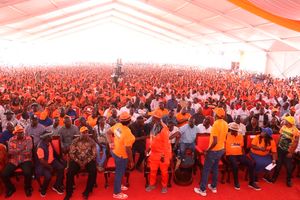
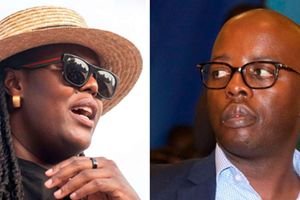
In what signals a deepening strain within the broad-based government, the Orange Democratic Movement has threatened to withdraw from its arrangement with President William Ruto’s administration, accusing the State of orchestrating systematic harassment and coercion of its lawmakers ahead of the 2027 elections.
The party alleges that senior government operatives are using state machinery and public resources to pressure its MPs—particularly from the Coast and Western regions—to defect to the United Democratic Alliance, with the aim of weakening ODM’s national standing and reducing it to a Luo Nyanza-based outfit.
In an exclusive interview with Nation , National Assembly Minority Leader Junet Mohammed said ODM believes there is a coordinated effort to undermine its influence within the coalition government and reshape the political balance ahead of the next General Election.
Suna East MP and National Assembly Minority Leader Junet Mohamed during an interview at Parliament Buildings in Nairobi on January 15, 2025.
Photo credit: Sila Kiplagat | Nation Media Group
He claimed that some officials within government feel threatened by ODM’s presence in state structures, arguing that incorporation of ODM leaders into Cabinet was not a favour but part of a political agreement meant to promote unity and inclusivity.
According to him, ODM agreed to cooperate with President William Ruto’s administration following the post-2024 political realignments and the youth-led protests that destabilised government operations. He added that the late former Prime Minister Raila Odinga supported the arrangement to stabilise governance and encourage national cohesion.
ODM has now scheduled a Central Management Committee meeting to assess the current political environment and determine its next course of action, including the possibility of exiting the arrangement if tensions persist.
“There are people in government who are fighting this union,” Junet said, alleging that a senior figure in government was leading efforts to sideline ODM. He warned that continued hostility could collapse the partnership, adding that ODM “has options” should the situation deteriorate.
He also insisted that ODM’s participation in government should not be treated as a political concession. “We are not in government by mistake. We joined to foster unity and inclusivity,” he said, warning that the party could reconsider its role if sidelined.
The controversy comes against the backdrop of President Ruto’s restructuring of government after the 2024 political crisis, which followed youth protests and an internal fallout between him and then Deputy President Rigathi Gachagua . Gachagua was later impeached, paving the way for the appointment of Kithure Kindiki as his replacement.
President William Ruto (left) interacts with Oburu Oginga, leader of the Orange Democratic Movement, after the Broad-Based Parliamentary Group meeting at the Kenyatta International Convention Centre in Nairobi on March 10, 2026.
Photo credit: Wilfred Nyangaresi | Nation Media Group
To stabilise his administration, President Ruto brought ODM figures into government. These included former ODM chairman John Mbadi, who was appointed Treasury Cabinet Secretary, and former Minority Leader Opiyo Wandayi, who became Energy Cabinet Secretary.
Other ODM-affiliated leaders who joined the Cabinet include Hassan Joho as Mining CS, Wycliffe Oparanya in the Cooperatives docket, and Beatrice Askul in the East African Community portfolio. Several others were appointed as principal secretaries and parastatal heads.
However, ODM now claims that its members within government are being pressured to distance themselves from the party. Junet alleged that even those serving in Cabinet and senior government positions are being discouraged from maintaining formal links with ODM structures.
He described the situation as intimidation, arguing that state machinery was being used to weaken party cohesion. “People ODM brought into government are being told not to associate with the party. This must stop,” he said.
At the centre of the dispute is also the question of political zoning and candidate distribution ahead of 2027. ODM has argued for structured seat-sharing arrangements within a coalition framework, while UDA has rejected any form of zoning, insisting on fielding candidates nationwide.
Junet said ODM does not oppose competition but rejects any attempt to use state power to influence internal party dynamics or poach its elected leaders. He warned that ODM would resist any efforts to “reduce it to a regional party,” insisting that it remains a national organisation with strong support in Coast, Western, Turkana, Gusii, and parts of Nyanza.
Some of these claims have been echoed by political actors who have defected from ODM. Kakamega Deputy Governor Ayub Savula said a significant number of ODM-elected MPs in Western Kenya had already aligned themselves with UDA ahead of 2027, suggesting an ongoing realignment in the region.
“We expect many of them to join UDA at the right time,” he said, adding that zoning arrangements would not determine outcomes in Western Kenya.
Rarieda MP Otiende Amollo.
Photo credit: File | Nation Media Group
On the other hand, Rarieda MP Otiende Amollo has urged both parties to focus on formal coalition negotiations rather than public confrontation. He called for the immediate establishment of a technical committee to guide pre-election talks between ODM and UDA, as previously agreed during a joint parliamentary meeting.
The proposed framework includes an eight-member committee to design a roadmap for coalition talks, but nearly a month after the announcement, it has not yet been constituted.
Amollo warned that delays in formalising negotiations could jeopardise the alliance and waste valuable time ahead of the election cycle. He urged both President Ruto and ODM acting leader Oburu Oginga to quickly appoint negotiating teams with clear mandates, including defining irreducible minimums and areas of compromise.
Meanwhile, internal ODM criticism has also emerged from within Parliament.
Homa Bay Town MP Peter Kaluma accused the government of failing to fully implement the ODM–UDA memorandum of understanding, particularly on inclusivity in state appointments.