President William Ruto is dusting off his 2022 “hustler” script in a fresh bid to reconnect with the masses ahead of his 2027 re-election battle.
From the so-called empowerment programme for boda boda riders and mama mboga to State House meetings with grassroots mobilisers, the President has returned to the narrative that catapulted him to power three years ago.
State machinery has also been deployed to fast-track flagship projects—modern markets, last-mile electricity connections, and the affordable housing programme—seen as crucial to regaining the support of low-income Kenyans.
In 2022, President Ruto rode to State House on a “hustler versus dynasty” platform that appealed to the unemployed youth and small traders. Analysts, however, warn that pushing the narrative may prove difficult in 2027, unless the opposition is divided.
Deputy President Kithure Kindiki has become the face of the “empowerment” blitz. His office says he has covered 180 constituencies so far, with plans to reach all 290 by May next year. Often, he visits at least two constituencies a day, while also hosting delegations at his homes in Karen and Tharaka-Nithi.
The President has been running a parallel track, hosting boda boda riders, grassroots leaders and Gen Z groups at State House. On Wednesday, he hosted 6,000 Kiambu residents, touting Sh30 billion worth of housing projects and Sh4.5 billion for 30 new markets. He held a similar meeting with Meru leaders on Friday.
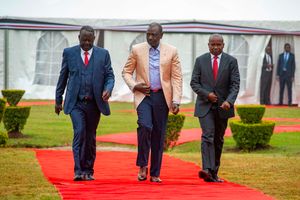
Deputy President Kithure Kindiki (second left) and National Assembly Speaker Moses Wetang'ula (second right) arrive at Tarbaj, Wajir County, for an Economic Empowerment Programme on August 24, 2025.
Photo credit: DPCS
Earlier this month, he unveiled cheaper electric motorcycles through a deal with Spiro and handed out business equipment to youth groups in Nairobi.
“This country is not just for the rich. It belongs to those at the bottom, those in the middle and those at the top. That is the philosophy that will ensure all Kenyans are involved in the economic development of their country,” the President said.
On August 9, he hosted hundreds of youth drawn from 1,115 groups from Nairobi’s 17 constituencies. They were handed various types of equipment for business.
Prof David Monda, a United States-based university lecturer and political analyst, said President Ruto has lost a huge chunk of his 2022 support base. He cited the apparent hostility in Mt Kenya, which was one of his main voting blocs.
“As it stands today, Ruto will start on the back foot, having a massive vote deficit from the Mountain. Most of the Mulembe (Western) has rejected him as have the Gusii in South Nyanza and the Kamba nation. The Coast has traditionally been hostile to Ruto. That leaves him with Luo Nyanza, whose loyalty at best will be lukewarm, even if Raila is still with Ruto. The numbers do not add up for the incumbent even with these empowerment programmes,” he said.
He added: “The more Ruto holds meetings with grassroots leaders, the more the public connects empowerment programmes to theft of public taxes and the more fraud is associated with mega projects like affordable housing, the more the hustler narrative becomes more like a bad joke than a public policy initiative.”
Similar views were shared by Machakos Deputy Governor Francis Mwangangi, who described the empowerment events as old tactics that were used by the Kanu regime to buy loyalty. He said the current voters are more sophisticated to be hoodwinked with cheap public relations stunts.
“Kenya Kwanza is basically back to the policies used by the Kanu regime, where you make them poor so that you can buy their support with handouts. The current population can see through this, and they know the money being dished out is stolen money,” said Mr Mwangangi.
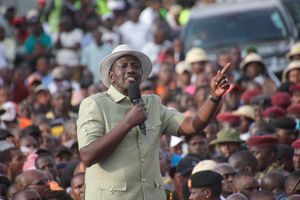
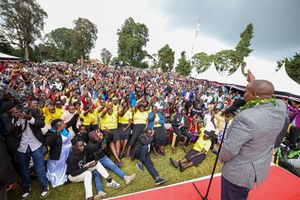
Deputy President Kithure Kindiki addressing Wajir residents during an Economic Empowerment Programme tour in Tarbaj on August 24, 2025.
He added that the sins Kenya Kwanza government has committed, cannot be forgiven at the ballot. He cited police killings and abductions, high taxation and reduced net pay for salaried Kenyans due to enhanced deductions.
“For them, it is okay to raise billions to bribe people in the name of empowerment, but frustrate devolution that has the potential to spur real development in the villages,” he added.
Prof Kindiki said that under the Sh28 billion Nyota Programme, the government will provide Sh50,000 in working capital to 70 youth-owned micro and small enterprises in each of the country’s 1,450 wards, aiming to stimulate expansion and create jobs.
National Assembly Majority Leader Kimani Ichung’wah, while speaking in Taita-Taveta last month, defended the empowerment events.
“This empowerment is not an afterthought. It is in our Kenya Kwanza manifesto, well captured in the Bottom-Up Economic Transformation Agenda. This agenda aims to raise income through expansion of businesses and financial support, which we are doing through this empowerment and other programmes under implementation,” he said.
According to the ministry, the Jukwaa la Usalama initiative seeks to assess the impact of government projects, gather feedback from the public and enhance the understanding and communication of government initiatives.
Mr Murkomen recently told MPs the meetings provide the government with a platform to assess flagship projects, clarify presidential directives through addressing misconceptions, and give the people an opportunity to provide feedback on public service delivery.
“By directly engaging with the county-level stakeholders, the Ministry of Interior aims to bridge the communication gap between the government and citizens to ensure effective implementation of national projects and address key concerns raised by the people,” Mr Murkomen told MPs.
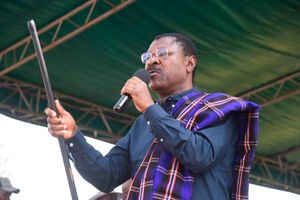
Deputy President Kithure Kindiki speaks at Marigat High School grounds on Saturday, August 16, 2025 during a women empowerment drive.
Photo credit: DPCS
Construction of markets and last mile connectivity are some of the projects seen as having an immediate impact on the majority poor that swept Kenya Kwanza administration to power. The regime came to power on the strength of lofty promises of creating jobs for millions of unemployed youth and prioritising the needs of low-income earners. According to President Ruto, his administration plans to construct a total of 400 markets nationally.
The affordable housing projects have also become a priority. Although the housing levy has remained unpopular among salaried Kenyans, President Ruto seems determined to push on with it.
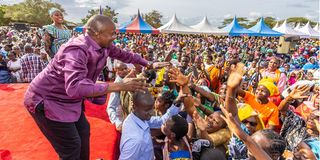
Deputy President Kithure Kindiki acknowledges greetings from members of the public during an economic empowerment drive in South Mugirango, Kisii County, on May 22, 2025.
Photo credit: DPCS
In its own mid-term scorecard, the administration said more than 130,988 houses are currently under construction, while another 127,476 are in procurement stages.
But even with the renewed push, the Kenya Kwanza administration faces the challenge of meeting its target of 200,000 houses per year.
The government has credited the affordable housing programme to economic growth through the creation of 244,232 jobs in the construction sector in 2024, with the number rising to 261,976 in 2025.
However, the 2024 Economic Survey by Kenya National Bureau of Statistics shows that jobs in the construction sector reduced last year.
“The construction sector declined by 0.7 percent in 2024 compared to 3 percent growth registered in 2023. There has been a reduced momentum in both public infrastructure projects and private sector developments that signalled a period of adjustment for the industry,” the report notes.