A proposed law giving the Independent Electoral and Boundaries Commission (IEBC) full ownership of election technology and unhindered access to election result servers has cleared a major hurdle after sailing through the debate stage in the National Assembly.
The Elections (Amendment) Bill, 2024, which progressed in the House last week, seeks to have election servers hosted in Kenya and ensure they are accessible for scrutiny by candidates, courts and other authorised persons.
The Bill also mandates the IEBC to provide access to information, including technology used in elections, without charging a fee where the information is requested in soft-copy format.
The scrutiny would be conducted in accordance with the Constitution, the Access to Information Act, the Elections Act, the Data Protection Act and the IEBC Act.
Clause 23 seeks to amend Section 44(4) of the Elections Act by inserting a new provision granting the IEBC ownership of intellectual property rights in election technology and access to the servers.
“In procuring the election technology, the commission shall ensure that intellectual property rights to the technology vest in the commission,” the proposed provision states.
The changes would, however, only take effect if the Bill is passed and signed into law in its current form.
The Bill, co-sponsored by Senate Majority Leader Aaron Cheruiyot (Kericho) and Minority Leader Stewart Madzayo, is based on recommendations of the National Dialogue Committee (Nadco) report, which was adopted by the Senate on February 21, 2024, and by the National Assembly a day later.
Kericho Senator Aaron Cheruiyot.
Photo credit: Lucy Wanjiru | Nation Media Group
Under the proposed law, any company contracted to provide the Kenya Integrated Elections Management System (KIEMS) technology would be required to grant the IEBC ownership of the intellectual property rights.
“The commission shall ensure that the technology is accessible and available for scrutiny by candidates, courts and such other persons as required under the law,” the Bill states.
The Bill would also require the commission to ensure that a supplier of election technology, or its associates, has not been found guilty of violating procurement laws, committed a crime, violated professional standards or been barred from participating in public procurement in any jurisdiction.
Currently, IEBC election servers are hosted outside the country, a situation the Bill seeks to change amid concerns over national security, legal compliance, operational sovereignty and public trust.
National Assembly Speaker Moses Wetang’ula , in a communication to the House on September 29, 2026, directed the Justice and Legal Affairs Committee (JLAC), chaired by Tharaka MP Gitonga Murugara, to fast-track consideration of the Bill.
“The committee is expected to review the proposals and recommend to the House any appropriate amendments for inclusion in the electoral amendment Bill that forms part of the priority business for this part of the session,” Speaker Wetang’ula said.
Granting the IEBC ownership of intellectual property rights is intended to strengthen the commission’s control over election technology and the management of election results, particularly after previous technology providers denied it access to servers despite court orders.
The Bill is among reforms intended to strengthen the independence of the electoral commission in managing elections and address disputes over ownership and access to election technology.
A proposed new Section 82A states that “the commission shall ensure access to information including any technology used in elections and shall not charge fees where the information requested is provided in soft copy.”
“Where an access request is made pursuant to scrutiny of votes, the commission shall facilitate access in the case of a presidential election, within three days of the date of the request and in the case of any other elective position, within seven days of the date of the request,” the Bill proposes.
Where the requested information is to be provided in hard-copy format, however, the commission may charge a prescribed fee.
“The fee shall not exceed the actual costs of making copies of such information and, if applicable, supplying them to the applicant,” the Bill states.
The Bill was passed by the Senate in December 2024 and transmitted to the National Assembly for consideration and concurrence.
It was read for the first time in February 2025 and committed to JLAC. A report on the Bill was finally tabled in the House last week, paving the way for debate.
IEBC has previously faced criticism over its handling of election technology, with political parties and candidates complaining about difficulties in accessing information held by the commission. The commission has also faced allegations that unauthorised persons gained access to its election servers, raising concerns over the security and possible manipulation of election data.
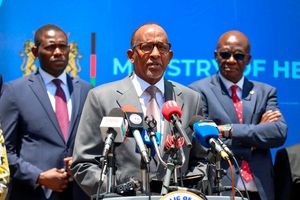
Immediate former National Assembly Speaker Justin Muturi has urged MPs to fast-track the passage of the Bill, saying it would strengthen the IEBC’s independence in managing election results.
“For me, a key item is for the IEBC to ensure that whoever is the provider of the KIEMS kits gives the commission the ownership of the intellectual property rights to avoid situations similar to the ones witnessed in the previous elections,” Mr Muturi, the Democratic Party leader, said.
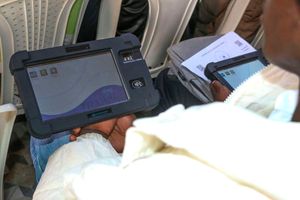
An IEBC official displays a KIEMS kit during a simulation process in the past.
Photo credit: File | Nation
Mr Muturi, who is also a former Attorney-General and Cabinet Secretary for Public Service, added: “I call on the National Assembly to move with speed to enact the law and on the IEBC to ensure compliance for greater accountability.”
His push is informed by the events surrounding the 2022 election, when Venezuelan firm Smartmatic International Holding BV, which supplied the KIEMS technology, denied the IEBC access to servers holding election results.
It was against this background that the Nadco report proposed amendments to the Elections Act “to cure such legal challenges”.
Smartmatic supplied and managed the software and hardware for the KIEMS kits, which were used for biometric voter registration, electronic voter identification on election day and electronic transmission of election results from polling stations to tallying centres.
The Venezuelan firm supplied the IEBC with more than 14,000 new KIEMS kits and upgraded the software on another 41,000 existing kits to support the 46,229 polling stations used during the 2022 General Election.
The technology provider for the 2017 election was French firm OT-Morpho, which later rebranded as IDEMIA.
The 2017, 2022 and 2027 elections have a common feature: the use of an integrated election management system.
This differs from the 2013 General Election, the first election held under the 2010 Constitution, which relied on separate, non-integrated technologies sourced from different vendors.
The Biometric Voter Registration (BVR) kits, for instance, were provided by Morpho Safran through a government-to-government arrangement with Canada.
The Canadian Commercial Corporation (CCC) was subsequently contracted to source 15,000 BVR kits manufactured by Morpho.
The Electronic Voter Identification Devices (EVIDs) were supplied by Face Technologies, a South African IT firm that provided the electronic poll books used to verify voters’ biometric details on election day.
The Results Transmission System (RTS) was developed and managed with software support from the International Foundation for Electoral Systems (IFES), alongside local telecommunications companies such as Safaricom, to transmit scanned election result forms.
The management of election data, including the voters’ register and election results transmission systems, has remained a contentious issue in Kenya’s electoral history amid persistent fears of manipulation of data to influence election outcomes.
During the hearing of the 2017 presidential election petition, the IEBC declined to open its servers despite orders from the Supreme Court.
At one point, Senior Counsel Paul Muite, who was then representing the IEBC in the presidential election petition, told the court that the commission’s servers were hosted in France and that it would take time to have them opened for access.
“My Lords, the servers are in Europe. We are not refusing to give access. Europe is a couple of hours behind and we have to wait for them to start working,” Mr Muite told the Supreme Court.
“They have to set up the access window with safeguards,” he added.
The failure to grant access to the servers was among the issues considered by the Supreme Court when it nullified the August 8, 2017 presidential election and ordered a “fresh, fair and credible” presidential election, which was held on October 26, 2017.