Less than a year before the August 2027 General Election, the National Assembly risks public backlash over delays in passing legislation that would give the Independent Electoral and Boundaries Commission (IEBC) full ownership of the intellectual property rights to election technology and access to election servers.
The Elections (Amendment) Bill, 2024, which has already been passed by the Senate, has been pending in the National Assembly for more than a year after being committed to the Justice and Legal Affairs Committee (JLAC).
The Bill proposes that any company contracted to provide the Kenya Integrated Election Management System (KIEMS) technology should grant the IEBC ownership of the intellectual property rights associated with the system.
The proposed changes are intended to strengthen the commission’s control over election technology and results, particularly after disputes in previous elections in which technology providers restricted access to election servers.
The delay has put the National Assembly under scrutiny over what critics describe as a failure to enact reforms designed to strengthen the independence and accountability of the electoral commission ahead of the 2027 elections.
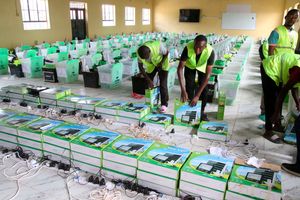
An IEBC official displays a KIEMS kit during a simulation process in the past.
Photo credit: File | Nation
Clause 23 of the Bill, which was drawn from recommendations of the National Dialogue Committee (Nadco) report adopted by Parliament, seeks to amend Section 44(4) of the Elections Act by inserting a provision that would give the IEBC ownership of intellectual property rights and access to election servers.
“In procuring the technology, the commission shall ensure that, subject to this Act, the Access to Information Act, the Data Protection Act and the right to intellectual property, the technology is accessible and available for scrutiny by candidates, courts and such other persons as required under the law,” the Bill states.
The Bill is sponsored by Senate Majority Leader Aaron Cheruiyot (Kericho) and his minority counterpart, Stewart Madzayo (Kilifi), and is based on recommendations contained in the Nadco report.
Kericho Senator Aaron Cheruiyot.
Photo credit: Lucy Wanjiru | Nation Media Group
It is anchored on the Access to Information Act, the Data Protection Act and the IEBC Act.
A proposed new Section 82A would require the commission to facilitate access to information, including technology used in elections, without charging fees where the information is provided electronically.
“Where an access request is made pursuant to scrutiny of votes, the commission shall facilitate access in the case of a presidential election within three days of the date of the request and, in the case of any other elective position, within seven days of the date of the request,” the Bill proposes.
However, where information requested is to be provided in hardcopy format, “the commission may charge a prescribed fee for the provision of the information.”
“The fee shall not exceed the actual costs of making copies of such information and if applicable, supplying them to the applicant,” reads the Bill.
The Bill was passed in the Senate in December 2024 and transmitted to the National Assembly for review, consideration and concurrence.
The Bill was read a first time in February 2025 and committed to the Justice and Legal Affairs Committee (JLAC).
National Assembly Departmental Committee on Justice and Legal Affairs chairperson and Tharaka Constituency MP George Gitonga Murugara appears before the National Assembly Budget and Appropriations Committee on Monday, March 23, 2026.
Photo credit: Dennis Onsongo | Nation Media Group
But more than a year down the line, JLAC, chaired by Tharaka MP Gitonga Murugara is yet to table a report in the House on its consideration of the Bill for debate and adoption or rejection.
Mr Murugara did not respond to our inquiries over when he intends to get back to the House via a report on the consideration of the critical legislation.
This even as some of his committee members who did not want to go on record, revealed that “our chairperson rarely gets time to attend to committee matters as he is busy on the ground campaigning to become Tharaka Nithi County Governor in 2027.”
While IEBC, in connivance with technology providers has hitherto blocked its stakeholders including political parties, candidates in elections among others, from accessing information it holds, it has been accused of allowing unauthorized access to its election servers, exposing it to risks of manipulating stored data- election results.
Immediate former Speaker of the National Assembly Mr Justin Muturi told the National Assembly to fast-track the passage of the Bill to “grant the IEBC the independence it so requires in the management of election results.”
“For me a key item is for the IEBC to ensure that whoever is the provider of the KIEMS kits gives the commission the ownership of the intellectual property rights to avoid situations similar to the ones witnessed in the previous elections,” Mr Muturi, the DP party leader, said.
Mr Muturi, also the immediate former Attorney-General as well as the immediate former Cabinet Secretary for Public Service, added: “I call on the National Assembly to move with speed to enact the law and on the IEBC to ensure compliance for greater accountability.”
Mr Muturi’s push is informed by the 2022 circumstances when Venezuelan firm- Smartmatic International Holding BV- which provided the Kiems kits technology, denied IEBC the access to the servers holding the election results despite the Supreme Court.
The company argued that granting access would infringe on the IP rights as it stayed put. It is because of this that the Nadco report proposed an amendment to the Elections Act “to cure such legal challenges.”
The Bill also mandates the IEBC to ensure that the supplier of the election technology “or their associates have not been found guilty of violating any procurement law, committed a crime, violated professional standards or been barred from participating in the public procurement in any jurisdiction.”
Smartmatic supplied and managed the software and hardware for the Kiems kits, used for biometric voter registration, electronic voter identification on the election day and the electronic transmission of election results from polling stations to tallying centres.
The Venezuelan firm supplied IEBC with over 14,000 new Kiems kits and upgraded the software for the other 41,000 existing kits to power the 46,229 polling stations across the country during the 2022 general election.
The technology provider for the 2017 elections was the French firm OT-Morpho that later rebranded to IDEMIA.
The common denominator for the 2017, 2022 and the 2027 elections is the employment of an integrated system.
This is unlike the 2013 general election, the inaugural elections under the 2010 constitution, which relied on separate non-integrated pieces of technology sourced from different vendors.
For instance, the Biometric Voter Registration (BVR) kits were provided by Morpho Safran through a government-to-government deal with Canada.
This led to the Canadian Commercial Corporation (CCC) being contracted to source 15,000 BVR kits that were manufactured by Morpho.
The Electronic Voter Identification Devices (EVIDs) were sourced from Face Technologies, a South African IT firm that supplied the electronic poll books used to verify voters' biometrics on the voting day.
The Results Transmission System (RTS), developed and managed with software support from International Foundation for Electoral Systems (IFES) alongside local telcos like Safaricom to transmit scanned election result forms.
The management of election data- voters register and the election results transmission system- has always been a contested affair in the country’s election history with fears of manipulation to twist the outcome of elections.
During the hearing of the 2017 presidential election petition at the Supreme Court, the highest court in the land, the IEBC declined to open its servers despite the court orders.
Senior Counsel Paul Muite.
Photo credit: File | Nation Media Group
At some point, Senior Counsel (SC) Paul Muite, the then IEBC lawyer in the presidential election petition confirmed to the court that the IEBC servers in the 2017 election were hosted in France and it would require some time to have them opened for access.
“My lords, the servers are in Europe. We are not refusing to give access. Europe is a couple of hours behind, and we have to wait for them to start working,” SC Muite then told the Supreme Court.
“They have to set up the access window with safeguards,” he added.
The failure by the IEBC to open the servers was among the reasons the Supreme Court nullified the August 8, 2017 presidential election results and directed that “a fresh fair and credible” presidential election be held on October 26, 2017.
The enactment of the Computer Misuse and Cybercrimes (Critical Information Infrastructure and Cybercrime Management) Regulations, 2024, compels for the localization of the country’s critical information infrastructure including election servers.
“An owner of a critical information infrastructure shall ensure that the infrastructure on which critical information is domiciled is located in Kenya,” the regulations state.
However, an owner of a critical information infrastructure who intends to have the critical information located outside Kenya, “shall apply to the National Computer and Cyber Crimes Co-ordination Committee'' for consideration.