The ruling United Democratic Alliance’s (UDA) vicious plot to consolidate and broaden influence beyond its current bastions ahead of 2027 has painted it as a ‘bully’ in the eye of its coalition partners.
Apart from the latest claims by the Orange Democratic Movement (ODM) of coercion and harassment of its members to ditch the outfit, President William Ruto’s UDA has also had running political tension with its allies within the Kenya Kwanza alliance.
UDA has been quietly and cautiously pushing its partners to fold in forming a dominant party ahead of the next contest, in a political push that has triggered political tension, especially with outfits that are reluctant to dissolve.
These overtures and machinations have since exposed deep-seated mistrust, succession anxieties, and calculations for survival in a volatile political landscape, while at the same time threatening Dr Ruto’s bid to cobble a political behemoth for his re-election.
Following close to two years of intense haggling, Amani National Congress (ANC) associated with Prime Cabinet Secretary Musalia Mudavadi agreed to fold and join UDA in January 2025.
The party is, however, today legally alive and fully operational following an unchallenged High Court ruling that nullified the process. Although party officials appeared to embrace the dissolution, there loud murmurs among party members.
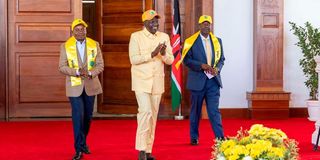
President William Ruto (centre), Deputy President Prof Kindiki Kithure (left), UDA Chairperson Cecily Mbarire (second right) and Secretary General Hassan Omar (right) during the UDA National Governing Council meeting at State House, Nairobi on January 26, 2026.
Photo credit: PCS
Similarly, Senate Speaker Amason Kingi’s Pamoja African Alliance (PAA) nearly gave in to the pressure to fold. In a strategic move for survival, Mr Kingi declined to dissolve, but agreed not to field candidates in the 2027 polls. Instead, the party would back those fielded by UDA. Mr Kingi has since joined UDA leaders, especially in Coast, in drumming support for UDA.
“In 2022, we toured this region extensively, campaigning for our party PAA candidates. Since then, we have had strategic meetings with the President in Nairobi on how to approach the next election as a united front. We have agreed that PAA will not field candidates in 2027,” said Mr Kingi.
But Ford Kenya of National Assembly has since told off UDA over demands to fold, terming it as not only ‘outrageous but a direct affront to the democratic space and an attempt to return the country to a single-party monolith.’
“FORD Kenya, alongside other affiliate parties, played a vital and decisive role in securing the current administration’s mandate. To demand the dissolution of Ford Kenya now is to "bite the finger that once fed you." It implies that affiliate parties were merely a ladder to power, to be discarded once the summit was reached,” Secretary-General John Chikati said in a hard hitting statement issued recently.
Ford Kenya said the calls for ‘a single-party monolith’ are a regressive attempt to return Kenyans to the "dark days" of political stifling.
“We must ask: what is the true objective of this mission to vanquish affiliate parties? If the goal was "unity," the results speak for themselves. Since the dissolution of parties like ANC to join UDA, we have witnessed a leadership vacuum where members now claim to be "politically homeless."
In the broad-based arrangement, ODM has accused UDA of coordinated attempts to undermine the party through coercion of its members to join the ruling party ahead of the next elections.
“Our members are being enticed with money to join UDA. The scheme is to reduce ODM to a Luo Nyanza affair. This is a cabal that feels that ODM has come to displace them,” National Assembly Minority Leader Junet Mohammed told the Nation.
UDA National Organising Secretary and Mwala MP Vincent Musau, however, dismissed the claims of alleged use of political underhand to undermine partner parties.
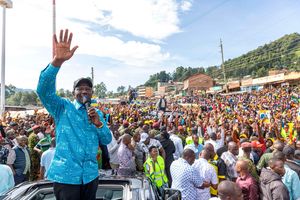
President William Ruto and UDA Party leaders when the Head of State hosted UDA grassroots leaders from Nyeri County at Sagana State Lodge, in Nyeri on January 17, 2026.
Photo credit: PCS
He, however, said that it is every political party’s dream to expand its influence by recruiting more members. He said even ODM would willingly take UDA members who wants to join it ahead of the next election.
He said the perceived tension between ODM and UDA was largely because of the DP position and political zoning as demanded by the Orange party.
“We have never bullied our partners, but remember, any party’s business is to woo and recruit as many candidates as possible. The issue that is arising is zoning. It has been our strong position that we should not do zoning because it is not popular with many.”
“I have seen some ODM members who want the DP position go to their party. I think the current DP is doing a good job, and we don't just replace people for the sake it. Even them, I don't think they have been realistic with this demand,” said Mr Musau.
ODM MP Mark Nyamita (Uriri) also downplayed any rift between the two parties, insisting the union with UDA remains their best bet going into the next elections.
“What we are seeing are tough bargains on the bride price. The union has so far delivered great progress for our people and we must ensure it gets better. Our best and only bet so far is the broad based government arrangement with UDA, the other purported coalitions will have no room in our regions,” said Mr Nyamita.
The lawmaker, who has declared interest for Migori governor seat on ODM, also appeared to oppose political zoning, which is at the heart of the current standoff between the two parties. He said ODM has to conduct credible party primaries for it to remain competitive nationally.
President William Ruto takes selfies with UDA grassroots leaders from Nyeri County at Sagana State Lodge, in Nyeri on January 17, 2026.
Photo credit: PCS
The push for zoning has since become a major talking point, especially in Nyanza, with locals openly opposed to it. Locals see it as scheme to protect some sitting MPs, seen to be loyal to the current leadership of the party.
“ODM remains a national movement. The current leadership must however continue to carry the hopes and aspirations of all the regions it represents to maintain its national appeal.”
“The dominance of either UDA/ODM in any region will solely depend on how credible they hold their primaries, anything short of a democratic and credible process will be fiercely rejected by the people.”
Prof Masibo Lumala of Moi University noted that smaller parties were already feeling the squeeze as Kenya Kwanza which started as a broad alliance of partners is increasingly narrowing into a single dominant centre.
“The logic behind this is not difficult to see. A dominant party prefers cohesion over complexity. Fewer parties mean fewer rival candidates, fewer negotiations, and tighter control of nominations, messaging, and resources ahead of 2027. In practical terms, it is political efficiency,” Prof Masibo explained.
He observed that the ongoing political machinations appear to echo realignments that were witnessed during the Kanu era, when the opposition space was gradually squeezed until the banning of the Kenya People's Union (KPU) in 1969 effectively ended competitive politics.
“By 1982, Kenya had become a formal one-party state under KANU, and political pluralism was legally extinguished. What followed was not immediate instability, but a long period of reduced accountability. Elections continued, but real competition weakened.”
He said the current consolidation by UDA may not mirror what happened during the Kanu regime, but it carries a familiar logic of reducing fragmentation and centralizing control.
“The key difference is that Kenya is now formally multiparty, with stronger institutions and more active opposition. But the underlying tension remains the same—between coalition politics that embraces diversity and party dominance that seeks uniformity.”
Frankline Mukwanja, Executive Director at Centre for Multiparty Democracy (CMD-Kenya), appeared to side with UDA for rejecting zoning while accusing ODM of engaging in “selfish, naïve, and unrealistic demands within any functioning democratic system.”
Mr Mukwana argued that rather than positioning the party for renewal, the demands by its leaders risk confirming the perception that ODM’s political vitality ended with Raila Odinga.
“In a democracy, it is voters who confer strongholds and power to political parties based on the agenda, issues, and interests they represent and aggregate. That is precisely how ODM and Raila built dominance in Nyanza region and extended strong support into other regions, particularly Western, Coast, among pastoralists and urban constituencies.”