The Independent Election and Boundaries Commission (IEBC) has revived its push to regulate campaign financing and donations in a bid to limit spending in next year’s General Election.
The commission has published fresh draft regulations that seek to cap expenditure on presidential campaigns at Sh4.44 billion and political parties' spending limits at Sh17.7 billion.
The new limits are contained in the Election Campaign Financing Regulations and the Election Campaign Contribution, Spending Limits and Authorised Expenditures published by the IEBC on Monday, July 6, 2026.
The regulations show that spending limits for County Governor, Senator and Women Representative will vary from Sh12.3 million to a maximum of Sh123 million, depending on the land size and population of the electoral unit.
Candidates wishing to contest constituency seats will fork out between Sh17.5 million and Sh123 million, depending on the size and population of the Constituency.
Those running for Member of the County Assembly will spend between Sh2.5 million and Sh20 million, depending on the size and population of the ward.
This is the second attempt by the IEBC to regulate election campaign expenditure after its first attempt in 2016 flopped.
The IEBC 2016 Gazette notice capping election spending limits was suspended by the National Assembly, which amended the Election Campaign Financing Act and stayed its application until after the 2017 General Election.
Article 88(4)(i) of the Constitution mandates the IEBC to regulate the amount of money spent by or on behalf of a candidate or political party during elections.
The Election Campaign Financing Act, 2013, regulates campaign funds during elections and referenda and allows the election commission to set financial limits.
The IEBC in August 2016 set campaign spending limits for the 2017 General Election, which capped expenditure for those contesting the seats of the President, Governor, MP, Senator and Member of the County Assembly. The Gazette Notice also spelt out limits for expenditure by political parties.
The commission at the time capped expenditure by presidential candidates at Sh5.2 billion and political parties’ spending at Sh15.03 billion.
IEBC also limited donations from a single source to a political party to 20 percent of the party’s total contribution limit, which translated to about Sh3.006 billion.
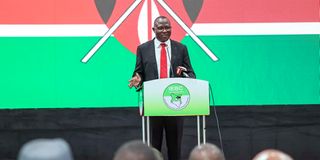
The Independent Electoral and Boundaries Commission (IEBC) Chairperson Erastus Edung Ethekon (center, podium) briefs the media on April 30, 2026, on the completion of the Enhanced Continuous Voter Registration (ECVR). With him are fellow IEBC Commissioners.
Photo credit: Francis Nderitu| Nation Media Group
The maximum campaign expenditure limit was capped at Sh432 million for those running for governor, senator and women representative seats, while those running for parliamentary seats were to spend a maximum of Sh33 million for constituencies with the highest voter population, while sparsely populated constituencies spent lower limits.
County Assembly aspirants’ campaign expenditure was limited to a maximum of Sh10.3 million in wards with high voter populations, while spending ceilings varied depending on ward voter population.
The latest regulations published by IEBC Chairperson Erastus Ethekon comes exactly 12 months to the next General Election slated for August 10, 2027.
“The proposed regulations aim to strengthen accountability in the management of campaign funds by candidates and political parties,” Mr Ethekon said in a public notice published in local dailies.
Mr Ethekon said the Election Campaign Financing Act provides for the regulation, management, expenditure, and accountability of campaign funds, with candidates and parties self-regulating under IEBC oversight.
The IEBC has already released the General Election roadmap, which political parties, public officers, and aspirants must meet ahead of the 2027 General Election.
The Election Operations Plan (EOP) 2025-2027 requires public officers intending to contest in the polls to resign from their positions by February 9, 2027, six months before the election date.
The commission expects political parties to submit their membership lists by March 16, 2027, while parties intending to field candidates in the General Election must also provide the names of aspirants seeking nomination through party primaries, as well as details of the dates and venues where the nominations will be conducted by the same deadline.
The roadmap shows that political parties must conclude their primaries and resolve all intra-party disputes by May 9, 2027, while independent candidates must submit their names and symbols to the commission.
Nomination of candidates for both political parties and independent aspirants will take place between May 29 and June 11, 2027.
The roadmap requires that any disputes arising from nominations must be filed with the IEBC no later than June 12, 2027.
The attempt by the IEBC to regulate campaign cash comes at a time when politicians have been splurging billions of shillings in empowerment drives.
Mr Ethekon said in determining the Election Campaign Finance Spending Limits for 2027 General Election, the IEBC considered two approaches for determining presidential spending limit.
He said the first approach involved costing all allowable expenses involved in a presidential campaign to obtain the total average cost of the presidential campaign.
The IEBC boss said the second approach involved the average cost at the lower electoral levels, including wards, constituencies, and counties.
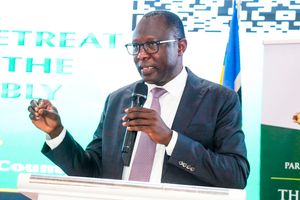
Independent Electoral and Boundaries Commission Chairperson Erastus Edung Ethekon during the signing of a Memorandum of Understanding between IEBC and the Kenya Media Sector Working Group on March 27, 2026 at Pullman Hotel.
Photo credit: Francis Nderitu | Nation Media Group
He said the average costs obtained were then used to estimate the unit cost associated with the two factors of population and land area, which is then used to estimate the presidential spending unit at each electoral level.
“The commission adopted the second approach, due to the availability of average cost at the lower electoral levels,” Mr Ethekon said.
“The president's spending limit of Sh4,435,565,094 was determined from the average limit obtained from the spending limit of the three levels.”
The IEBC tabulations show the presidential limit for the 47 counties is Sh2.39 billion, Constituencies (Sh5.27 billion), and Counties (Sh5.64 billion), bringing the average spending to Sh4.435 billion.
The IEBC has given Kenyans until the close of business on July 15, 2026, to submit memoranda on draft regulations governing campaign financing ahead of the 2027 General Election.
The IEBC is seeking views on regulations covering campaign contributions, spending limits, authorised expenditures, disclosures, monitoring, and record-keeping.
Mr Ethekon said Section 29 of the Election Campaign Financing Act empowers the IEBC to issue regulations on expenditure rules and financial regulations during the campaign and election period.
He added that Sections 12, 18, and 19 of the Act mandate the IEBC to prescribe campaign contributions and authorised expenditures through a Gazette notice at least 12 months before a General Election.
Section 12 of the Act stipulates that at least twelve months before a general election, the IEBC, by notice in the Gazette, prescribes limits on total contributions, contributions from a single source, paid-up media coverage, and loans forming part of a contribution, which a candidate, political party or referendum committee may receive during the expenditure period.
“The commission shall, at least twelve months before an election, by notice in the Gazette, prescribe the spending limits, including the total amount that a candidate, political party or referendum committee may spend during an expenditure period, including the limit for media coverage,” Section 18 of the Act states.
Section 19 of the Act requires the commission to prescribe the nature of authorised items or activities for which campaign expenses may be incurred, including the cost of venue where campaign activities may be undertaken, publicity material for campaigns, advertising for the campaigns, campaign personnel, transportation in respect of campaign activities, and any other justifiable expenses.
“The IEBC invites the public to submit memoranda on the Draft Regulation, Authorised Expenditures and Spending limits,” Mr Ethekon said in the notice.
Mr Ethekon said the public input will help shape a framework that promotes fair competition among candidates while enhancing transparency in campaign financing.