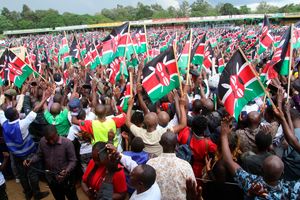
Kenya's political and electoral landscape is marred by a culture of handouts and dirty money splurged during election campaigns to secure victories.
According to the Elections Observation Group (ELOG), a network of civil society organisations that monitors electoral processes in Kenya, MPs spent over Sh30 million each to get elected in the 2022 general election.
Politicians and those seeking elective office love this culture because poverty and a lack of civic education make poor voters susceptible to manipulation by the political class.
This culture of handouts is perpetuated by politicians as a means of controlling the masses, meaning that voters are actually victims of this corrupt system.
In such a setup, where poverty, divisions and fractures form the basis of mobilisation, winning an election requires a lot of money to fund the campaign.
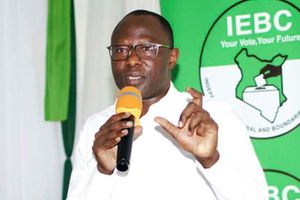
The failure of the Independent Electoral and Boundaries Commission (IEBC) to implement the Election Campaign Financing Act, which would ensure a level playing field among competing candidates, has not helped, as candidates continue to spend large sums of money in their quest for electoral office.
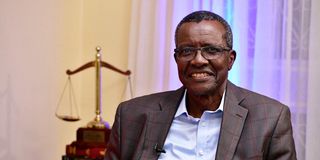
In what appears to be a paradigm shift ahead of the 2027 general election, presidential hopeful David Maraga, the former Chief Justice, has already raised Sh8 million through online fundraising appeals to finance his campaign.
The retired CJ’s campaign is publicly funded, an alternative to the traditional “handout” politics he has criticised. By yesterday (Thursday), this had realised contributions totalling Sh7.75 million through a paybill from 1,834 supporters and other well-wishers.
Kenyans in the diaspora have been the largest contributors so far, accounting for over Sh6 million, with the former CJ committing to contribute between Sh1 and Sh2 million towards his campaign fund.
He has also promised that every cent received will be accounted for, and that any surplus funds will be redirected to a public cause.
Mr Maraga expressed his gratitude to supporters for their contributions, describing them as a true statement in Kenyan politics.
“Your continued contribution is a true statement in our politics that Kenyans have demanded for a long time. You are building this change yourselves. This is your journey,” he said, though he did not reveal the challenges he has faced so far or his thoughts on the strategy.
Political analyst Mr Barasa Nyukuri notes that politicians require 'loads' of money to sway 'both the conscious and the unsuspecting' voters, and even to buy and corrupt votes.
“Most voters in Kenya are accustomed to receiving such money from politicians and not the other way round,” says Mr Nyukuri.
He adds that “politicians want it that way and that's why they have frustrated and rejected all campaign funding reforms.”
The retired CJ, who started as a lawyer in practice, before serving as High Court judge, Court of Appeal judge before retiring as Chief Justice and President of the Supreme Court, has not been associated with opulence and therefore depends on well-wishers for his campaign kitty.
He has since assured his supporters transparency and accountability in handling the funds. “My commitment to you, as best as humanly possible, guided by integrity and constitutional fidelity, is that of complete transparency, accountability in handling your resources,” said the presidential hopeful.
Nation Media Group's Editor in Chief Joe Ageyo and former Chief Justice David Maraga.
Locally, Mr Maraga may compare to former ODM leader, the late Raila Odinga.
Although people liked Odinga and often voted for him without inducements, he often drew much of his funding from the business tycoons, who will feel nothing parting with a Sh5 million a plate dinner, the large corporates, doing it discreetly, as well as through his international connections.
Globally, notable political leaders leverage grassroots fundraising and small-holder donations to fund their campaigns, largely as a strategy to demonstrate broad public support as opposed to the influence of large corporate donors.
The notable political leaders funded through people-driven fundraising include US president Donald Trump, his predecessor Barack Obama and former US Senator Bernie Sanders among others.
President Trump, despite significant billionaire backing, has been historically successful in small-holder fundraising with small donations accounting for about 69 percent of individual contributions to his campaign.
Mr Obama’s 2008 presidential election campaign is cited as a pioneer digital grassroots fundraising.
Mr Sanders is known for powering his 2016 and 2020 presidential campaigns almost entirely through small-holder individual contributions.
In 2020, about 54 percent of his $181 million came from small donors, allowing him to shun traditional large-donor “gatekeepers.”
However, other than Odinga, CJ (Rtd) Maraga’s political goodwill from the people, also has other similarities locally.
During the 2022 election campaigns, Kericho Governor Dr Erick Mutai, Bomet County Woman MP Ms Linet Chepkorir aka Toto and Mumias East MP Peter Salasia, had the goodwill of their electorates.
They did not spend big as the people either offered to fundraise for their election campaigns, or promised them votes without conditions.
Igembe South MP John Paul Mwirigi.
Photo credit: File | Nation Media Group
Mr John Paul Mwirigi, the Igembe South MP, made history in August 2017 when he was elected at the age of 23 becoming the youngest MP in the 12th parliament.
"It is the love of the people that got me elected and reelected because unlike other politicians, I have no money to dish out," says Mr Mwirigi.
During his first election, he ran as an independent candidate with no political party backing or significant resources.
He famously campaigned on foot and sometimes used a motorbike to conduct door-door visits to reach the voters.
In 2022, he successfully defended his seat on the UDA party ticket without spending big.
Nyaribari Masaba MP Dan Manduku, who was first elected in the 2022 general election, says that he did not spend big during his campaigns “because I did not have so much money.”
Mr Manduku notes that the fact that some MPs were elected in 2022 from voter donations shows it's possible to have an accountable campaign funding culture in Kenya with adequate people-centred goodwill.
“Without a doubt this culture can change but it will take a struggle, lots of civic education and generations for the culture of voters financing politicians to take root,” says Mr Manduku.
Former Chief Justice David Maraga during the People Dialogue Festival (PDF) held on March 6, 2025, at Uhuru Park.
Photo credit: Francis Nderitu | Nation Media Group
Senior Counsel Dr Koki Muli Grignon, a democracy and elections expert, says that many Kenyans have financed the election of leaders they want before because they believe they will deliver.
“It is a paradigm shift in the case of CJ emeritus Maraga, a novelty, public crowd sourcing through paybill etc, is relatively new,” says Dr Grignon.
Dr Grignon adds that before, such financial support was “a private affair” and revolved around people known by or close to the candidates.
“In the case of the former CJ, this is different because the donors are not necessarily people he knows but Kenyans of goodwill. It is very similar to the fundraising of former US President Barack Obama,” Dr Grignon adds.
Ms Sheila Masinde, the Executive Director of Transparency International (TI) - Kenya notes that as long as campaign financing remains unregulated in Kenya, a section of political players including women, youth, People Living With Disabilities (PWDs) will have an unequal playing field in competitive politics.
While acknowledging that individual public giving for campaigns is commendable, it needs to be subjected to campaign financing transparency and accountability standards.
“We must implement the campaign financing law but first review it to make provisions that will ensure transparency and accountability on funding sources and expenditure, more practical,” says Ms Masinde.
She observed that citizens fund campaigns they believe in, but unfortunately a number of elected officials fail to remain accountable and accessible to the public after election and fail to deliver their promises.
This, she says, makes public giving for campaigns unsustainable as people want to continue giving to people that will deliver positive outcomes to them.
Mr Mule Musau, a prominent Kenyan leadership consultant and election expert serving as Elog’s national coordinator, says that Maraga’s case should be a paradigm shift.
But he hastened to add that “if the kind of money being raised for elections is anything to go by we are still not out of the woods yet.”
“Our analysis of election costs indicate that MPs are spending more than Sh30 million to get elected. It’s not the kind of money you can get through public fundraising,” says Mr Musau.
He notes that regional/ ethnic political mobilization still plays a major role in who gets elected and it can contribute in helping favourable candidates who are aligned or politically correct.
“That said it is encouraging to see a number of politicians opting to fundraise publicly and doing well,” the Elog boss observes.
However, Dr Grignon notes that “sadly, this is not a paradigm shift from what we have been used to- where voters demand handouts from those seeking elective seats.
The Senior Counsel argues that the country will always have those who demand handouts because they lack conviction of their political beliefs or they simply support none or democracy means nothing to them.
She observes that to such individuals, “what Maraga is doing may be seen among many Kenyans as poverty and Kenyans don’t like to vote for poor people!”
“This is why wealth declarations are so public and a measure of the best candidate! Kenyans view the former CJ as weak because he has not stolen from the public, amassed wealth to run as a presidential candidate,” she says. She notes that some presidential aspirants are brandishing billions in the hope of buying votes!
Section 18 of the Election Campaign Financing Act states that IEBC shall, at least 12 months before an election, by notice in the gazette, prescribe the spending limits including the total amount that a candidate, political party or referendum committee may spend during an expenditure period, including the limit for media coverage.
The law goes on to state that except for contribution by a candidate into his or her own campaign financing account, any contribution from a person, organization or any other lawful source contributed to a candidate, a political party shall not exceed the limit of the total contribution prescribed.