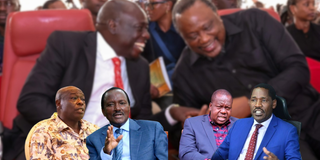
A fragile unity forged in the urgency to unseat President William Ruto is now showing early cracks, as rival camps within the nascent United Opposition dig in over how to pick a single presidential flag bearer for the 2027 General Election.
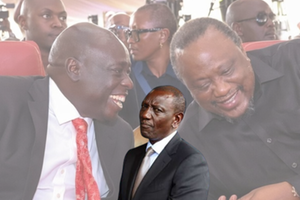
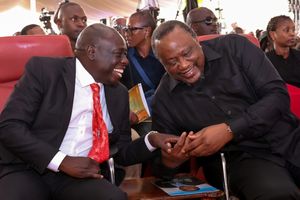
Despite leaders showing public camaraderie, including the recent meeting by former President Uhuru Kenyatta and ex-Deputy President Rigathi Gachagua , insiders say that what was once billed as an inclusive alliance of like-minded leaders has quickly morphed into a contest of competing strategies, egos and political philosophies pitting a Gachagua–Kalonzo Musyoka axis against a Fred Matiang'i–Peter Munya bloc.
Despite public showcase of camaraderie, including meeting by former President Uhuru Kenyatta and ex-Deputy President Rigathi Gachagua, insiders say United Opposition has quickly morphed into a contest of competing strategies pitting a Gachagua–Kalonzo Musyoka axis against a Fred Matiang'i–Peter Munya bloc.
Photo credit: NMG
At the heart of the dispute in the coalition that prides itself as the United Alternative Government and also brings forth DAP-K leader Eugene Wamalwa, People’s Liberation Party’s Martha Karua and Justin Muturi’s Democratic Party, is a deceptively simple but politically explosive question: who decides the flag bearer, and how?
While the Gachagua-Kalonzo camp is pushing for a consensus-based approach, essentially backroom negotiations among principals, the Matiang’i-Munya faction is demanding a “scientific, transparent and objective” process, likely anchored on opinion polls and measurable national appeal.
The standoff has already claimed its first casualty. A high-stakes retreat in Naivasha, intended to hammer out the framework for selecting the coalition’s presidential candidate in February, was abruptly shelved—underscoring the depth of mistrust simmering beneath the surface.
United Opposition spokesperson Dr Mukhisa Kituyi confirmed that what was meant to be a closed-door strategy session never materialised as planned.
“That retreat was supposed to be done in Naivasha, but because a section of the leadership wanted to have that meeting with the Inspector General, we converted it into a meeting in Nairobi—but it was not a retreat,” Dr Kituyi said, hinting at internal disagreements that derailed the process.
The postponement has left critical questions hanging—among them, the rules of engagement, a code of conduct for aspirants, and even the ethical framework that candidates are expected to sign before the selection process begins.
“We are not yet there,” Dr Kituyi admitted. “There are so many things we have not done between the different players… we have not agreed on the code of conduct, the ethics for the candidate.”
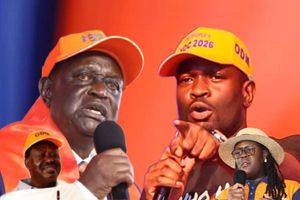
His remarks point to a coalition still in its formative stages, struggling to align competing interests while expanding its ranks. The entry of new players like the Linda Mwananchi into the opposition ring — steered by Nairobi Senator Edwin Sifuna and his allies —has only complicated the arithmetic.
“There is also the new kid on the bloc—Sifuna and his team. We have to talk to them and see the next steps they are taking,” Dr Kituyi added.
During an interview on NTV’s Fixing the Nation in February, Mr Sifuna, whose Linda Mwananchi team consists largely of perceived ODM Party rebels — Siaya Governor James Orengo and Embakasi East MP Babu Owino, among others, hinted at a possible working relationship with the United Opposition.
Linda Mwananchi and the United Opposition share the desire to make President Ruto a Wantam- shorthand for “one term head of state.
“We need an overwhelming repudiation of William Ruto and everything that he stands for. It has to be overwhelming. We must beat William Ruto by at least five million votes. Just Kenyans to demonstrate that we reject this sort of thing so that it is a lesson and a precedent for the entire country that if you ever build a government that does not listen to the people we will send you home,” He told NTV’s Fixing The Nation show.
ODM Secretary General Edwin Sifuna addresses delegates during the People’s Delegate Convention organised by the Linda Mwananchi faction of the ODM at Ufungamano House in Nairobi on March 27, 2026.
Acknowledging that beating President Ruto would not be easy, the senator called for a united front against the Kenya Kwanza second-term bid to conceal the loopholes that could divide votes.
When asked whether he would be joining the United Opposition side, the senator stated that it would be delusional to think of removing the sitting president without a well-calculated move, such as joining forces.
“Let nobody think that we think it is an easy thing, no, we are up against a very wild politician, you must give him his flowers, he knows his turf. So we must accept that he has certain strengths and agree that those strengths that he has do not allow much room for sentiments within the opposition rank. All of us must be able to agree and say this is a formula that will take this gentleman home.”
Yet even as the United Opposition leadership insists that no decision has been made on a presidential flag bearer, signals from the ground suggest otherwise.
During the start of their tour of the Lower Eastern region (Ukambani) on Monday, Mr Gachagua dropped his clearest hint yet that Mr Musyoka could be the coalition’s preferred candidate—remarks widely interpreted as an attempt to shape the narrative before formal consultations are concluded.
Addressing residents in Makueni, Mr Gachagua lavished praise on the Wiper leader, positioning him as a credible alternative to President Ruto.
“The Kamba vote is a vote you can take to the bank,” he said, urging the region to consolidate behind Mr Musyoka and Wiper candidates.
Former Deputy President Rigathi Gachagua.
Photo credit: Joseph Kanyi | Nation Media Group
The comments did not go unnoticed within the coalition, with allies of Dr Matiang’i and Mr Munya reading them as a premature endorsement—and a sign that the consensus model may, in reality, be a vehicle to impose a preferred candidate.
For the Matiang’i camp, the stakes are existential.
In a recent interview, the former Interior Cabinet Secretary warned that the method used to select the flag bearer could determine whether the coalition survives—or collapses before it even gets to the ballot.
“My honest view is that it should be a scientific, transparent and objective process that can pass muster,” Dr Matiang’i said. “You cannot frog march parties, individuals and Kenyan voters to a decision.”
He framed the debate as more than a procedural disagreement, arguing that a flawed process would render the eventual candidate politically illegitimate in the eyes of both partners and voters.
“If four or five candidates are in the race, the losers must be able to go back to their supporters and explain why they are not the candidates,” he said. “If the system used is not objective and credible, then it becomes a zero-sum game.”
Former Interior and Coordination of National Government Cabinet Secretary Fred Matiangi.
Photo credit: File | Nation
His ally, Mr Munya, the Party of National Unity (PNU) leader, echoed the sentiment, insisting that no single faction should dictate the outcome.
“The one to be nominated must be chosen through an open process that involves all players,” he said, pushing back against what he termed attempts to “create the impression” that some leaders have the final say.
On the other side, proponents of consensus argue that formulas and polls risk fracturing the coalition instead of strengthening it.
Kitui Senator Enoch Wambua, an ally of Mr Musyoka and a Wiper Patriotic Front National Executive Committee (NEC) member, dismissed the “so-called” scientific method, saying the coalition should rely on internal mechanisms already set up by its leadership.
“I do not understand what this scientific method would be,” he said. “There are some leaders in the fold who are behaving funny… it is as though they are with us to be supported but not keen on supporting anyone else. We are watching them with more than passing interest. It is not clear whose interests they are pushing, but this hide-and-seek game will come to an end soon. For me, August this year is where I draw the line for unveiling our presidential candidate,” Mr Wambua told Nation yesterday.
He went on: “What I know is that a team was set up by our leaders to look into this matter. They will advise all of us and a decision will be taken.”
Mr Wambua had recently gone further, deploying the “Simon Makonde” analogy to question what analysts observed as Dr Matiang’i’s suitability—suggesting that his appeal may be broad but politically shallow compared to Mr Musyoka’s experience.
Wiper deputy leader Mutula Kilonzo Jr, also an ally of Mr Musyoka, on Monday reinforced the case for consensus, warning that rigid formulas could undermine trust.
“Formulas don’t keep coalitions together. Camaraderie does,” he said. “Every player must be recognised and appreciated.”
“We will ensure no one is taking advantage of the other and that agreements are complied with. The business of political deceit must be eliminated.”
Caught somewhere in the middle are leaders like former Jubilee Secretary General Jeremiah Kioni, who have adopted a cautious tone amid shifting alliances.
“The approach that will arrive at the people’s choice,” Mr Kioni said when pressed on his preferred method—an answer that reflects uncertainty within the coalition.
Borabu MP Patrick Osero, an ally of Dr Matiang’i, argued that only a scientific poll can determine which candidate has the national spread required to win.
“You can appear to command support in two or three regions with huge voter populations, able to easily translate to a 50 plus one percent of the total votes cast, but what about the 25 percent requirement in at least 24 counties?” he posed. “Only a scientific poll can give a clear picture.”
He added: "For us we are fully behind the use of a scientific poll to pick the single opposition presidential candidate because it will give us a clear picture of which candidate stands the best chance of winning the 2027 presidential race. It is only through a scientific poll that we can determine which candidate can muster the support of majority of voters across the country and not just two or three regions."
A joint framework between Jubilee and PNU has already tilted the scales in favour of Dr Matiang’i, with PNU declaring it will not field a presidential candidate and will instead back him.
At the same time, opinion polls suggest a race that remains wide open.
An Infotrak survey conducted in December placed President Ruto at 28 percent, followed by Dr Matiang’i at 13 percent and Mr Musyoka at 12 percent, with a significant 27 percent of voters undecided.
President William Ruto delivers his speech during the launch of the Kisumu-Malaba Standard Gauge Railway at Kibos in Kisumu County on March 21, 2026.
Photo credit: Alex Odhiambo | Nation Media Group
The numbers underscore both the opportunity and the risk facing the opposition: unity could force a run-off, but disunity could hand the incumbent a clear path to re-election.
Dr Matiang’i has warned against what he calls “conspiracy-style politics,” arguing that any opaque deal would be impossible to sell to supporters.
For now, the coalition’s leadership insists that no candidate has been chosen—and that regional endorsements are merely part of mobilisation efforts.
“As you go to Ukambani, you say Kalonzo. As you go to Kisii, you say Matiang’i,” Dr Kituyi said. “It doesn’t mean much at this point.”
The indefinite postponement of the Naivasha retreat in February, the emergence of rival camps, and the hardening positions on the selection formula all point to a coalition at a crossroads—one that must decide whether to prioritise unity of purpose or supremacy of method.
With 2027 still some distance away, analysts say, there is time to bridge the divide.
“But as history has shown, Kenyan opposition coalitions often unravel not because they lack numbers—but because they cannot agree on who should lead them. Unless the United Opposition finds a way to reconcile consensus with credibility, the battle to unseat President Ruto may well be lost long before the first vote is cast,” says advocate Chris Omore.