A dramatic political thaw between former President Uhuru Kenyatta and his once-bitter rival Rigathi Gachagua could reshape the Mt Kenya political landscape, threatening to upend President William Ruto’s re-election calculus in 2027.
What was once an acrimonious fallout in the aftermath of the 2022 General Election now appears to be giving way to a calculated rapprochement, one that could fundamentally alter the region’s political direction and redefine national power dynamics.
The public display of unity during the burial of former Kirinyaga Senator Daniel Karaba on Wednesday, analysts say, was more than symbolic.
It signalled the culmination of months of behind-the-scenes negotiations aimed at consolidating the vote-rich Mt Kenya bloc under a single political direction.
Political analyst Prof Gitile Naituli described the rapprochement as long in the making, dismissing any suggestion that it was an opportunistic or cosmetic arrangement.
“That thing has been in the making for long,” he said, pointing to a series of quiet engagements and reconciliatory gestures that have sought to bridge the divide between the two leaders.
Among the most striking of these gestures was a March 20 visit by former Jubilee Secretary General Jeremiah Kioni to Mr Gachagua’s home, reportedly bearing gifts of livestock in what insiders say was a culturally symbolic olive branch tied to the former president.
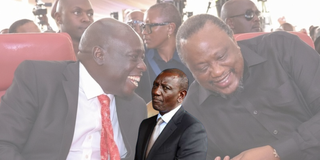
Former President Uhuru Kenyatta (right) shares a light moment with the former Deputy President Rigathi Gachagua during the burial of Daniel Karaba in Kirinyaga on Wednesday, April 1, 2026.
Photo credit: Pool
“There’s a time Kioni took goats… a lorry of goats—24. Twelve, I’m told, were from Uhuru,” Prof Naituli revealed.
While seemingly anecdotal, such gestures carry deep cultural and political significance in Mt Kenya, often signalling reconciliation, trust-building, and the restoration of fractured alliances.
The implications of the Uhuru–Gachagua truce are immediate and far-reaching, particularly for President William Ruto, who rode on the back of overwhelming support from the region in 2022.
According to political scholar Prof Peter Kagwanja, the reunion effectively disrupts the electoral arithmetic that delivered Mt Kenya to Dr Ruto in the last election.
“President Ruto garnered 87 per cent of the vote here in 2022. There is every credible indication that most of that share has since shifted allegiance,” he said.
The emerging unity, analysts argue, could therefore dash any hopes of a Ruto comeback in the region, significantly complicating his path to re-election.
Deputy President Kithure Kindiki has in recent days appeared to have softened his tone in his Mt Kenya tours, signalling a possible shift in strategy amid changing political dynamics and the emerging unity between rival camps.
Speaking in Embu, Prof Kindiki emphasised service over political confrontation, in remarks widely interpreted as a departure from his earlier hardline stance against his predecessor, Mr Gachagua.
The Deputy President struck a more conciliatory tone while addressing residents in Tigania West, Meru County, calling for unity and restraint even in the face of political attacks.
“I’m a leader and there’s today and tomorrow. Even after leadership we shall remain as one community. I don’t have any problem with any leader, even those who insult me. I have forgiven them unconditionally,” he said.
In an apparent reference to Mr Gachagua, Prof Kindiki added: “I have forgiven my brother… I will not answer him because as an elder of Njuri Ncheke, you cannot insult your brother.”
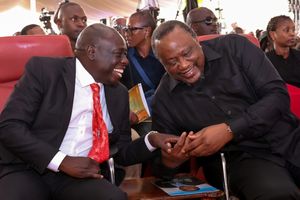
Uhuru Kenyatta and Gachagua share a hug after arriving at the burial of Daniel Karaba in Kirinyaga on Wednesday, April 1, 2026.
Photo credit: Pool
Analysts say the shift reflects a calculated attempt to de-escalate tensions in a region increasingly marked by political realignments.
Analysts believe that the consolidation of the region under an Uhuru-Gachagua wing could force President Ruto to change tack further on his handling of the region, but warn that time is of the essence.
The partnership of Mt Kenya’s vote under a unified leadership also enhances the opposition’s bargaining power nationally, positioning the region as a kingmaker rather than a peripheral player.
At the centre of this realignment are Wiper leader Kalonzo Musyoka and Jubilee presidential candidate Fred Matiang’i, who appear to be emerging as the convergence point for both Mr Kenyatta and Mr Gachagua.
Mr Kenyatta has previously endorsed Mr Musyoka for leadership within the Azimio coalition and has fronted Dr Matiang’i as his Jubilee Party’s preferred presidential candidate, while Mr Gachagua’s recent remarks in Ukambani have been interpreted as tacit support for the Wiper leader’s bid.
“There appears to be a consensus on a Kalonzo ticket,” Prof Naituli observed, adding that discussions are also leaning towards a possible running mate drawn from a younger political generation, including Nairobi Senator Edwin Sifuna.
The potential alignment around Mr Musyoka not only strengthens the opposition’s cohesion but also signals a strategic shift towards building a broad national coalition anchored on regional kingpins.
However, beneath the surface of unity lies an undercurrent of rivalry—particularly between Mr Gachagua’s Democracy for the Citizens Party (DCP) and Mr Kenyatta’s Jubilee Party.
The two outfits, now seemingly aligned, are still competing for dominance within the Mt Kenya political space.
Jubilee, once the region’s dominant political vehicle, has seen its influence wane, with many of its leaders defecting to either President Ruto’s United Democratic Alliance or Mr Gachagua’s DCP.
Mr Kenyatta’s recent remarks—where he refrained from explicitly endorsing Jubilee or any candidate—have further fuelled speculation about the party’s future.
“I don’t need any seat… I am retired. You can choose whomever you want,” he told mourners, in what some interpreted as a shift from direct political control to a more advisory role.
This ambiguity has left Jubilee in a delicate position—caught between maintaining its identity and adapting to a new political order in which Mr Gachagua appears to be gaining ground.
Uhuru Kenyatta and Gachagua shake hands after arriving at the burial of Daniel Karaba in Kirinyaga on Wednesday, April 1, 2026.
Photo credit: Pool
As with any political realignment, the Uhuru–Gachagua rapprochement is producing clear winners—and equally significant casualties.
Among the most affected is DP Kindiki, whose political fortunes are closely tied to his ability to deliver Mt Kenya votes for President Ruto.
Analysts argue that a united front led by Mr Kenyatta and Mr Gachagua significantly undermines his leverage within the Kenya Kwanza administration.
“It will be hard for him to control anything to make him relevant,” political analyst Herman Manyora observes.
Also facing turbulence is Dr Matiang’i, who had been positioning himself as Mr Kenyatta’s preferred presidential candidate through the Jubilee Party.
The former president’s shift towards a broader, more inclusive approach—emphasising unity over individual endorsement—has complicated Dr Matiang’i’s path within the opposition.
But Jubilee Party Deputy Secretary General Mr Zack Kinuthia told Nation that Mr Kenyatta spoke like an angled statesman who gave room to dialogue, negotiations and consensus-building between opposition principals instead of aligning with any wing.
“The fact that Mr Kenyatta did not endorse Dr Matiang’i and the Jubilee Party does not mean he withdrew his earlier expression of favour for the two. Let us not be lazy democrats. Mr Kenyatta chose cohesion in place of conflict,” he said.
However, internal divisions within the United Opposition, where competing camps are already emerging over the method of selecting a flag bearer, could affect the unity.
Within Mt Kenya itself, the truce has sparked both excitement and uncertainty.
For some, it represents long-awaited unity after years of political fragmentation. For others, it raises questions about inclusivity and the fate of smaller political players.
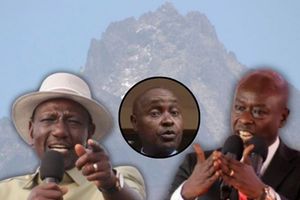
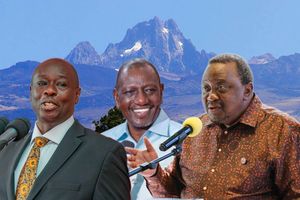
From left: Former Deputy President Rigathi Gachagua, President William Ruto and former President Uhuru Kenyatta.
Photo credit: Nation Media Group
“The Mountain is now one… the train has left the station,” he said, warning that late entrants may find it difficult to secure political space.
Laikipia East MP Mwangi Kiunjuri argued that the region’s political landscape remains diverse and competitive.
“It is not about two leaders. We have more than ten political parties… voters will give us the answer,” he said.
Mr Kenyatta’s remarks also extended to the clergy and younger voters—two groups that played a significant role in the 2022 election.
In a rare rebuke, he accused religious leaders of influencing voters towards what he termed a “bad political choice,” urging them to stay out of politics.
At the same time, he called on the youth to remain steadfast and resist short-term inducements, framing the 2027 election as a choice between immediate gratification and long-term national interest.
Despite the show of unity, significant challenges remain.
The United Opposition must still navigate internal divisions, particularly over the selection of a presidential candidate—a process that could either cement or fracture the coalition.
At the same time, President Ruto’s allies insist that the opposition’s gains in Mt Kenya may be overstated.
Kirinyaga Governor Anne Waiguru dismissed the emerging alliance as politically inconsequential, arguing that incumbency remains a powerful advantage.
“No president has ever been dislodged prematurely,” she said.
Siaya Senator James Orengo, while aligned with the opposition, offered a cautionary note, warning that Dr Ruto remains a formidable political strategist capable of exploiting divisions.
“You are dealing with a very strategic politician,” he said. “You have to be at your best—alert.”
The Uhuru–Gachagua truce marks a significant inflection point in Mt Kenya politics—one that could redefine alliances, reshape voter behaviour, and alter the trajectory of the 2027 General Election.
Long-serving administrator Mr Joseph Kaguthi told Nation on Thursday that “the coming together of Mr Kenyatta and Mr Gachagua will help us come up with a simplified localised Truth, Justice and Reconciliation Committee that will help us bring together all acrimonies that reign among us”.
He said, “key will be visiting the Kenyatta family and apologising to Mama Ngina Kenyatta, who we named and shamed in the 2022 campaigns, as well as using the moment to gather all willing to approach a united front for 2027 goals”.