A high-stakes political contest is quietly taking shape ahead of the Independent Electoral and Boundaries Commission (IEBC) voter registration drive set to begin on Monday, March 30, with both the ruling coalition and opposition scrambling to lock in millions of new voters in what could define the 2027 General Election.
This comes at a time young Kenyans across the country have intensified the campaign to register as voters using the rallying call “Niko Kadi” or “Tuko Kadi” (I am registered or we are registered as voters).
For President William Ruto, the target is to capitalise on the IEBC’s Enhanced Continuous Voter Registration (ECVR) targeting at least 2.5 million new voters in the first phase, and position themselves to influence up to 6.3 million more in the subsequent mass registration before the 2027 race.
There is an estimated 12 million Kenyans—and growing—eligible to vote and armed with identity cards, who have not enlisted as voters.
For the United Opposition, bringing together Rigathi Gachagua, Kalonzo Musyoka, Eugene Wamalwa, Martha Karua, Fred Matiang’i and Justin Muturi, the intense registration push represents an equally critical battleground, particularly among young people who have recently come of age or remain outside the voters’ roll despite holding national identity cards.
The IEBC has laid the groundwork for what is expected to be one of the most consequential voter registration drives in recent years.
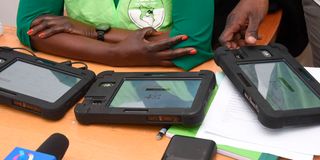
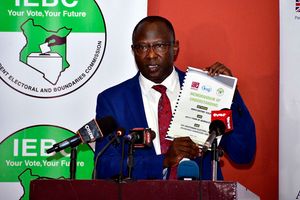
Speaking in Nairobi, IEBC chairperson Erastus Ethekon said the commission has deployed 12,000 clerks who will operate in more than 30,000 registration centres across the country.
The voter registration builds on lessons from previous voter registration drives, with a renewed focus on decentralisation, youth targeting and data-driven deployment of resources.
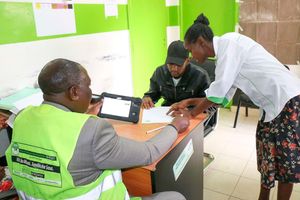
Registration centres have been moved closer to the people—from constituency offices to ward level and institutions of higher learning—in a deliberate attempt to eliminate barriers that have historically locked out millions of eligible voters.
Data from the State Department for Immigration and Citizen Services, given by Principal Secretary Belio Kipsang, paints a picture of a country sitting on a massive untapped voter base.
National ID cards. Students who have reached the age of 18 will be issued with identity cards and registered as voters while still in school if a new Bill before Parliament is passed.
Photo credit: File
According to the PS, between 1995 and February 2026, a total of 34.9 million national identity cards have been issued. Yet, as of March 10, only 22.3 million Kenyans are registered voters.
That leaves roughly 12 million eligible citizens—armed with IDs but not registered as voters—forming the single largest pool of potential voters ahead of the next election.
“Voter registration remains relatively low compared to the number of citizens with IDs,” Dr Kipsang’ told Sunday Nation . “Approximately 12 million eligible persons have yet to register as voters.”
The Ruto administration has, over the past three years, quietly built a pipeline designed to feed directly into the voter register.
Between August 2022 and February 2026, the government issued more than 7.3 million new IDs, with projections indicating that at least 3 million more Kenyans will be registered before the next election cycle.
Key to this push has been a series of reforms and innovations aimed at removing long-standing barriers to acquiring identification documents.
According to Dr Kipsang’, among them is the abolition of fees for first-time ID applicants, a move gazetted in March 2025, which he notes, has significantly boosted applications among young people.
Mobile registration initiatives such as Usajili Mashinani and Jukwaa la Usalama have also taken services closer to the people, particularly in marginalised and hard-to-reach areas.
Under these programmes, registration officers use live capture technology to process applications on-site, reducing turnaround time from as long as 30 days to just seven.
The government has also partnered with schools to register students who have attained the age of 18, with more than 33,000 young people already issued with IDs through school-based programmes.
“These documents enable students to apply for HELB loans and enroll in government programmes,” Dr Kipsang’ said, noting the link between citizenship documentation and socio-economic participation.
One of the most immediate opportunities lies in the more than 460,000 national IDs that remain uncollected at Huduma Centres across the country, making it difficult for their owners to register as voters.
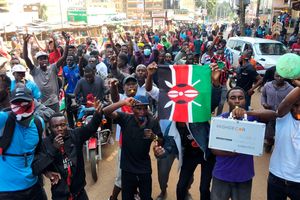
Youths in a peaceful procession on the streets of Mombasa during the 'Niko Kadi' voter registration campaign on March 24, 2026.
Photo credit: Kevin Odit | Nation Media Group
According to Dr Kipsang’, delays in processing in the past discouraged applicants from collecting their IDs, but improvements in turnaround time are expected to reverse the trend.
“Currently, about 462,000 IDs remain uncollected,” he said. “We are working with chiefs and national government administrative officers to distribute the documents.”
Beginning in June, he said, applicants will receive SMS notifications at every stage of the process—from printing to delivery—mirroring the passport tracking system.
For the political class, these uncollected IDs represent low-hanging fruit in the race to expand the voter base.
The United Opposition has already taken the campaign to the grassroots, framing voter registration as the most direct path to sending president Ruto home.
“The only easier way to make Ruto a Wantam (one term) President is to register as voters,” he said during a mobilisation drive in Wangige, Kiambu County.
The message is being amplified across key political strongholds, particularly in the Mt Kenya region, where turnout and voter registration rates could prove decisive.
The opposition is banking on the youth vote—energised in recent years by protests and civic engagement—to tilt the scales.
United Opposition principal Eugene Wamalwa said the coalition has embarked on a nationwide campaign to mobilise young people to register in large numbers.
DCP leader Rigathi Gachagua (Centre) flanked by other opposition leaders address journalists at Anniversary Towers, Nairobi on January 28, 2026, after a meeting with IEBC.
Photo credit: Lucy Wanjiru | Nation Media Group
“So far, we are very impressed by the initiative of the young people—Niko Kadi. We want to urge all the young people to embrace that campaign and come out to register,” Mr Wamalwa told Sunday Nation .
He went on: “We will also be calling on those who haven’t collected their IDs to collect them because so far we have over 460,000 uncollected IDs. That will give them a voice in this coming election. Whether you are saying Wantam (one term for President Ruto) or Tutam (two terms for President Ruto), the only way you can make it happen is through your vote. We don’t want them to miss this opportunity. 460,000 is a large number, remember Ruto only won by 200,000. So those uncollected IDs are very important.”
Mr Wamalwa outlined an aggressive mobilisation schedule that spans multiple regions, including Central Kenya, Eastern, Coast and Western.
“We have been to Murang’a to Kiambu with the same message. Beginning Monday, we will be heading to Makueni, Kitui, Machakos then roll into the Coast… then Western the following week,” he said.
He urged the IEBC to gazette all polling stations to ensure voters can access nearby registration points without incurring additional costs.
“We want to know the official polling stations… so that anybody who wishes to register should not travel long distances,” he added.
The voter registration drive has also reignited debate over whether Kenya should allow citizens to vote using national IDs instead of requiring separate voter registration.
Dr Kipsang’ said such a move could simplify the process and reduce costs but would require legislative changes and public participation.
“The idea could help reduce the cost and burden of registering voters for separate cards,” he said. “But it requires careful consultation and legal adjustments.”
Mr Wamalwa, however, urged caution, citing concerns over the potential misuse of IDs.
“This is something that needs to be debated seriously because it has its pros and cons,” he said. “There are many dead people whose IDs can be used.”
“For now, we must ensure that anyone with an ID must register as a voter and have a voter’s card.”
And with an estimated 12 million potential voters up for grabs, the stakes could not be higher.
As both sides deploy their strategies—from government-backed ID issuance programmes to grassroots mobilisation campaigns—the battle lines are being drawn, beginning today, not in rallies or courtrooms, but in registration centres across the country.
In the end, the outcome may well come down to who shows up—and who doesn’t.