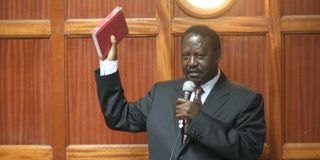
In October 2011, Prime Minister Raila Odinga took the witness stand to testify as a witness of former Alego-Usonga MP Otieno Mak’Onyango.
Narrating his ordeal, Mr Odinga told then High Court judge Kalpana Rawal that he was arrested on August 11, 1982 and taken to the GSU headquarters where he found University of Nairobi lecturer Prof Alfred Asanyo and Mr Mak’Onyango at the camp.
Mr Odinga recalled that he was terribly beaten by visibly drunk police officers led by the then police boss Ben Gethi and Peter Mbuthia.
He said Mr Gethi went to his cell munching a piece of meat and tried to compel him to write a confession. According to him, he wrote four statements but all of them were torn to pieces by the officers.
“They beat me ruthlessly yet we had not been found guilty,” Mr Odinga said.
He added that while they tortured him, he could hear wails from adjacent cells where other detainees – Prof Asanyo and Mr Mak’Onyango – were being held.
Raila Odinga in court in 2011.
Photo credit: File
Mr Odinga said they were held incommunicado and in solitary confinement, although they used to meet with fellow detainees in the mornings. He said no family members or lawyers were allowed to visit them.
While being cross-examined by former President Moi’s lawyer Kethi Kilonzo, Mr Odinga said Mr Moi should have been held liable for the cruel treatment they underwent.
“Yes, Moi should take personal and political responsibility,” he said.
Mr Odinga further denied playing a role in the attempted coup, although he said there were rumours of a planned overthrow of Moi’s government, which was to happen on August 5, 1982.
He said the rumours implicated former powerful Attorney-General Charles Njonjo before the Njonjo Commission as persons behind plans to overthrow Moi’s government.
He further dismissed allegations contained in his biography, Raila Odinga: An Enigma in Kenyan politics , written by Nigerian writer Babafemi Badejo. He said he was planning to write his own autobiography, which would correct misrepresentations contained in Badejo’s book.
Although Mr Odinga admitted having graced the launch of Mr Badejo’s book and even wrote a personal statement in the book, he said the author based his facts on other sources and not him.
Mr Odinga later wrote his autobiography – The Flame of Freedom , where he admitted playing a ‘peripheral role’ in the attempted coup. He added that they were found to have a case to answer and were committed to the High Court for trial.
The State, however, terminated the case, but he was detained for six years while Mr Mak’Onyango was held for four years.
According to Mr Odinga, it was James Mathenge, the then Permanent Secretary in charge of provincial administration and internal security, who signed a notice sending them to detention. He explained that they occasionally appeared before the Detention Review Board where they appealed for their release.
The court later awarded Mr Mak’Onyango Sh20 million, with Justice Rawal saying that the evidence tabled in court led to an “irresistible conclusion that the detention of the plaintiff was unconstitutional, unjustified and unlawful”.
Mr Mak’Onyango was arrested on August 17, 1982 by the police from his workplace at the Standard Group, along Likoni Road, in connection with the failed coup, which had taken place about three weeks earlier.
Mr Mak’onyango was taken to the Criminal Investigation Department Headquarters in Nairobi. The next day, the police took him to his home in Buru Buru estate, where the officers conducted a search without a warrant. They confiscated his books, personal letters, documents and passport.
Mr Mak’Onyango was then 35 years and in his case, he said the arrest and eventual detention brought an end to his career as a journalist.