There is a particular kind of political exhaustion that comes not from losing an argument but from never being allowed to finish one.
That is the condition the United Opposition finds itself in this week, and nobody wears it more visibly than Wiper boss Kalonzo Musyoka .
At 72, he has told his inner circle plainly that time is no longer a resource he can spend carelessly. It’s now or never, he says. That single line carries more honesty than anything said publicly by his coalition partners in the days since reports emerged that Rigathi Gachagua had privately endorsed him as the opposition’s 2027 flag-bearer.
Kitui Senator Enoch Wambua, a close Kalonzo ally, said as much on the record. Mr Musyoka did not deny it. Then the walking-back began, and with it, the headache that defines this coalition came into full view.
Martha Karua’s response set the tone. “I know for sure that even the framework for arriving at such a decision is yet to be agreed upon,” she said, declining to confirm or dismiss the endorsement outright and instead redirecting reporters to coalition spokesperson Mukhisa Kituyi.
Mr Kituyi, when he did speak, offered no such nuance. His answer ran to two words: “No and no.”
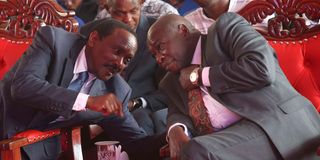
Kalonzo Musyoka (left) and Rigathi Gachagua during a meeting by leaders of the Opposition in Nairobi on September 8, 2025.
Photo credit: Pool
Fred Matiang’i would not even go that far when we contacted him. “I don’t want to engage in that discussion,” he told the Sunday Nation. “It is something we shall sit down as a team to deliberate on.”
Three senior figures, three different registers of avoidance. None of them said the endorsement was false. None of them said it was true. That is the opposition’s condition in miniature — a coalition that cannot agree on what has or hasn’t happened inside its own ranks since it first started calling itself united. It’s about posturing for the public and presenting a united front against a formidable opponent or reflecting the sheer uncertainty of facing a presidential election.
Mr Gachagua himself has been the most voluble, though without providing clarity. On Saturday, he threw a spanner in the works as he addressed the “Kalonzo endorsement” talk.
“My priority is that I get that ticket,” he said. “But my people have told me to go to that table with an open mind and be ready to support the overall winner.”
In the same breath, he insists the whole process of naming a candidate must wait.
“The united opposition candidate will be named at the tail end of the IEBC (Independent Electoral and Boundaries Commission’s) deadline. We can only be late in naming that candidate if we do so after May 15, 2027,” he says, before adding the justification. “Naming that candidate is our secret weapon. Naming him/her now will be donating that candidate to state persecution.”
When the endorsement story broke, he pushed back on the framing rather than the substance. “I see some State propaganda machinery trying to say I have endorsed Kalonzo Musyoka,” he said. “The intention is to disorient the other principals. But we are smarter than Kasongo (in reference to one of President William Ruto’s nicknames). We know his anxiety and his intention to divide us. No one has endorsed the other. We are mobilising our individual blocs and indoctrinating them to ‘Wantam’ (one-term) values and faith.”
And in case anyone doubted how crowded his own ambitions remain, he offered his own count of the field: “For your information, the Mountain has about three presidential candidates so far: Rigathi Gachagua, Kalonzo Musyoka (Mt Kenya South), Martha Karua and Justin Muturi .”
For Mr Musyoka’s camp, the argument has always rested on sacrifice. Mr Wambua, the Kitui Senator, makes it without embarrassment.
From left: DCP leader Rigathi Gachagua, Wiper party leader Kalonzo Musyoka and PLP leader Martha Karua, alongside other United Opposition leaders head to Vigilance House in Nairobi on January 30, 2026.
Photo credit: Bonface Bogita | Nation Media Group
“He’s not bitter towards anyone. He wants the best for this country. If Kenyan politicians want to learn about making personal sacrifices for the greater good of the country, they should take a lesson from Kalonzo Musyoka. He was ready for the 2013 and 2017 elections, but he stepped down to support Raila. He did the same in 2022, even though he wasn’t even the running mate,” he said.
It is a case built entirely on patience rewarded, on a debt the coalition owes him for 20 years of standing down.
Mr Wambua goes further still on temperament: “The country is in dire need of a father figure to lead it. He has the temperance, humility and maturity needed in a president. This country does not need a strongman who will kill and maim our children. Kalonzo has a wealth of experience in governance. He was Vice-President, and you never heard him contradict his boss.”
And on unity as obligation rather than choice: “The unity of the opposition is a prerequisite to removing Ruto from office. They owe it to Kenyans to remain united and present a single candidate against him at the ballot.”
The trouble is that “they owe it to Kenyans” is a moral argument, not a political one, and moral arguments have not been enough to move Ms Karua or Dr Matiang’i off their insistence on process.
“Any formula must include a scientific component,” Ms Karua has said. “Scientific opinion polling is essential because it tells us whether a candidate resonates with voters. You cannot win an election with a candidate who lacks public support.”
It is a polite way of saying that seniority and sacrifice are not, on their own, a mandate.
“Choosing our flag-bearer will not be based on tribal inclination. He or she will be the person the majority of Kenyans feel can work for them. This decision will not be made by me and my brothers alone. We shall come to you and your opinions will be considered in determining who is the best pick,” Ms Karua said in Ahero yesterday.
Even inside the coalition’s younger ranks, there is open discomfort with the entire premise of an elders’ consensus. One younger opposition figure put it bluntly: “Our generation wants new people and we cannot afford to mess up in the coming election because young people want a new face in this game. The reason we formed this team is to give hope to our young people who are demanding change. It was not for Gachagua, Kalonzo or any other candidate in the opposition to be president. To be clear, we did it to ensure we send President William Ruto home.”
That is a generation telling its own principals that the project was never about crowning any one of them.
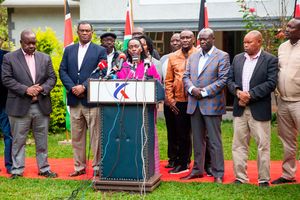
United Opposition leaders, led by former Deputy President Rigathi Gachagua (center), DAP-K Party leader Eugene Wamalwa (left) and Wiper party leader Kalonzo Musyoka (right), address the media at SKM command center in Nairobi on November 3, 2025.
Photo credit: Lucy Wanjiru | Nation Media Group
Beneath the positioning sits a deeper anxiety: how any of this gets paid for against an incumbent’s war chest. Mr Gachagua has been candid about the scale of it. “I have looked at your budget, and the whole election process is about Sh2 billion,” he said during his London trip in May. “From the nomination fees, we’ll be able to raise Sh1 billion, and the party will look for another Sh1 billion.”
Makueni Senator Dan Maanzo, an ally of Mr Musyoka, described the presidential aspirant’s fundraising architecture: “We have launched a platform similar to the one that Barack Obama used. There are many foreign friends who asked us to create this platform so that they can finance his campaign. For the last 15 years we have been helping Raila Odinga in his presidential campaigns and that is exactly what we are doing now.”
He added that the machinery is already running quietly: “We already have a secretariat in place for the candidate and it is working internally as we wait to unite with the coalition principals. Very soon we will unveil the secretariat for the United Opposition.”
That last sentence captures the coalition’s dilemma. A secretariat is running. Money is being raised. A slogan is trademarked. Yet, publicly, the answer to who is running remains “No and no.”
Political analyst Edwin Kegoli has described what actually binds this group together, and it is not affection for Kalonzo or admiration for Gachagua. “Their unity is purely driven by hatred of President Ruto’s administration,” he said. “They just want him voted out despite their political differences.”
Political analyst Dismas Mokua argues that the credibility of the nomination process may ultimately prove more important than the nominee.
“The process determines whether supporters accept the outcome. Without legitimacy, unity becomes impossible,” he said.
Political analyst Mark Bichachi believes the opposition should rely more heavily on technology, volunteer mobilisation and the organisational lessons demonstrated during the Gen Z protests.
Mr Mokua, however, argues fundraising alone will not succeed unless accompanied by a compelling national message.
Making President Ruto a one-term president, he says, is insufficient. “The coalition must present a clear alternative on jobs, taxation, governance and economic management.”
Prof Gitile Naituli of Multimedia University agrees that while campaign resources matter, elections are ultimately shaped by public mood, organisation and voter turnout.
He also believes Nairobi Senator Edwin Sifuna’s growing profile has significantly altered the coalition’s arithmetic.
By positioning himself as an articulate advocate for governance and constitutionalism, the Nairobi senator has broadened his appeal beyond Nairobi while attracting younger urban voters.
For coalition strategists, his emergence represents both an opportunity and a challenge, expanding the opposition’s appeal while complicating efforts to balance competing regional and generational interests.
For Mr Musyoka, the agony is specific and personal. He is the most senior man in the room, owed the most by the logic of loyalty, and still waiting on people younger and more ambivalent than himself to decide whether loyalty is enough. Everyone around him is speaking in the language of process, patience and mobilising blocs. He is the only one who has said, without qualification, what this actually is: “Now or never.”