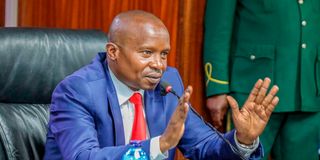
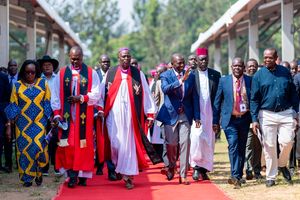
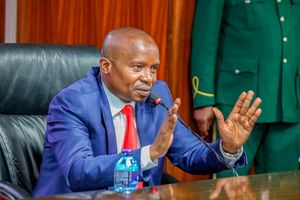
Deputy President Kithure Kindiki has barely completed two years in office, yet the battle over whether he will remain President William Ruto 's running mate in the 2027 General Election is already dominating Kenya's political conversation.
The debate stretches far beyond the corridors of power. It is being fought in church gatherings across Mt Kenya, inside ODM strategy meetings, on social media, at government functions and within the Kenya Kwanza coalition itself.
Every political move by Prof Kindiki, every presidential tour and every opinion poll is increasingly being interpreted through one question: Is the Deputy President secure?
In many respects, Prof Kindiki finds himself under siege from three different directions.
The first front is political. Former Deputy President Rigathi Gachagua has pitched camp in Mt Kenya East, the very region that forms Prof Kindiki's political base, determined to wrest it from President Ruto's grip before next year's election.
The third front is institutional. Recent reports claiming that some of the Deputy President's influential responsibilities had been transferred to Prime Cabinet Secretary Musalia Mudavadi fueled speculation that his influence inside government was shrinking.
Prime Cabinet Secretary Musalia Mudavadi.
Prof Kindiki has dismissed those reports as "fake news", insisting no such changes have occurred.
Whether these developments are isolated political events or signs of a larger realignment is now the question occupying allies and rivals alike.
Kenya's second-highest office has increasingly become one of the country's most politically precarious positions.
President Ruto knows that reality better than most, if not all. During former President Uhuru Kenyatta's second term, many of the coordination roles traditionally associated with the Deputy President's office gradually shifted elsewhere as relations between the two leaders deteriorated.
Former Interior Cabinet Secretary Fred Matiang'i emerged as one of the most powerful figures in government, chairing Cabinet committees and coordinating government operations that many believed ordinarily fell within the Deputy President's sphere.
When President Ruto assumed office in 2022, he promised a different relationship with his deputy. Yet history appeared to repeat itself.
Mr Gachagua's tenure quickly descended into public disagreements, accusations of exclusion and eventually impeachment in October 2024.
His removal paved the way for Prof Kindiki, then Interior Cabinet Secretary, to ascend to the country's second-highest office with a promise of stability, discipline and administrative efficiency.
Now, less than two years later, speculation surrounding his future has once again revived debate over whether the deputy presidency has become Kenya's most politically unstable office.
If Prof Kindiki hoped his home region would remain politically secure, recent events suggest otherwise.
President William Ruto and Deputy President Prof Kithure Kindiki arrive for the launch of the NYOTA Business Capital Support for young businesspeople at Moi International Sports Centre, Kasarani, Nairobi on January 19, 2026.
Photo credit: PCS
He has vowed to shadow every presidential visit to the region with political rallies of his own, determined to dismantle government influence village by village.
Addressing supporters during his tour, Mr Gachagua accused pro-government politicians of dividing the mountain and promised that leaders allied to President Ruto would face defeat in next year's election.
Since assuming office, the Deputy President has maintained an intense schedule of development tours, commissioning roads, inspecting affordable housing projects, launching agricultural initiatives and chairing implementation meetings across the region.
Supporters argue these visits have helped reassure residents that Mt Kenya remains represented at the heart of government despite Mr Gachagua's impeachment.
His strategy mirrors the grassroots mobilisation that helped Kenya Kwanza dominate the region in 2022—only this time directed against the very administration he helped elect.
If Mr Gachagua represents external political pressure, Dr Oburu Oginga-led ODM has introduced a different challenge from within President Ruto's broad-based arrangement.
Senior ODM leaders have publicly declared that the deputy presidency should now belong to their party if cooperation with UDA is to continue beyond the next election.
ODM co-deputy party leader Simba Arati says that if President Ruto seeks re-election on a UDA ticket, ODM should produce his running mate.
National Assembly Minority Leader Junet Mohamed has gone further, describing the position as a condition for sustaining the partnership between the two parties.
The party has floated several possible candidates, including Cabinet Secretaries Wycliffe Oparanya and Hassan Joho as well as ODM National Chairperson Gladys Wanga.
The campaign reflects ODM's growing confidence that its cooperation with Kenya Kwanza deserves greater political dividends.
For Prof Kindiki, however, analysts say the demands represent more than ordinary coalition bargaining.
They introduce an entirely new layer of uncertainty into discussions that were previously centred almost exclusively on Mt Kenya politics.
If President Ruto eventually concludes that securing ODM's support offers greater electoral value than retaining the current ticket, the deputy presidency could become the biggest bargaining chip available.
The latest speculation intensified after reports emerged suggesting that Prime CS Mudavadi had taken over some responsibilities previously associated with the Deputy President.
The reports quickly triggered debate over whether Prof Kindiki's influence inside government had diminished.
The Deputy President responded bluntly, dismissing the claims as "fake news."
His position received immediate backing from Head of Creative Economy and Special Projects Dennis Itumbi, who argued that the reports fundamentally misunderstood Kenya's constitutional framework.
According to Mr Itumbi, the country's intergovernmental relations are distributed across several legally established institutions rather than controlled by a single office.
He maintained that the National and County Government Coordinating Summit remains chaired by President Ruto, while the Deputy President continues to chair the Intergovernmental Budget and Economic Council (IBEC) as provided under the Public Finance Management Act.
The Prime Cabinet Secretary's involvement, he explained, arises from separate responsibilities relating to parliamentary affairs rather than a transfer of Prof Kindiki's constitutional mandate.
For government insiders, the rapid rebuttal reflected an awareness that perceptions often matter as much as reality in politics.
Allowing speculation about a weakened deputy president to take root, they argue, would only embolden rivals already positioning themselves for the 2027 contest.
They point to a combination of administrative competence, loyalty, regional arithmetic and political temperament.
Political analyst Steve Ngari argues that the Deputy President has consistently demonstrated the qualities expected of a principal assistant to the Head of State.
Mr Ngari argues that although the President enjoys constitutional freedom to choose any running mate, Prof Kindiki currently satisfies most of the qualities expected of a deputy.
"The main role of a Deputy President is to serve as the President's principal assistant," he says.
"In that respect, Prof Kindiki has distinguished himself as sober, resolute, calm and collected. His personality complements President Ruto's leadership rather than clashes with it."
Mr Ngari says the Deputy President has earned respect even among political opponents because he is viewed as approachable and less polarising.
Prof Kindiki leads as the top choice for President Ruto's running mate, capturing 34 percent support in a recent Infotrak Research and Consulting poll.
Beyond personality, Mr Ngari says the electoral value of Mt Kenya East cannot be ignored.
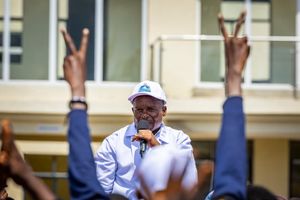
Deputy President Kithure Kindiki addresses a public rally at Mwatate Town in Taita Taveta County.
Photo credit: DPCS
Replacing Prof Kindiki, he argues, risks alienating an important voting bloc that expects to retain the country's second-highest office through incumbency.
Where differences may exist, other allies say, they are handled internally.
Unlike predecessors whose relationships with presidents became publicly confrontational, Prof Kindiki has projected an image of “discipline, restraint and institutional loyalty,” he says.
Former Kanu Secretary General Nick Salat argues that replacing Prof Kindiki at this moment will be tantamount to dirty politics.
"There is no time for that. Over the last four years, this government has demonstrated that it is inclusive and focused on development. Kenyans will make their decision based on that record, not on any other consideration. The people of the Mt. Kenya region should therefore take stock of the significant roles they currently hold in this administration, including Cabinet Secretaries and other key positions," Mr Salat told Nation.
Political analyst Charles Munyui believes Prof Kindiki has actually strengthened the case for retaining the position.
"He has demonstrated the same qualities that made him the preferred choice in the first place," Mr Munyui says.
"Those supporting government consistently view him as steady, competent and dependable."
According to Mr Munyui, there is little evidence suggesting Prof Kindiki has underperformed.
Instead, he says, his tenure has reinforced sentiments that he provides stability within government.
Dropping him, Mr Munyui argues, would raise uncomfortable political questions.
"It would create the impression that loyalty, competence and performance count for little," he says.
"It could also reinforce claims that President Ruto discards political allies once circumstances change."
Such perceptions, analysts warn, could complicate efforts to convince political partners that long-term loyalty within Kenya Kwanza is rewarded.
President William Ruto and Deputy President Prof Kindiki Kithure at State House, Nairobi on April 29, 2025.
Photo credit: PCS
With President Ruto facing resistance in parts of Mt Kenya West following the fallout with Mr Gachagua, retaining a deputy from the eastern side of the region may help prevent further political erosion.
Analysts argue that replacing Prof Kindiki could alienate voters who now view the office as their strongest guarantee of continued influence in national government.
For President Ruto, the deputy presidency has become more than a constitutional office.
It is now the focal point where coalition management, regional balance, electoral mathematics and political loyalty converge.
Perhaps no government official has defended Prof Kindiki's political future more aggressively than Public Service Cabinet Secretary Geoffrey Ruku.
For months, Mr Ruku has insisted there is no vacancy in the deputy presidency.
He has repeatedly declared that leaders seeking the position should look elsewhere because President Ruto's running mate has already been settled.
"Those looking for seats should not bother with the presidency or the deputy presidency," Mr Ruku has maintained.
The Cabinet Secretary has gone even further by warning that Mt Kenya East could politically chart its own course should other sections of the region refuse to rally behind the Deputy President.
While Mr Gachagua continues advocating for a united mountain under his leadership, some leaders from the eastern counties increasingly argue that political loyalty should flow toward the region's highest-ranking national leader.