A simmering debate over the political and economic identity of Mt Kenya East and Mt Kenya West is exposing fresh fault lines within President William Ruto's support base, threatening to complicate his efforts to retain the region's backing ahead of the 2027 General Election.
At the centre of the emerging storm is Public Service Cabinet Secretary Geoffrey Ruku, whose renewed calls for Mt Kenya East to chart its own political path have sparked sharp reactions from leaders across the region.
Mr Ruku argues that the Meru, Embu and Tharaka communities of Meru, Embu and Tharaka Nithi counties should no longer be politically tethered to the larger Mt Kenya bloc dominated by the Agikuyu and Kirinyaga communities.
"These are independent communities with more than two million votes but with no attachment to the Agikuyu community. We are unique in our own way and we also fought for this country's independence. We also had generals in the freedom struggle," Mr Ruku said.
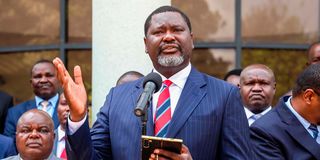
Public Service Cabinet Secretary Geoffrey Ruku at a past event at the Kenya School of Government, Nairobi on September 21, 2025.
Photo credit: Lucy Wanjiru | Nation Media Group
The Cabinet Secretary has sustained the narrative for nearly a year, occasionally drawing support from leaders in Mt Kenya East, including Embu Governor Cecily Mbarire and Mbeere North MP Geoffrey Ruku's allies in the region.
According to Mr Ruku, the larger Mt Kenya political arrangement has historically benefited the Agikuyu community at the expense of others.
"It is through that arrangement that the blood spilled during the struggle for independence produced presidents such as Mzee Jomo Kenyatta, Mwai Kibaki and Uhuru Kenyatta. Yet when one of our own, Prof Kithure Kindiki, is poised for greater leadership, opposition suddenly emerges," he said.
Mr Ruku maintains that Deputy President Kithure Kindiki has faced resistance from sections of Mt Kenya West since his elevation to the country's second-highest office following the impeachment of Rigathi Gachagua in 2024.
Prof Kindiki had initially emerged as a leading contender to become President Ruto's running mate in 2022 before Mr Gachagua was eventually selected. Following Mr Gachagua's impeachment, Prof Kindiki was appointed Deputy President.
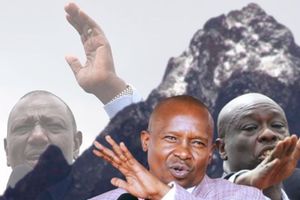
President William Ruto (left), Deputy President Kithure Kindiki and former Deputy President Rigathi Gachagua.
Photo credit: File | Nation Media Group
Rather than retreat from the political stage, Mr Gachagua reinvented himself as the face of opposition politics in the Mt Kenya region. Through his Democracy for Citizens Party (DCP) and the "Wantam" campaign, he has embarked on an aggressive mobilisation drive aimed at unseating President Ruto in 2027.
Political observers say Mr Gachagua's sustained attacks on both President Ruto and Prof Kindiki have intensified efforts by pro-government leaders to create alternative centres of political influence within the region.
"When friendship only exists during the hunt but disappears when it is time to share the spoils, then this mountain must be split," he said.
He argues that once Meru, Embu and Tharaka Nithi counties negotiate independently rather than under the broader Mt Kenya banner, Prof Kindiki will command a solid political base capable of shaping future succession politics.
However, the proposal has attracted fierce criticism from leaders who view it as politically dangerous.
Energy Principal Secretary Alex Wachira dismissed the calls as divisive and potentially damaging to President Ruto's reelection prospects.
"He is not guided by facts when discussing the relationship between Mt Kenya East and Mt Kenya West," Mr Wachira said.
He pointed to former President Mwai Kibaki's administration where influential leaders from Mt Kenya East occupied key government positions, including former Head of Public Service Francis Muthaura, former Finance Minister David Mwiraria and former minister Kiraitu Murungi.
"Mt Kenya East has always played a central role in government. There is no historical basis for claims of exclusion," he said.
Mr Wachira warned that efforts to divide the region could alienate voters who remain supportive of President Ruto.
"You are complicating an already fluid political situation. Many voters in Mt Kenya West are still willing to support President Ruto in 2027," he said.
He also accused CS Ruku of reopening sensitive historical wounds by attempting to reinterpret the Mau Mau liberation struggle through a contemporary political lens.
"Our forefathers fought together for independence. Just as they struggled together, we should remain united politically. After supporting President Ruto's reelection in 2027, we can collectively determine who should lead the region's quest for power in 2032," he said.
Political analyst Stanley Wang'ombe believes Mr Ruku's remarks reflect deeper anxieties within government circles over the region's shifting political mood.
"It must be understood that he may not be speaking entirely on his own behalf. The messaging appears carefully packaged around advancing Prof Kindiki's political standing. Unless the Deputy President publicly distances himself from the narrative, questions will continue to arise," Mr Wang'ombe opined.
Repeated efforts by the Nation to obtain Prof Kindiki's response through his media team were unsuccessful.
Kikuyu Council of Elders Chairman Wachira Kiago downplayed the significance of the debate, describing it as part of normal political manoeuvring ahead of a high-stakes election.
"We are actively involved in discussions aimed at keeping the region united as we head towards 2027. Some political formations are uncomfortable with emerging trends in the region and will naturally seek survival strategies. Mr Ruku is entitled to his views," he said.
Laikipia East MP Mwangi Kiunjuri defended Mr Ruku, arguing that the comments were a reaction to persistent attacks against Prof Kindiki by Mr Gachagua and his allies.
"When Mr Gachagua moves around the region dismissing Prof Kindiki as a stooge and an ineffective leader, those who support the Deputy President are bound to feel aggrieved," he said.
Mr Kiunjuri argued that had Mr Gachagua preserved unity during his tenure as Deputy President, the current divisions might have been avoided.
"He failed to unite the region while in office and he is failing to unite it now in opposition. He must expect political pushback," he said.
Mr Gachagua, however, insists that the growing calls to fragment Mt Kenya are evidence of a government struggling to retain support in the region.
"You have heard Ruku talking about Mt Kenya East secession. You have heard claims that Laikipia is not Mt Kenya. Similar narratives are emerging elsewhere. These are desperate survival tactics from a government whose popularity in the region is declining," he said in a recent interview on Inooro TV .
He argues that the push to create separate voting blocs is designed to weaken Mt Kenya's bargaining power ahead of 2027.
"We are more united than ever. We are expanding our alliances and building partnerships beyond the mountain. Those banking on division will be disappointed," he said.
As political realignments gather pace ahead of the next election, the debate over whether Mt Kenya should remain a single political bloc or fragment into competing regional identities is emerging as one of the most consequential battles within President Ruto's traditional support base.
And with both government and opposition forces now openly contesting the region's future direction, the outcome could significantly shape the 2027 presidential race.