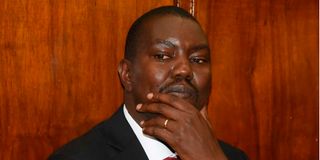
Auditor-General Nancy Gathungu has revealed that taxpayers are likely to lose Sh1.1 billion dished out by former governor Jackson Mandago and his administration in housing, car and student loans without collateral.
Some of the housing and car loans were issued to Mr Mandago and members of his administration when he was Uasin Gishu governor between 2013 and 2017.
A Senate committee has now recommended that the Ethics and Anti-Corruption Commission be roped into the loans scandal, to enable recovery of lost funds where possible.
The damning report has laid bare how the devolved unit is staring at the risk of losing more than Sh790 million in non-performing loans through beneficiaries who are unwilling to repay loans advanced to them.
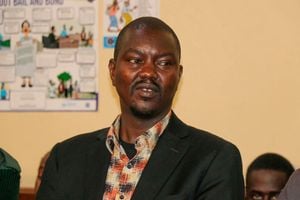
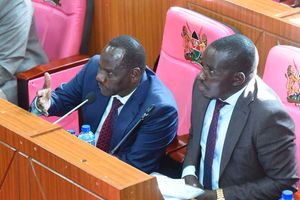
From left; Uasin Gishu Senator Jackson Mandago, county officials Joshua Lelei and Meshack Rono, during the hearing of the Sh1billion Finland Education Scholarship case at a Nakuru court on September 24, 2024.
Photo credit: Boniface Mwangi | Nation
Mr Mandago, his former deputy, Daniel Kiprotich and eight other senior officers during the 2013-2017 administration have been entangled in the borrowing scandal, as they cumulatively owe the county over Sh118.9 in defaulted loans.
The other former officers include Stephen Kipyego Lel, a former County Attorney, who owes the Uasin Gishu Executive Mortgage and Car Loan Scheme Sh5.24 million and has not been responding to demand letters to repay his loan.
The other defaulter is Barnabas Kipchumba Sang, a former ICT executive and now a Director of ICT at the Ministry of Education, who owes the scheme in excess of Sh5 million.
Ms Mary Wanjiku Njogu, a former Water and Environment executive and now a director at the Ministry of Environment, only paid Sh50,000 out of Sh4.4 million when a demand letter was issued to her.
Former Agriculture executive Ambrose Cyril Cheruiyot owes the scheme Sh5.76 million, while Robert Ngisirei, who served as the lands executive, was not responding to calls to service his loan balance of over Sh4.8 million.
Former Chief of Staff Joseph Tanui owes the scheme over Sh2.7 million, one Mr Shadrack Samboi – currently working at County Pension Fund – owes over Sh5.7 million, and lastly, Ms Jemutai Ruth Rop, a former chief officer for public service management, owes over Sh5.4 million.
The former deputy governor, currently the chairperson of the New Kenya Planters Cooperative Union, owes more than Sh16.75 million.
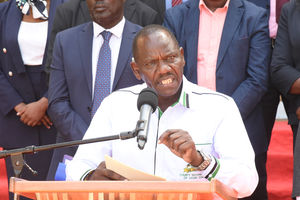
On the other hand, Senator Mandago owes the scheme over Sh62.8 million without interest being factored in and is in default, citing insufficiency in his payslip.
Usain Gishu Senator Jackson Mandago.
The revelations emerged during a Senate County Public Investments and Special Funds Committee on Thursday, March 19, 2026, where senators demanded EACC commence investigations into the “heist” with a view to arresting and prosecuting culpable county officers.
The latest development comes hot on the heels of an ongoing probe into the Sh1 billion overseas education scholarship saga, popularly known as the Finland scandal, where Mr Mandago is one of the suspects.
According to the report for the financial year ending June 30, 2025, the recoverability of the Sh118.94 million as part of Sh507.37 million loan is now in doubt.
The auditor revealed that a Sh52.89 million mortgage loan was due as of June 30, 2025, plus accrued interest of Sh6.6 million, but nothing had been repaid.
The committee, chaired by Vihiga Senator Godfrey Osotsi, heard that Mr Mandago had an advanced excess mortgage and car loan, blowing the set ceiling by Sh24 million.
The senator was advanced a 20-year mortgage loan of Sh40 million in the financial year ending June 30, 2017, which was later topped up to Sh64 million, exceeding the allowed maximum for a governor by Sh24 million according to the law.
According to the Salaries and Remuneration Commission (SRC) circular of December 17, 2014, a maximum of Sh30 million mortgage benefit is prescribed for a county governor with a ceiling of Sh40 million according to the third remuneration and benefits review cycle for county government officers covering financial years 2021/22 to 2024/2025.
Apart from the 10 defaulters, the audit also revealed that loans amounting to Sh9.47 million in respect to some 39 officers were underperforming during the year under review, with no proof of recovery or punitive measures instituted against the defaulting officers.
“This is a classic case of abuse of office where the former governor, his deputy and CECs took loans and have refused to pay the same in a show of impunity,” said nominated Senator Hamida Kibwana.
Senator Godfrey Osotsi, who is the chairperson Senate County Public Investment Committee.
Photo credit: File | Nation Media Group
Senator Osotsi decried how the Scheme was run unlawfully, describing how the former county boss was advanced Sh40 million, and before he could repay, he was given another Sh24 million in clear breach of the law.
“There were a lot of illegalities in the administration of the Scheme where people in circles of influence and seemingly untouchable did whatever they wanted and were not even bothered to repay the money,” said Mr Osotsi.
Nominated Senator Peris Tobiko called on Governor Jonathan Bii’s administration to put in measures aimed at recovering the outstanding loans, even if it means attaching properties of the defaulters, including the title deeds and log books that were provided as security for the loans.
“We are talking about millions here yet we have Kenyans rotting in different prisons in the country for stealing just a chicken. We must use this as an example of repercussions of misuse of public funds by having EACC seized of the matter,” said Ms Tobiko.
For his part, Governor Bii called on the Senate to help the county follow up on the matter in order to recover the millions of shillings.
“The former governor is saying he has another loan and so he is not able to repay this one. This is impunity. I would like to see action from the Senate to prove you are walking the talk on matters accountability,” he said.
In a classic case of covering their tracks, the Fund lacks an approved debtor’s management policy guiding loan administration, monitoring, collection, and reporting contrary to Regulation 158(1)(a) and (b) of the Public Finance Management Regulations, 2015.
The regulation requires an accounting officer of a county to develop and implement risk management strategies, including fraud prevention mechanisms.
But that was not all. Under the Uasin Gishu Executive Education Revolving Fund, some Sh325.38 million has been disbursed since inception in 2014, but only Sh2.5 million, or 0.8 percent, has been recovered, indicating weak recovery mechanisms.
Raising the alarm, the Fund did not maintain a payment register of each beneficiary and the amount owed, throwing into doubt the recovery of the remaining Sh322 million, out of which Sh316 million are non-performing.
According to the auditor, the loans were not supported by the date of issuance, principal loan amount, applicable interest rate, interest charged, amount repaid and outstanding balance, among others.
“A significant portion of the loans amounting to Sh316,044,586 remains non-performing, and recovery efforts have not yielded any tangible results,” stated the report.
Governor Bii told the committee that it is only upon assuming office that they introduced an amendment to the Fund’s regulations to require a beneficiary to provide security in the form of a guarantor before accessing any loan.
He revealed that the problem that has dogged the Fund was the condition of having gainful employment as a security.
Interestingly, the money was also being channelled to institutions where the beneficiaries were studying instead of being given to the beneficiaries directly.
The county boss explained that the Fund began in 2014 as a scholarship fund before suddenly turning into a revolving fund in 2016.
“It appears there was monkey business in the administration of this Fund. Something like an inside job. I can even see a case of double issuance to a beneficiary where the individual was given Sh277,000 twice,” said nominated Senator George Mbugua.
Senator Tobiko added: “This was nothing but a scheme to siphon public funds with no intention or strategy to recover the loans at all. We must involve the EACC in this.”
“Can you assure this committee that this is not an extension of the Finland scandal. Uasin Gishu has become known for all the wrong reasons in matters education,” said nominated Senator Beth Syengo.
The county told the committee that it has written to KRA and the Ministries of Health and Education to assist in tracing loan beneficiaries who have secured employment. There has been little success in recovering the loans.
Going forward, however, the county said it intends to approach the Credit Reference Bureau to assist in the listing of the defaulters.
“There is a serious risk of not recovering the money because of the lack of security attached to the loans,” said Mr Osotsi.
Uasin Gishu Governor Jonathan Bii.
Photo credit: File | Nation Media Group
Governor Bii agreed, saying: “Help us recover the money even if it means EACC being seized of the matter. The former governor is now your colleague at the Senate.”
The Controller of Budget made another startling revelation that some of the loans were being maintained manually on an Excel sheet.
“This is not prudent utilisation of public funds. The county has shown they have no capacity to run the revolving fund. They should consider engaging financial institutions to manage the fund on their behalf.”
Besides the two scandals, the county government was involved in another one regarding the administration of the Uasin Gishu Cooperative Enterprise Development Fund.
According to Ms Gathungu, the Fund disbursed loans amounting to Sh429.1 million to 195 Co-operative Societies, however, loans amounting to Sh340 million advanced to 91 Cooperative Societies had no recoveries made during the year under review.
Further, the Sh340 million advanced to 57 primary Cooperative Societies affiliated to Moisoy Farmers Cooperative Union, amounting to Sh285 million, and accumulated interest of Sh37.69 million had been defaulted upon.
The loans were disbursed on different dates between February 2019 and June 2022 through an understanding that the loan repayment was to take effect upon operation of a maize milling plant at Moisoy Farmers’ Cooperative Union.
But a physical verification in August 2025 revealed that the construction of the milling plant had stalled.
Further, the auditor revealed, the Fund did not secure the issued loans that have attracted a cumulative accrued interest of Sh37.6 million.
The Fund did not charge any interest on the outstanding loan balance of the Sh47 million advanced to some 28 Cooperative Societies.
“The Fund’s loan book was not provided for audit verification and therefore it was not possible to determine whether or not interest was being charged on the loans and whether the loan repayments were being done within the required time,” said Ms Gathungu.
Senator Osotsi added: “It looks like the Funds were set up in Uasin Gishu purposely to siphon public funds as all of them have problems. The Funds were created to give loans which the county was not keen on recovering.”
Uasin Gishu Senator Jackson Mandago.
Photo credit: File I Nation Media Group
Senator Mandago was not present during the session, with his absence shining the spotlight on a failed push to have former governors seeking to contest either as senator or MCA immediately after the end of their terms barred for at least five years.
Even after the proposed legislation – The Constitution of Kenya (amendment) Bill, 2023 – received a green light from the Senate Justice and Legal Affairs committee in 2024, it never saw the light of day.
The Bill, by nominated Senator Raphael Chimera sought to amend Article 180 of the Constitution of Kenya by inserting a new clause to provide that a person who has served as a county governor shall not be eligible to be elected as a senator or MCA within the first five years immediately after the end of the term of service.
Mr Chimera argued that the consequence of the draft bill is to allow for any ongoing accountability processes, such as auditing of county government accounts, to be concluded.
The outcome of such processes, he said, would have a bearing on whether such a person would be suitable to hold any other elective office.
The lawmaker pointed out that county governors, in the course of their duties, have to account to the county assemblies and the Senate for any financial and administrative decisions made.
Currently, former Mandera Governor Ali Roba and Mr Mandago are serving as senators after being elected immediately after serving two terms as governors. However, there are more governors who have already indicated they will be going for the senatorial seats at the end of their two terms in 2027.
The Bill received fierce opposition with different actors saying singling out ex-governors was discriminatory and is not in conformity with Article 38 of the Constitution, which states that every citizen is free to make political choices.
The Council of Governors, in particular, argued that the contents of the Bill are in violation of Article 50(2)(a) on the presumption of innocence and fair hearing on the basis that the provisions are speculative.