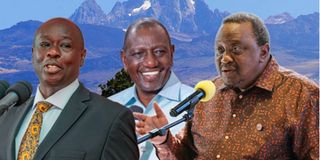
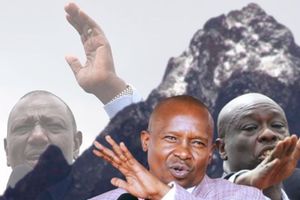
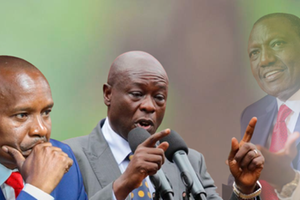
Retired President Uhuru Kenyatta has once again found himself at the centre of Mt Kenya’s restless political orbit, as shifting loyalties around ex-Deputy President Rigathi Gachagua and President William Ruto redraws the region’s influence map ahead of the high-stakes 2027 elections.
Since his fallout with president Ruto, Mr Gachagua has cast himself as the region’s chief mobiliser, rallying leaders and opinion shapers under a narrative of political and economic marginalisation.
As the 2027 election cycle slowly takes shape, the region finds itself in a familiar yet more complicated position—caught in a three-way tug-of-war between president Ruto, Mr Gachagua, and Mr Kenyatta.
Across the region, individual politicians tell the story of a political bloc in motion.
Perhaps no figure better illustrates the current ambiguity than former Jubilee Secretary General Jeremiah Kioni, once a staunch ally of Mr Kenyatta but now appears to drift towards Mr Gachagua.
Mr Kioni last Week (March 20), in a move that raised eyebrows across the political divide held talks with Mr Gachagua, in what appeared to be a drift from Mr Kenyatta’s wing.
Jubilee Co-Deputy Party Leader Jeremiah Kioni.
Photo credit: File | Nation Media Group
Even though he was quick to dismiss suggestions that he was abandoning the former president for Mr Gachagua, insiders suggest his recent removal as Jubilee secretary general may have unsettled him, prompting a reassessment of his political positioning.
In a rare praise of Mr Gachagua when reached by Nation , he remarked; “Rig G (Gachagua) has succeeded to achieve what RAO (the late Raila Odinga) never achieved during our ‘open the server’ demonstrations.”
The statement was both a critique on the late ODM leader and an acknowledgment—highlighting Mr Gachagua’s growing influence even among Mr Kenyatta ‘loyalists.’
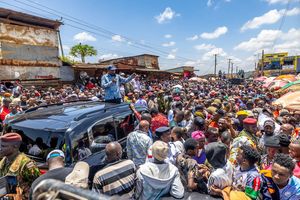
Mr Gachagua’s tours across Mt Kenya have doubled as both a resistance campaign and a bid to inherit the kingpin mantle from Mr Kenyatta, even as cracks emerge over strategy, timing and the question of who ultimately calls the shots.
Yet even as Gachagua – the Democracy for the Citizen’s Party (DCP) leader pushes his case, the quiet reawakening of Jubilee Party leader, Mr Kenyatta’s networks is complicating the equation.
Once written off as politically spent following Azimio la Umoja One Kenya’s 2022 election loss, the former president is steadily reasserting influence through backchannel engagements, exclusive consensus-building and renewed ties with sections of the opposition.
His re-entry has revived old loyalties within the mountain, presenting an alternative centre of gravity for leaders wary of burning bridges ahead of 2027.
Former Deputy President Rigathi Gachagua.
Photo credit: File | Nation Media Group
Caught in the middle is president Ruto, whose grip on the vote-rich region is increasingly being tested by the twin pressures of internal dissent and external realignment, even as he heavily banks on his Deputy Prof Kithure Kindiki to leverage the support.
While the President continues to lean on development promises, new alliances and incumbency to steady his base, the erosion of a once-solid Mt Kenya bloc threatens to fragment a coalition that was pivotal to his 2022 victory.
The 2022 elections saw Mt Kenya rally almost unanimously behind Dr Ruto, with Mr Gachagua emerging as the region’s chief mobilizer.
Mr Kenyatta, then outgoing president, had seemingly lost his grip on his political backyard after backing the opposition.
But politics in Mt Kenya, analysts say, rarely stands still.
Political analyst Dismas Mokua says that already, concerns are emerging among 2027 aspirants in the region, “many of whom are uneasy with what they describe as an increasingly centralised and coercive political environment,” being advocated by Mr Gachagua, hence Mr Kenyatta’s quiet influence.
“Aspirants are not guaranteed free and fair party primaries,” Mr Mokua claims. “They also find the forced pecuniary support for certain political outfits dictatorial. That is why many are looking at Jubilee and Justin Muturi’s Democratic Party as more accommodating options.”
President William Ruto and Deputy President Kithure Kindiki inspect the Kulamawe–Garbatulla section of the 750km Isiolo–Mandera Road under the Horn of Africa Gateway Development Project on February 11,2026.
Photo credit: PCS.
According to Mr Mokua, this discomfort is fuelling resistance against what he terms a “strongman approach” to politics in the region.
“There is a growing phobia of authoritarian-style leadership,” he says. “Efforts to turn one party into the sole de facto vehicle in Mt Kenya risk suffocating democracy.”
Unlike in 2022 when the ground appeared solidly behind Ruto-Gachagua, today, it is shifting again—this time in a way that suggests the region may be returning, at least partially, to Mr Kenyatta’s orbit, but with the former DP (Gachagua) acting as a bridge rather than a barrier.
Once president Ruto’s most dependable ally in the region, Mr Gachagua has increasingly carved out an independent political identity under his Democracy for the Citizens Party (DCP).
His messaging has evolved from defending the government to positioning himself as the true custodian of Mt Kenya’s political and economic interests.
Faced with internal competition from Prof Kithure Kindiki, who is advancing president Ruto’s message in the region, and sustained pressure from Ruto-aligned legislators, Mr Gachagua has sought to consolidate a personal power base that extends beyond the ruling coalition.
His outreach to Mr Kenyatta - once unthinkable, analysts say, signals a strategic reset aimed at uniting the region under a broader political umbrella.
“For Kenyatta, the shifting alliances present an opportunity for political redemption. After a bruising 2022 defeat, many had written him off as a spent force. Yet his influence within Mt Kenya’s business and political elite has remained intact,” argues advocate Chris Omore.
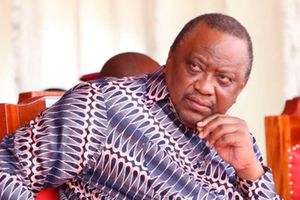
Retired President Uhuru Kenyatta.
Photo credit: File | Nation Media Group
Across the region, individual politicians tell the story of a political bloc in motion.
Few figures capture this better than former Nyeri Town MP Wambugu Ngunjiri. Once a loyalist in the camp of Mr Kenyatta, he gravitated toward Mr Gachagua during the latter’s rise as deputy president.
But as political winds change yet again, Mr Ngunjiri appears to be drifting back toward Mr Kenyatta, illustrating the circular nature of Mt Kenya politics where yesterday’s alliances are constantly renegotiated.
A similar, path has been walked by ex-Bahati MP Kimani Ngunjiri.
After leaving Uhuru’s fold to ride Mr Gachagua’s wave, he now finds himself politically at variance with the former DP.
Former Cabinet Secretary Moses Kuria is one of the earliest and most vocal defectors from Uhuru’s camp ahead of the 2022 elections.
He played a pivotal role in Dr Ruto’s campaigns in the region. Yet today, his apparent ouster from the inner circles of power suggests a politician carefully navigating uncertain terrain outside the establishment he helped build.
That sense of realignment is also evident in Kiharu MP Ndindi Nyoro. Once among Dr Ruto’s most visible and trusted lieutenants in the region, Mr Nyoro has in recent months become one of the vicious critics of the Kanya Kwanza administration.
After nearly three year’s of silence, that her allies link to her ‘devotion’ to service, Kirinyaga Governor Anne Waiguru has come out firmly to assert her alignment with president Ruto, representing a bloc of leaders who see stability in sticking with the incumbent.
She has cautioned against framing Mt Kenya politics around regional dominance, saying the region wants to be part of a broader national project rather than appear as a bloc seeking to lord over others.
“Mt Kenya wants to be seen as an integral part of the Kenya mosaic, not a majority people lording over others,” Ms Waiguru told Nation .
People's Liberation Party leader Martha Karua delivers her speech during the party's launch in Nairobi on February 27, 2025.
Photo credit: Boniface Bogita | Nation Media Group
For People’s Liberation Party (PLP) leader Martha Karua, associated with Mr Kenyatta’s Azimio coalition in 2022, has increasingly found common cause with Mr Gachagua in the United Opposition—an unlikely convergence that reflects shifting priorities.
The cracks within Uhuru’s traditional base are further illustrated by former Kieini MP Kanini Kega. Once a staunch defender of Jubilee and Mr Kenyatta, Mr Kega has joined Mr Gachagua’s DCP camp, signaling that even long-standing loyalties are no longer guaranteed.
Nominated MP Sabina Chege has taken a different route, transitioning from Uhuru’s inner circle to working more closely with President Ruto, aligning with the realities of state power.
Mathira MP Eric Wamumbi, has taken an unfamiliar position, abandoning Mr Gachagua – his constituent, and choosing to remain firmly in Dr Ruto’s camp.
Advocate Chris Omore says: “These individual journeys paint a broader picture of a region in flux. Mt Kenya is no longer a monolithic voting bloc but a dynamic arena where alliances are constantly tested, abandoned, and rebuilt."
As the road to 2027 unfolds, he says, these shifting loyalties may determine not just the region’s political direction - but the future of the country itself.
For President Ruto, Mt Kenya remains indispensable to his re-election strategy.
While he retains loyalists—led by Prof Kindiki, there is growing unease among leaders who fear being locked out of future political arrangements.
Analysts argues that at the moment, neither President Ruto, Mr Gachagua, nor Me Kenyatta can claim uncontested authority over the region.
This, they say, has created both uncertainty and opportunity.
“As 2027 approaches, the central question is not whether Mt Kenya will unite—but under whom and at what cost,” argues Mr Mokua.