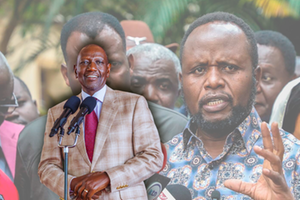
A bid by a section of Members of Parliament to tighten the law on their recall failed on the floor of the House during consideration of the Elections (Amendment) Bill, 2024
Calls to make the recall ‘easier’ for the electorates and the risk of the court nullifying the law less than one year to the general elections led to a proposal by Suba North MP Millie Odhiambo failing to carry the day.
Ms Odhiambo, supported by a section of MPs who argued that a threshold on recall should be elaborate and subjected to the same process as that of the President.
Ms Odhiambo proposed a new clause seeking to add that for an MP to be recalled, he must have committed a felony under international law, tried, convicted and sentenced for at least six months.
An MP can be recalled for gross violation of a provision of the Constitution or any other law; where there are serious reasons for believing that the member has committed a crime under national or international law and for gross misconduct.
In its report, the Justice and Legal Affairs Committee proposed a new Clause 26A in the Bill in order to address the gap in the recall law that the courts nullified.
The committee proposed that a recall of MPs will only be done if at least one-third of registered in every ward of the affected constituency sign the petition and, in the case of a senator, one-third in every constituency.
However, in the recall by-election, the winner will be decided by simple majority.
However, Ms Odhiambo opposed the amendment, saying it makes the recall easier.
“Whether I stand alone, I will stand on my truth, I oppose this amendment .The threshold you are providing here is very low, Kenyans are very political in nature and whether you win fairly or not, someone will complain that you have stolen their election,” Ms Odhiambo said.
Suba South MP Caroli supported the call to tighten the recall requirement, warning his colleagues that the new requirement will come back to haunt them.
“We must provide for a mechanism of trial which is independent of the electorates so that you are subjected to a court process or a tribunal which will find you guilty after which members of the public can now recall you,” Mr Omondi said.
“Getting a third in every ward is so easy, it is like closing your eyes and walking in space. The threshold of removing people’s representatives to remove them must be high enough so that this process is not abused,” Mr Raso said.
However, Majority leader Kimani Ichung’wah and his Minority counterpart Junet Mohamed accused their colleagues of legislating in fear, saying a recall should not be made difficult for the electorates to actualise.
“We should not legislate in fear, we don’t legislate for ourselves but for posterity. By putting 50 percent in every ward, we are just repeating what the court had rejected and we will be legislating in vain because it will be nullified again,” Mr Iching’wah said.
“In any case not all of us are elected by 50 percent, so it cannot be that you want a higher threshold for a recall,” he added.
Mr Mohammed pointed out that the process of removal of a President and MP cannot be the same, explaining that while a President is subjected to a trial in Parliament, MPs cannot be tried by their colleagues.
“You cannot have a trial of an MP in the same house; you must take him back to the people. We have, however, put a provision that the recall must be approved by a third of registered voters in every constituency
“Members should not come here to hide under the law. You must be recalled. People should not fear, if you have lost a third of your constituency in every ward, then go and do something else, you don’t deserve to be an MP,” he added.
Dagoretti North Beatrice Elachi warned her colleagues against making legislation that is likely to be nullified by the courts again.
“Let it not look like we are trying to protect ourselves on something that will go to court and get back to bite us. A third per ward is okay. Getting it is not easy,” Ms Elachi said.
Article 104 provides that Parliament shall enact legislation that provides for grounds upon which a member may be recalled and the procedure to be followed.
The Commission, however, said the court declared section 45 (2) of the Election Act, which provided for grounds for removal, unconstitutional.
In 2017, a three-judge bench comprising Kanyi Kimondo, George Odunga and Chacha Mwita declared the law on recall of MPs as meaningless, discriminatory and unconstitutional.
The High Court declared sections 45 (2) (3) and (6), 46 (1) (b), (ii) and (c) and 48 of the Elections Act (Cap 7) and sections 27 (2) (3) and (6) and 28 (1) (b) (ii) and 9c) of the County Governments Act (Cap265) unconstitutional in its judgment in a case of Katiba Institute and Another vs Attorney General and Another (2017) Eklr1.