The National Assembly has scrapped proposed legal safeguards that would have strengthened the electoral commission’s ownership of election technology and required election servers to be hosted in Kenya, reopening questions about who controls the systems used to manage and transmit election results.
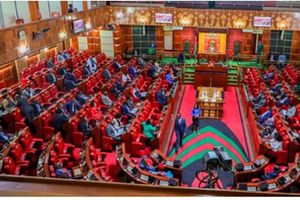
The House adopted amendments by Homa Bay Town MP Peter Kaluma to the Elections (Amendment) Bill, 2024, removing provisions that sought to vest intellectual property rights in the Independent Electoral and Boundaries Commission (IEBC) and require election technology providers to host servers in the country.
The changes were adopted without a contest as MPs considered the Bill, which now returns to the Senate, where it originated, for consideration of the National Assembly’s amendments.
The decision comes against the backdrop of the disputed management of election technology in previous polls, particularly the 2017 presidential election, which the Supreme Court nullified, and the 2022 election, when technology provider Smartmatic International Holding BV reportedly denied IEBC access to election servers despite a court order.
The provisions were part of reforms proposed by the National Dialogue Committee (Nadco) to strengthen the commission’s independence, improve transparency and prevent election technology suppliers from using intellectual property rights to restrict scrutiny of election systems.
Homa Bay Town MP Peter Kaluma.
Photo credit: File I Nation Media Group
But Mr Kaluma questioned the need to entrench the requirements in law, arguing that issues surrounding the location of servers and ownership of technology should not be legislated in the manner proposed.
“In procuring the technology, the commission shall ensure that, subject to the Constitution, this Act and the Data Protection Act, the technology is accessible and available for scrutiny by candidates, courts and such other persons as required under the law,” read the amendment adopted by the House.
“When we start saying that the server and data centre shall be located in Kenya, what are we talking about? I am requesting that we delete this,” Mr Kaluma said.
The original Bill proposed amending Section 44 of the Elections Act to require the commission to secure intellectual property rights to election technology procured from suppliers. The aim was to prevent a repeat of situations in which technology providers could invoke proprietary rights to restrict the commission’s access to critical systems.
The proposal also sought to guarantee access to election technology and information for scrutiny by candidates, courts and other authorised parties, with the commission barred from charging fees for information supplied in soft copy.
Mr Kaluma questioned the rationale for including the intellectual property provision in legislation, arguing that ownership should ordinarily follow procurement.
“What are we talking about? When you procure something, it becomes yours. These are not things to put in law,” he said.
He also challenged the proposal to require election servers to be hosted in Kenya, questioning whether internet-based information could be confined within national borders.
“May I ask those who are knowledgeable in Information and Communication Technology (ICT) where this place called the ‘Cloud’ is, or where our information is?” he posed.
The provisions were intended to address concerns over the commission’s dependence on private technology suppliers, particularly where proprietary rights could limit access to election systems during disputes.
Currently, IEBC has its election servers hosted in Data Centres outside the country, a situation that the Bill wanted changed based on the risks spanning national security, legal compliance, operational sovereignty and public trust, making it a highly contentious topic in local politics.
The Bill further granted the commission the mandate requiring that the supplier of the technology, or their associates, shall not have been found guilty of violating any procurement law, committed a crime, violated professional standards, or been barred from participating in public procurement in any jurisdiction.
“Should these be matters for the tender or procurement documents rather than a law like this?” posed the Homa Bay Town MP as the House agreed with him.
The Bill is one of the “progressive reforms” meant to assert the independence of the electoral commission in the management of elections while promoting the interests of foreign companies providing the election technology.
An IEBC clerk keys in a voter’s ID details during a past biometric voter registration exercise. IEBC is targeting 6.3 million new voters ahead of the 2027 General Election.
Photo credit: File | Nation
Granting IEBC ownership of the intellectual property rights aimed at promoting integrity in managing election results, especially when previous technology providers have denied the commission access to election servers despite valid Supreme Court orders.
A proposed new section 82A of the Bill had also provided that “the commission shall ensure access to information including any technology used in elections and shall not charge fees where the information requested is provided in soft copy.”
“Where an access request is made pursuant to scrutiny of votes, the commission shall facilitate access in the case of a presidential election, within three days of the date of the request and in the case of any other elective position, within seven days of the date of the request,” the Bill proposes.
The MP did not alter the requirement that, where information requested is to be provided in hardcopy format, “the commission may charge a prescribed fee for the provision of the information.”
“The fee shall not exceed the actual costs of making copies of such information and, if applicable, supplying them to the applicant,” reads the Bill.
While IEBC, in connivance with technology providers, has hitherto blocked its stakeholders, including political parties, candidates in elections, among others, from accessing information it holds, it has been accused of allowing unauthorised access to its election servers, exposing it to risks of manipulating stored data- election results.
The IEBC's failure to open the servers was among the reasons the Supreme Court nullified the August 8, 2017 presidential election results and directed that a “fresh, fair and credible” presidential election be held on October 26, 2017.
Democratic Party leader Justin Muturi delivers his speech during the launch of the Independent Electoral and Boundaries Commission Strategic Plan 2024–2029 and Election Operations Plan 2025–2027 at Kenyatta International Convention Centre in Nairobi on June 24, 2026.
Photo credit: Wilfred Nyangaresi | Nation Media Group
The immediate former Speaker of the National Assembly, Mr Justin Muturi, argued that “granting the IEBC the independence it so requires in the management of election results is crucial for a free, fair and credible process”
“For me, a key item is for the IEBC to ensure that whoever is the provider of the KIEMS kits gives the commission the ownership of the intellectual property rights to avoid situations similar to the ones witnessed in the previous elections,” Mr Muturi, the DP party leader, said.
Mr Muturi, also the immediate former Attorney-General and the immediate former Cabinet Secretary for Public Service, added, “I call on the parliament to enact the law and on the IEBC to ensure compliance for greater accountability.”
Mr Muturi’s push is informed by the 2022 circumstances where Venezuelan firm Smartmatic International Holding BV, which provided the Kiems kits technology, denied IEBC access to the servers holding the election results despite the Supreme Court.
It is because of this that the Nadco report proposed an amendment to the Elections Act “to cure such legal challenges.”
Smartmatic supplied and managed the software and hardware for the Kiems kits, used for biometric voter registration, electronic voter identification on election day and the electronic transmission of election results from polling stations to tallying centres.
The Venezuelan firm supplied IEBC with over 14,000 new Kiems kits and upgraded the software for the other 41,000 existing kits to power the 46,229 polling stations across the country during the 2022 general election.