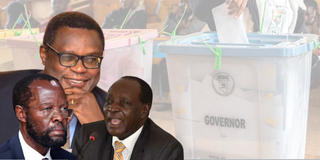
Clan dynamics are emerging as a dominant factor in four gubernatorial successions in western Kenya, where the current incumbents are completing their final terms in office.
Ahead of the 2027 General Election, political leaders seeking to succeed governors who have served their two terms are increasingly invoking regional representation and clan dynamics to rally support.
Bungoma, Vihiga and Kisumu counties are already witnessing intense political contests, with aspirants positioning themselves through ethnic and sub-regional alliances as they seek to succeed outgoing governors.
All eyes are on Nyamira, where the governor is eligible for another term after his predecessor died after serving over two and a half years.
In Bungoma County, Governor Kenneth Lusaka is serving his second and final term, having first held office from 2013 to 2017 before reclaiming the seat in 2022. Mr Lusaka hails from Kimilili Constituency, while his predecessor, Wycliffe Wangamati, who served between 2017 and 2022, comes from Kanduyi Constituency.
Political temperatures have already risen, with aspirants clashing over which region should produce the next governor.
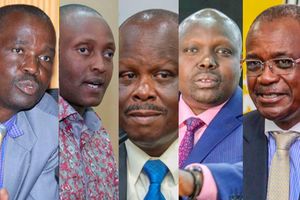
The race is shaping up as a fierce contest featuring Kimilili MP Didmus Barasa, Westlands MP Tim Wanyonyi, and former governor Wycliffe Wangamati, who is seeking a political comeback.
Westlands MP Tim Wanyonyi.
Photo credit: Evans Habil | Nation Media Group
Mr Barasa is a second-term MP, while Mr Wanyonyi traces his roots to Kabuchai Constituency, which was carved out of the larger Sirisia Constituency in 2013. Mr Wangamati, meanwhile, remains a strong contender from Kanduyi.
Kimilili MP Didmus Wekesa Barasa speaks to the media at Bunge Tower Nairobi on June 18, 2025.
Photo credit: Dennis Onsongo | Nation Media Group
Sirisia MP John Waluke, who has recently been viciously campaigning for Mr Wanyonyi, stirred political debate when he declared that the governorship should not return to Kimilili, in what was widely seen as a direct jab at Mr Barasa, who is eyeing the seat on a UDA ticket.
“County leadership should rotate and be shared fairly rather than remain in one region. We have agreed that the governorship should not stay in Kimilili because they have already held it for 10 years,” Mr Waluke, a Jubilee MP, said during an event in Mt Elgon, attended by Forestry Cabinet Secretary Deborah Mulongo and Mr Barasa himself.
Former Bungoma Governor Wycliffe Wangamati.
Photo credit: File | Nation Media Group
Mr Waluke has repeatedly urged the MP not to “waste his time” pursuing the governorship, advising him instead to seek a third term as MP.
Since 2013, Bungoma’s governorship has been held by Ford-Kenya, but the party currently appears to lack a formidable candidate. Mr Wanyonyi, younger brother to Ford-Kenya leader Moses Wetang’ula , has declared that he will not contest on his brother’s party ticket. Mr Wangamati, meanwhile, is expected to run on DAP-Kenya, led by Eugene Wamalwa in the United Opposition.
In Vihiga County, political tensions are intensifying between the Maragoli and Abanyore communities over who should take over the governor’s seat in 2027.
Governor Wilberforce Otichillo, from the Abanyore community, is serving his second term after previously serving as Emuhaya MP before winning the governorship in 2017. His predecessor, Moses Akaranga, who served from 2013 to 2017, is Maragoli. He is now eyeing the senatorial seat.
Former ODM co-deputy party leader Godfrey Osotsi.
Photo credit: Dennis Onsongo | Nation Media Group
Several prominent figures have already entered the race, including Senator Godfrey Osotsi, former senator George Khaniri, Emuhaya MP Omboko Milemba and former Kenya Secondary School Heads Association chairman Kahi Indimuli.
Former Vihiga Senator George Khaniri.
Photo credit: File | Nation Media Group
The Maragoli community is concentrated in Hamisi, Sabatia, and Vihiga constituencies, while the Abanyore predominantly occupy Luanda and Emuhaya.
Political observers note that Maragoli candidates have often lost the governorship due to vote-splitting, while the Abanyore have traditionally united behind a single candidate.
This dynamic is credited with helping them secure both the governorship and senate seats for Luanda and Emuhaya in the 2022 elections.
UDA Deputy Secretary-General Omboko Milemba.
Photo credit: File | Nation Media Group
“My goal is to strengthen healthcare services, improve urban planning, build markets, enhance infrastructure, and address development gaps I have observed during my tenure as senator,” Mr Osotsi said while leading Linda Mwananchi rallies across the county on April 8.
While Mr Osotsi and Mr Omboko come from Luanda/Emuhaya, Mr Indimuli, a close ally of Prime Cabinet Secretary Musalia Mudavadi , is Maragoli.
Residents have always insisted they prioritise leadership performance over ethnic or communal considerations.
In Kisumu County, at least six contenders are already positioning themselves to succeed Governor Anyang’ Nyong’o, whose second term ends in 2027.
Those eyeing the seat include Kisumu Central MP Joshua Oron, Nyakach MP Aduma Owuor, Senator Tom Ojienda, former governor Jack Ranguma, Deputy Governor Mathews Owili, and former Kisumu Central MP Ken Obura.
Mr Ranguma, from the influential Kano clan, is seeking to reclaim the seat he lost to Nyong’o in 2017. Mr Oron also comes from Kano, while Owuor, Ojienda, and Owili all come from Nyakach.
On November 13 last year, 13 sub-clans allied to Kano publicly endorsed Mr Oron’s gubernatorial bid.
“As the Kano community, we have unanimously resolved to support Dr Joshua Oron because of his proven leadership and service. Even before becoming an MP, he was helping residents,” said elder Walter Aluoch.
“We also have capable leaders like Jack Ranguma and Ken Obura, but our decision is based on Oron’s performance. He has stood with the people, and we are standing with him,” Elder Aluoch added.
Two weeks ago, Muhoroni MP James Onyango K’Oyoo also declared his support for Oron.
“Despite being the majority in Kisumu County, our region has often been sidelined in the current administration. Muhoroni is backing Oron. There is no difference between Nyando and Muhoroni, and all our votes must go to Oron,” Mr K’Oyoo said.
The Kano voting bloc, which includes Nyando, Muhoroni, Kisumu East, and parts of Kisumu Central, holds significant electoral influence, while Nyakach, Kisumu Town West and Seme command fewer numbers.
However, some leaders argue that Kano held the governorship in Mr Ranguma’s first term and that it is now Nyakach’s turn to lead the county.
In Nyamira County, Governor Amos Nyaribo from North Mugirango is eligible for a third term in office, and several contenders have already entered the race.
The county’s first governor, the late John Obiero Nyangarama, hailed from West Mugirango, prompting calls for the governorship to shift to either Borabu or Kitutu Masaba.
Nyaribo took over in December 2020, and if re-elected, he will be among the few governors to serve for over 10 years.
Nyamira politics are traditionally shaped by complex Abagusii clan dynamics, a factor expected to play a decisive role once again in 2027.
Former Kitutu MP Timothy Bosire.
Photo credit: File | Nation Media Group
Among those eyeing the seat are ODM National Treasurer Timothy Bosire, a former Kitutu Masaba MP; Senator Okong’o Omogeni from Borabu; and Walter Chanua, a county official in Narok who comes from North Mugirango, as well as former Borabu MP Ben Momanyi.
Nyamira Senator Okong’o Omogeni.
Photo credit: Dennis Onsongo | Nation Media Group
Borabu Constituency, home to various Abagusii clans, is not viewed as the exclusive political base of any single gubernatorial aspirant, making the race particularly unpredictable.
However, analysts say the political influence of Jubilee Deputy Party Leader Fred Matiang’i could prove decisive in determining who ultimately secures the county’s top seat.