For nearly three decades, the late ODM leader Raila Odinga perfected the art of opposition politics and became synonymous with it.
Rallying supporters through economic boycotts, political mobilisation through rallies, international lobbying and knitting broad political alliances, Odinga used these strategies to pile pressure on successive regimes
Now, less than two years after his fallout with President William Ruto, former Deputy President, Rigathi Gachagua, the Democracy for the Citizens Party (DCP) leader, appears to be borrowing from the very script he once fiercely criticised, signaling a dramatic shift in Kenya's opposition politics.
When Mr Gachagua urged foreign tourists and investors to stay away from Kenya until after the 2027 General Election, many viewed the remarks as yet another escalation in his confrontation with President Ruto's administration.
But to seasoned observers of Kenya's politics, the appeal represented something much bigger.
It was the latest indication that the former Deputy President is steadily embracing the opposition tactics that defined the late Odinga's decades-long political career—using economic pressure, international messaging and coalition politics to pile pressure on the government without wielding State power.
Just as Odinga repeatedly sought to amplify domestic grievances beyond Kenya's borders and mobilise economic pressure against governments he opposed, Mr Gachagua is increasingly adopting similar strategies as he positions himself as President Ruto's principal challenger ahead of the 2027 General Election.
Perhaps the clearest similarity between Odinga and Mr Gachagua lies in the use of economic pressure as an instrument of political resistance.
In July 2023 and earlier following the disputed 2017 presidential election in which he successfully petitioned against, Odinga urged Kenyans to boycott products and services offered by companies he accused of supporting the government.
In 2023, the boycott formed part of Azimio la Umoja's anti-government campaign over the high cost of living, electoral justice and governance.
Government officials at the time, including Mr Gachagua, condemned the move, arguing that Odinga was hurting Kenyan businesses and threatening jobs.
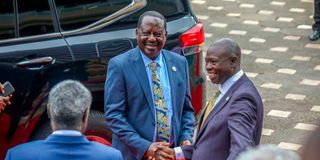
Former Deputy President Rigathi Gachagua with the late former ODM leader Raila Odinga at the Mombasa International Airport on September 16, 2022.
Photo credit: Courtesy | Rigathi Gachagua's Facebook page
“We cannot allow an individual to cause chaos in the country and destroy peoples’ businesses. That’s not a leader, but a criminal,” Mr Gachagua charged while still serving as Dr Ruto’s deputy.
Barely three years later, Mr Gachagua appears to have adopted a similar philosophy—only with an even broader target.
Instead of singling out companies, the former Deputy President appealed directly to tourists and foreign investors to postpone visiting or investing in Kenya, arguing that insecurity and political violence had made the country unsafe.
His message was simple: until governance improves, international visitors should wait.
Like Odinga's corporate boycott, the strategy seeks to increase pressure on government by targeting sectors central to Kenya's economy.
Mr Gachagua’s latest call has, however, also exposed the risks of borrowing from Odinga’s political playbook, after it triggered criticism not only from the Kenya Kwanza administration but also from within the opposition itself.
United Opposition spokesperson Dr Mukhisa Kituyi described the remarks as "unfortunate," noting that he did not support calls that could undermine one of the country's key economic sectors.
"The statement about tourists was unfortunate. I do not support it," he said, signalling that while the opposition remains critical of the government's handling of governance and security, there are differing views on how that criticism should be communicated.
Dr Kituyi's position further exposes emerging policy differences within the United Opposition, where leaders appear united in challenging President Ruto's administration but divided over whether political pressure should extend to discouraging tourism and foreign investment.
Another hallmark of Odinga’s opposition politics was taking Kenya's domestic political disputes beyond its borders.
Whether after disputed elections or during periods of political unrest, Odinga frequently engaged diplomats, international observer missions and foreign governments to highlight governance concerns.
Rather than limiting his criticism to local political rallies, he has increasingly chosen international platforms to articulate concerns about insecurity, political intolerance and alleged State excesses.
His appeal to tourists and investors effectively sought to enlist the international community in exerting pressure on President Ruto's administration.
The strategy has elevated Kenya's domestic political debate into an international conversation about governance and security.
For nearly three decades, he repeatedly united parties and leaders with diverse political backgrounds under formations such as the National Rainbow Coalition (NARC) in 2002, the Coalition for Reforms and Democracy (CORD) in 2013, the National Super Alliance (NASA) in 2017 and later Azimio la Umoja One Kenya in 2022.
Since his dramatic fallout with President Ruto, he has embarked on an aggressive campaign to bring together opposition figures across the political divide.
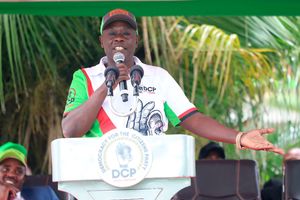
Democracy for the Citizens Party (DCP) leader Rigathi Gachagua.
Photo credit: Bonface Bogita | Nation Media Group
Apart from his colleagues in the United Opposition including; Wiper leader Kalonzo Musyoka, Jubilee Deputy Leader Dr Fred Matiang’i, People’s Liberation Party chief Martha Karua, her Democratic Party counterpart Justin Muturi and DAP-Kenya’s Eugene Wamalwa, Mr Gachagua has hosted Safina Party leader Jimi Wanjigi at least twice at his Wamunyoro home, with the latest meeting held on Tuesday.
The emerging United Opposition includes leaders who previously occupied different political camps but now share a common objective of unseating the Kenya Kwanza administration.
Like Odinga before him, Mr Gachagua appears convinced that defeating an incumbent requires a broad political alliance rather than isolated regional support.
For decades, Nyanza remained his strongest support base before he expanded into Western, Coast, Eastern and parts of Nairobi.
His first priority has been consolidating the Mt Kenya region, where he argues the electorate has been politically betrayed following his impeachment and fallout with President Ruto in October 2024.
Only after strengthening support in Mt Kenya has he intensified outreach to other regions, including Ukambani, Western and the Coast.
Unlike politicians who become active only during election seasons, Odinga maintained a near-permanent campaign throughout his years in opposition.
He held rallies, consultative meetings and nationwide tours that kept his supporters politically energised between elections.
Despite no longer holding public office, he has maintained an intensive programme of county tours, roadside rallies, church meetings and public engagements at his Wamunyoro home in Nyeri County.
“Sustain political momentum, dominate public discourse and keep pressure on the government long before official campaigns begin,” argues pundit Eric Muli from Machakos County.
Odinga consistently portrayed himself as fighting for ordinary citizens against an insensitive State.
His campaigns centred on the cost of living, electoral justice, constitutional reforms and social equality.
Mr Gachagua's messaging, Mr Muli says, increasingly mirrors that narrative.
“His speeches alongside those of other opposition chiefs frequently focus on punitive taxation, rising living costs, insecurity, political persecution and economic hardship,” Mr Muli adds.
Rather than presenting his fallout with President Ruto as a personal dispute, Mr Gachagua has framed it as evidence of wider governance failures affecting all Kenyans.
Yet it is Mr Gachagua's latest remarks on tourism and investment that have generated perhaps the strongest political reaction.
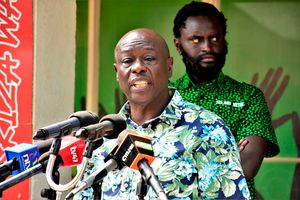
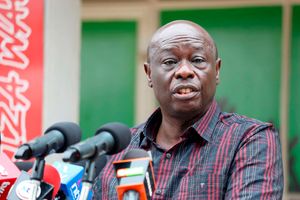
Former Deputy President Rigathi Gachagua (centre) addresses the media in Wamunyoro on June 23, 2026.
Photo credit: Gitonga Marete | Nation Media Group
In a statement that exposed early differences within the emerging United Opposition, Jubilee Party distanced itself from the boycott call.
While acknowledging concerns over governance, insecurity and shrinking democratic space, the party argued that discouraging tourism and foreign investment risked hurting ordinary Kenyans rather than those in power.
"Any communication made in pursuit of political change must equally safeguard the national interest," the statement signed by Secretary-General Moitalel Ole Kenta said.
The party noted that the biggest victims of declining tourism would not be politicians but workers across the hospitality value chain.
"The people who bear the greatest cost of declining tourist arrivals or reduced investment are not those in positions of political authority.
"It is the hotel worker in Diani, the tour guide in Maasai Mara, the artisan in Mombasa, the farmer supplying fresh produce to hospitality establishments, the taxi operator and the thousands of families whose daily incomes depend on a vibrant economy."
Jubilee reaffirmed that Kenya remained an attractive destination for tourists and investors despite political disagreements.
"Our differences with the current administration are political and policy based. They should never diminish confidence in the Republic of Kenya itself."
The disagreement underscores both the strengths and risks of the opposition strategy Odinga perfected over decades.
While economic pressure and international attention can amplify political demands, they also expose opposition leaders to accusations of undermining the country's economy.
Odinga faced similar criticism whenever he organised mass protests, election boycott or product boycotts.
Government officials, including Mr Gachagua as DP, routinely accused him of damaging investor confidence and disrupting economic activity.
As Deputy President, Mr Gachagua frequently defended government policies and criticised Odinga's anti-government campaigns.
Today, occupying the opposition benches, he is employing several of the same political tactics he once condemned.
“Kenya's opposition politics has historically relied on a combination of grassroots mobilisation, coalition building, symbolic messaging, economic pressure and international advocacy.”
“Those strategies helped Raila remain the country's dominant opposition figure for more than three decades despite repeated electoral defeats,” argues analyst John Anditi.
He went on: “Gachagua appears to believe the same formula can weaken President Ruto's political dominance before 2027.”
Unlike Odinga who spent most of his political career outside government, Mr Anditi adds, Mr Gachagua is attempting the transition from Deputy President to opposition leader after serving at the highest levels of State.
“That history exposes him to accusations of inconsistency from both allies and opponents,” Mr Anditi says.
He adds: “It also means he must persuade Kenyans that his criticism reflects genuine concern rather than political revenge.”